
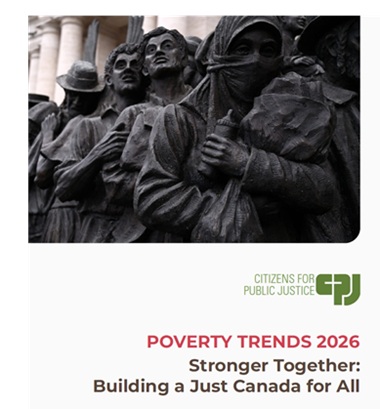
The image used by CPJ is a close-up of ‘Angels Unawares’ by Timothy Schmalz, whose ‘Be Welcoming’ has just been installed at Christ Church Cathedral (see Around Town).
Every October, Citizens for Public Justice (CPJ) publishes ‘Poverty Trends,’ a report which “provides readers with a review of data on poverty in Canada and the state of government action, as well as a vision for how we can move forward.”
This year’s report by Nevena Langlois is titled Poverty Trends 2026: Stronger Together: Building a Just Canada for All.
It focuses primarily on “the relationship between immigration and poverty, highlighting inadequate social assistance, wage gaps and precarious labour as key factors for poverty in Canada.”
CPJ describes itself as an organization “inspired by faith to act for social and environmental justice in Canadian public policy. . . . As Christians, we are called to live out our response to God’s call to love and justice. This response is at the heart of public justice.”
Go here for an introduction to Poverty Trends 2026 and to download the 22-page report. Following is just one portion of the report, which highlights five “proven policy solutions” and offers a good sense of CPJ’s priorities.
Policy solutions
Poverty in Canada is not the result of individual circumstances alone. It is shaped by the policies, systems and economic conditions that determine whether people can meet their basic needs. As a diverse and multicultural country, Canada is built on the principle that people from different backgrounds should be able to participate fully in society and contribute to their communities. Ensuring that everyone has the resources and opportunities to do so is a shared responsibility.
1. Providing a minimum income floor through government transfers
The evidence is clear that social assistance – including for the general public – for people with disabilities and newcomers is inadequate. Across the country, people in need of support are either missed due to unnecessarily stringent eligibility criteria or they receive financial support that does not meet even their most basic needs, leaving thousands of people in Canada in deep poverty.
Furthermore, the levels of poverty among workers in Canada demonstrate that poverty extends beyond social assistance users. Canadians need income support policies which provide a safety net for all. We know that universal cash transfers like the Old Age Security and the Guaranteed Income Supplement for seniors and the Canada Child Benefit provide the most direct and effective relief. We propose that these benefits be expanded, and made stackable, to provide a minimum income floor for
all Canadians.
- Example policy recommendations
• Implement a national basic income guarantee program for people aged 18 to 64 and youth exiting care (as early as 16 years old) that is means-tested (i.e., delivered to people below a certain wealth threshold), gradually reduced with earned income, and that is stackable with other benefits.
• Raise the Canada Disability Benefit amount and expand eligibility beyond the Disability Tax Credit criteria to include anyone who is already receiving other disability benefits. Convert the benefit to an automatic refundable credit so neither the CDB nor other income supports get clawed back.
• Introduce the End Poverty Supplement (CCB-EndPov) to the Canada Child Benefit, increasing the amount received by low income households, and expand eligibility to all children residing in Canada. Offset these costs by phasing out the CCB faster among the top 20 percent of households, redirecting these funds where they are most needed.
• Invest in a new Early Learning and Child Care Workforce fund to improve wages, benefits and other labour conditions as well as training for ELCC workers, who are disproportionately women. Increased affordability and accessibility of childcare spaces and improved ELCC working conditions increase women’s participation in the paid workforce, improve the economic well-being of workers and improve educational outcomes for children.
• Increase the minimum wage to reflect a living wage across all provinces and territories to ensure that working Canadians are able to support themselves and their families.
2. Improving resettlement support
We are proud to be a country that welcomes newcomers, and we expect our leaders to carry on that legacy and make this a place where all families can thrive.
- Example policies
* Build a more inclusive and future-ready Canada by implementing a broad regularization program. The rights of all people in Canada, including temporary and undocumented migrants, should be protected. Temporary and undocumented workers contribute to the functioning of every system in Canada, and they should have equal access to those systems, including health care. Access to permanent resident status will help protect and uphold these rights.
* Reverse the 30 percent Copayments and $4 Prescription Fees for Refugee Healthcare. We know that access to healthcare is integral to the wellbeing of all people. Refugees and migrants who are faced with increasing health care costs may delay treatment, resulting in worsening health outcomes and an increased burden on emergency rooms. An investment in the health and wellbeing of refugees as they settle into Canada is an investment towards a more resilient nation that is ready to realize the full potential of immigration.
* Increase monthly and one-time payments by the Resettlement Assistance Plan to bring recipients over the poverty threshold. Lifting refugees out of poverty improves their resettlement experience and improves the overall well-being of our communities.
- Other policy recommendations
This year, Poverty Trends has focused on the relationship between immigration and poverty, highlighting inadequate social assistance, wage gaps and precarious labour as key factors for poverty in Canada. However, poverty is a vast and complex issue, with many considerations not mentioned in this report.
CPJ continues to advocate for the below policy recommendations, which serve the ultimate goal of poverty eradication in Canada.
3. Providing stability and security through adequate housing
We know that core housing need is a pervasive indicator of poverty in Canada, and we know that adequate housing is necessary to lift people out of poverty. We recommend that policies that regulate the financialization of housing be implemented as part of a broader poverty reduction strategy.
- Example policy recommendations
• Invest in non-market and co-op housing units to bring Canada’s proportion of non-market rental housing supply up to the OECD average of 7 percent.
• Bring more private land into public ownership for the construction of non-market, affordable rental housing, and purchase land from all levels of government.
• Implement rent and vacancy controls, limiting the amount rental rates can be increased annually and between tenants. This will both reduce and begin to reverse the financialization of housing and protect the buying power of income supports and earned wages.
• End various real estate incentives, including the Tax-Free First Home Savings Account and stop the preferential tax treatment of Real Estate Investment Trusts (REITs), which inflate the housing market and support the financialization of housing.
• Invest in for-Indigenous by-Indigenous housing and infrastructure to repair, maintain and build housing on and off-reserve for urban, rural and northern Indigenous communities.
• Ensure gender-based equity in funding for National Housing Strategy housing investments, prioritizing investment in affordable housing that genuinely addresses the depth of poverty experienced by women and gender-diverse people.
• Incorporate universal design principles into the National Building Code to make universal design mandatory in all new multi-unit residential buildings, both rental and ownership. All federal housing investments, including those through the National Housing Strategy, should align with universal design principles
4. Improving publicly-funded, publicly-delivered health and social services
Recent fiscal policy has signalled a shift toward austerity in health care, with Budget 2025 introducing a $1.2 billion cut to bilateral health funding and the Spring Economic Update issuing no new funding for existing or new pharmacare agreements.
This shift is further highlighted by the $2 billion cut to Immigration, Refugees and Citizenship Canada (IRCC), which includes significant cuts to the Interim Federal Health Program (IFHP), the federal health insurance program that provides healthcare coverage to refugee claimants until they have access to provincial health insurance.
These moves are contrary to the well-established relationship between poverty and health; when individuals have access to health care, they are both less likely to experience poverty and more likely to leave poverty.
- Example policy recommendations
• Build a single-payer public pharmacare program for Canada. Canada is the only country with universal health care that doesn’t include pharmacare. Evidence shows that other countries with healthcare systems that pharmacare achieve better access to medicines and better financial protections when people are ill, at lower costs than any Canadian province achieves.
• Enforce the principles and conditions of the Canada Health Act, beginning with funding more robust monitoring and sanctioning capacity by Health Canada to ensure Canadians are not faced with extra billing, user fees and diminished access to health care as provinces move to for-profit care providers.
• Extend the principle of universality to the Canadian Dental Care Plan (CDCP). Statistics Canada reports that “during the period from November 2023 to March 2024 – before the CDCP was available to help pay for care – 47 percent of CDCP-eligible individuals avoided visits to an oral health professional and 38 percent avoided recommended dental care in the past year because of the cost.”
• Increase investments in the Early Learning and Child Care Infrastructure Fund to accelerate the creation of affordable, culturally appropriate, accessible quality childcare in publicly owned or non-profit facilities, bringing fees down to a maximum of $10 a day.
5. Generating needed revenue through progressive taxation
Canada is a country with incredible wealth, which is inaccessible to the vast majority of its residents. We know that effective poverty reduction policies and programs are expensive, and progressive taxation is a viable revenue source, ensuring that everyone is doing their fair share to make our society a healthier and happier one.
- Example policy recommendations
• Tax extreme wealth. The Canadian Council for Policy Alternatives’ Alternative Federal Budget (AFB) estimates that a progressive tax on net wealth over $10 million would redistribute wealth and power, while raising over $39 billion in the first year, benefiting 99.4 percent of Canadians.
* Make corporate income tax more progressive, bringing it back up to 20 percent (closer to 2007 levels when it was set at 22 percent, since dropping down to 15 percent in 2012). The AFB notes that while these tax cuts were sold as supporting investment, job creation and growth, business investment was lower in 2023 than it was in 2012.
• Tax capital gains like workers’ income. Previous loopholes for capital gains disproportionately benefited finance, insurance and real estate companies as well as extremely wealthy individuals, allowing 50 percent of capital tax gains to be tax-free.
Go here for an introduction to the Poverty Trends 2026 report and to download the full report.