
 Do people still say that there is little common ground between science and religion? Or even that one has to choose between the two? Apparently they do.
A Pew Research Center study on religion and views of science last year found:
Half of U.S. adults say that science and religion are mostly in conflict, while 47 percent say that science and religion are mostly compatible.
The more religious they are, the more likely Americans are to say science and religion are mostly compatible. The less religious they are, the more likely they are to see conflict between science and religion.
An article posted by ETWN News reported on Pope Leo XIV’s meeting with members of the Vatican Observatory this spring:
“Today . . . . science and religion face a different, and perhaps more insidious, threat: those who deny the very existence of objective truth,” the pontiff said.
During his address, he recalled that his predecessor Pope Leo XIII refounded the Vatican Observatory in 1891 in a context where science was beginning to emerge as a rival source of truth to religion. Because of this, he said, the Church felt the “urgent need to counter the growing perception that faith and science were enemies.”
As British Columbia is probably the least religious corner of North America, it seems likely that many of our neighbours are dubious about the value of linking religion and science in any positive way.
As in the States, however, Christians are more likely to see compatibility. Local scientists and academics are leading the way – and a series of recent books and events prove that the conversation between faith and science is vigorous, as least in the Christian community.
- Dennis Venema: Chasing Adam – Can Evangelicals Find the First Humans?
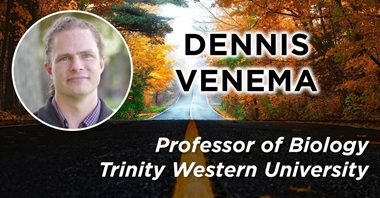
Dennis Venema will speak at DeVries Centre on the Trinity Western University campus October 28.
His topic:
Populations genomics evidence strongly supports the conclusion that humans do not uniquely descend from a founding pair, but rather evolved as a substantial population.
In response to these data, evangelical apologists have proposed various models that attempt to locate Adam and Eve either within an evolutionary population, or as specially created individuals.
This talk will survey the evidence for human evolution and population genomics, and examine these models in light of the scientific evidence.
Dennis R. Venema (PhD University of British Columbia) is Professor of Biology at Trinity Western University and past Fellow of Biology for the BioLogos Foundation. He is co-author, with Scot McKnight, of Adam and the Genome: Reading Scripture After Genetic Science. His research focuses on the genetics of pattern formation using the common fruit fly, Drosophila melanogaster.
Go here for information about the October 28 lecture at TWU.
This event is sponsored by TWU’s Faculty of Natural and Applied Sciences and the Canadian Scientific & Christian Affiliation (CSCA) Vancouver chapter – which has an events page featuring several events which are not local but may be viewed online.
- Myron Penner: The Science of Religion – Cognitive and Evolutionary Approaches
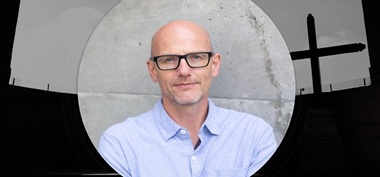
Myron Penner will speak about his work at TWU.
Myron Penner will discuss his current research and scholarship as part of the Faculty Speakers Series at the TWU Library November 3.
An article on the TWU site discusses the work leading up to Myron Penner’s lecture:
When scientists use aesthetic criteria in their scientific work, it can open new realms of discovery.
TWU philosophy professor Dr. Myron A. Penner, together with co-investigator and chemistry professor Dr. Amanda J. Nichols (Oklahoma Christian University), are researching how properties like beauty, simplicity and elegance can communicate information that increases scientific understanding.
Their project, Beauty and Truth in Science and Religion, is a three-year (2023 – 2026) project funded by a Templeton Religion Trust grant ($250,910 USD)
“Sometimes scientists will be struck by the aesthetic qualities of an object they are dealing with, whether that’s a theory, or an observation in the lab, or even a particular experimental process,” Dr. Penner, who teaches in TWU’s graduate MA in Interdisciplinary Humanities program and undergraduate philosophy courses, begins.
Take symmetry, for example. Symmetry is found in many fields of scientific inquiry, from cosmology down to molecular design.
“When you look at the properties of molecular structures,” Dr. Penner continues, “there’s an elegance and theoretical beauty in how molecular structures can be classified according to their symmetry properties and how those classifications explain how the molecule will behave in different conditions.”
In this way, he indicates, a molecular structure can be a sort of “scientific work of art.”
This gathering is primarily for students, faculty and staff, but no doubt exceptions can be made. Go here for more information.
The next several events – which took place in the last month or two – are all based on recently published books. The talks are now available online:
- Ross Hastings: God and Molecules: Chemical Evolution and Divine Providence
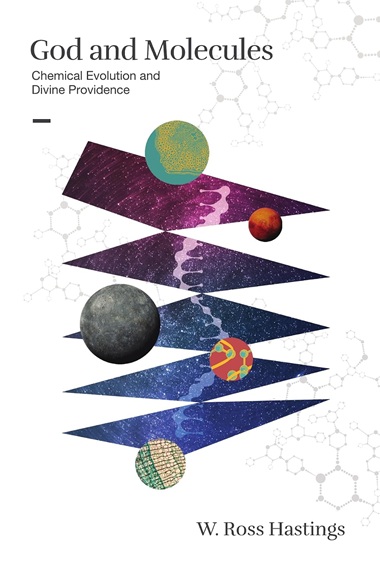
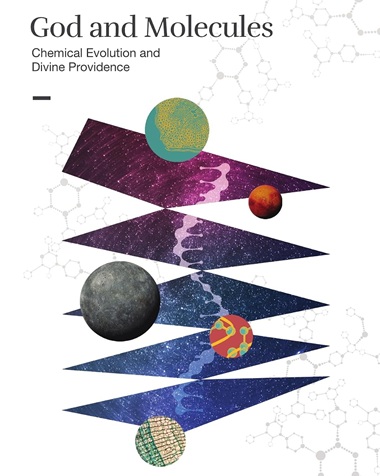
God and Molecules was published in May and Ross Hastings discussed his work on a Regent College podcast in August.
IVP Academic introduces the book:
God has been present and active in creation from the moment he created it ex nihilo. Few Christians would question this claim, but its implications for ongoing theology-and-science dialogues have not been fully explored.
In this pathbreaking and field-advancing work, Ross Hastings brings his expertise in both scientific and theological disciplines to bear on the topic of divine providence in chemical evolution.
Based on the latest research in the developing field of chemical evolution and the work of theological giants such as Karl Barth, Hastings shows how God may have been providentially and non-competitively at work in the process by which simple prebiotic molecules gave rise to the complex molecules in the first living organisms.
In God and Molecules, Hastings:
-
- provides cutting-edge theological engagement with the developing scientific field of chemical evolution,
- advances the discussion in theology and science with this new integrative work, and
- offers a holistic alternative for thinking about chemical evolution that overcomes the binary of theology versus science.
God and Molecules pushes toward new frontiers in theology and science and casts a compelling, integrative, and ultimately healing vision for how God has been lovingly involved in the developmental process of the earliest life on earth.
Ross Hastings (PhD chemistry, Queen’s; PhD theology, St Andrews) is the Sangwoo Youtong Chee Professor of Theology at Regent College. Among other books, he is the author of Missional God, Missional Church; Total Atonement; and The Resurrection of Jesus Christ. He also serves as an Anglican priest at St. John’s Vancouver and enjoys watching rugby, soccer and cricket. He lives in Vancouver with his wife, Tammy; they have five children and nine grandchildren.
Go here for an August 7 podcast in which Hastings discusses God and Molecules and here to read the first chapter of the book.
- Dennis Danielson: A Universe of Earths: Our Planet and Other Worlds, from Copernicus to NASA

Dennis Danielson spoke about A Universe of Earths (Oxford University Press, 2025) at Regent College October 8.
Regent College’s introduction to the lecture:
Between four and five hundred years ago, astronomers such as Copernicus and Galileo proposed that Earth is a planet—a “wandering star” – thus liberating it and its inhabitants from being located in what Renaissance humanist Pico della Mirandolla only a few years earlier had called the “excrementary and filthy parts of the lower world.”
Since then, we have also increasingly grasped our smallness relative to a still-expanding Universe. What does that smallness imply for our and Earth’s ‘place’ and meaning within the cosmic scheme?
For centuries, there has been a tendency among scientists to read earthly smallness as entailing triviality or insignificance.
Dr. Dennis Danielson’s lecture illustrated the persistence of this glib tendency and offer tools for reimagining Earth’s and humankind’s significance despite their cosmic smallness.
Dennis Danielson, Professor Emeritus of English at the University of British Columbia, is an intellectual historian who seeks to fuse the insights of science and the humanities, especially as illustrated in the enduring legacy of Copernicus’s attempt to reimagine earth amid the universe.
Among his other books:
- Milton’s Good God: A Study in Literary Theodicy, Cambridge University Press, 1982;
- The Book of the Cosmos: Imagining the Universe from Heraclitus to Hawking, Perseus Publishing, 2000;
- The First Copernican: Georg Joachim Rheticus and the Rise of the Copernican Revolution, Walker & Co., 2006;
- Paradise Lost and the Cosmological Revolution, Cambridge University Press, 2014.
Go here for Danielson’s lecture: ‘The Unscientific Denigration of Humanity in the Name of Science,’ on YouTube.
- Jens Zimmermann: Safeguarding Our Humanity in a Digital Age
 The Regent Vine posted two comments by Jens Zimmermann on ‘Safeguarding Our Humanity in a Digital Age, September 17 and 28.
In Part One, Jens Zimmermann explores how digital technology and AI are reshaping our understanding of what it means to be human, offering a Christian perspective rooted in creation, incarnation,= and human dignity.
In the second part of his series, he explores how digital culture is reshaping our understanding of reality, attention and what it means to be human. Drawing on Christian theology, he considers the importance of embodied life, sustained attention and the difficult work of thinking and writing.
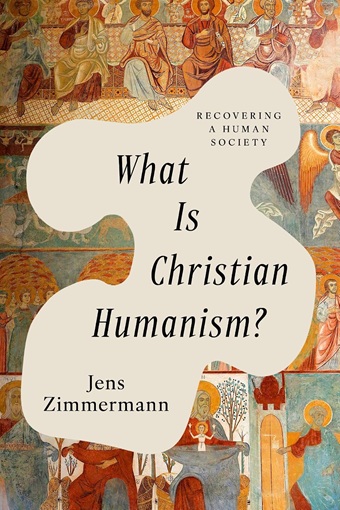
He will also be launching his brand new book, What is Christian Humanism: Recovering a Human Society (IVP Academic, 2026) at Regent College November 5.
In our rapidly changing world, we face a rising tide of threats to our humanity. From artificial intelligence and the erosion of free speech to bioengineering and euthanasia, the humanistic values we cherish, like intrinsic human rights and the dignity of all persons, are increasingly at risk. We are in danger of losing our humanity without even realizing it.
Jens Zimmermann (PhD, University of British Columbia; PhD, Johannes Gutenberg University) is the J.I. Packer Chair of Theology at Regent College and has published widely in philosophy and theology. His books include Incarnational Humanism (IVP Academic, 2012), Hermeneutics: A Very Short Introduction(Oxford, 2015), Dietrich Bonhoeffer’s Christian Humanism (Oxford, 2019), Human Flourishing in a Technological World (Oxford, 2023) and the coedited Oxford Handbook of Theological Anthropology (forthcoming).
Go here and here for his Regent Vine comments and here for his November 5 Houston Centre lecture at Regent College. Go here to download Chapter 1 of What is Christian Humanism?
- Graham Tomlin: Blaise Pascal – a Thinker for Our Time
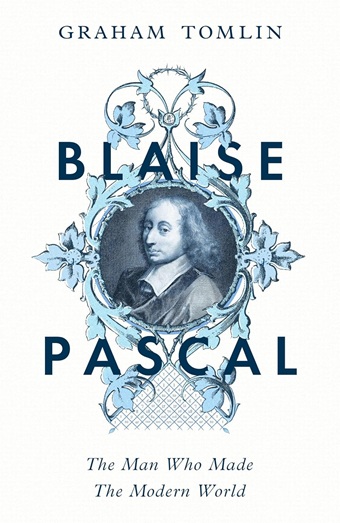 Graham Tomlin spoke on Blaise Pascal for UBC Graduate & Faculty Christian Forum (GFCF) September 30.
From the GFCF introduction:
Blaise Pascal was a physicist, a mathematician, an inventor, entrepreneur, philosopher theologian and polemicist. . . .
In his book, Blaise Pascal, the Man Who Made the Modern World, Tomlin portrays Pascal as navigating extremes – combining medieval piety with Enlightenment scientific zeal, reason with faith, intellect with personal experience – and as a figure who both helped shape modernity and offered one of its earliest and sharpest critiques.
He argues that Pascal’s insights remain highly relevant to contemporary debates on science and religion, distraction in an information-saturated age, the search for meaning, and the nature of belief.
Graham Tomlin is editor-in-chief of Seen & Unseen, president of St Mellitus College and chair of the Inter-Anglican Standing Commission on Unity, Faith and Order. He was bishop of Kensington from 2015 to 2022. He has written many books.
Tomlin’s talk can be seen on YouTube.
The GFCF will host Steve Mairs: When the Heavens Speak – Faith, Science and the Search for Purpose January, 27, 2027.
- Jason Lisle: Ultimate Proof of Creation (& more)

Jason Lisle will deliver four lectures in one day.
Creation BC is bringing in Jason Lisle to deliver four lectures at two locations October 24.
His approach will no doubt be quite different from the speakers above, but these talks – as all the others – afford opportunities for valuable dialogue:
- Ultimate Proof of Creation
Very different from most other creation presentations, the Ultimate Proof of Creation gives a bullet-proof defense of the Christian faith that no skeptic can cogently answer.
Every student should see this presentation before going off to college. Even without knowing a lot about the scientific evidence for creation, one can show that biblical creation is certainly true and is in fact necessary for science to be possible.
- Logic and the Christian Faith
Critics often claim that the Bible is illogical. But is it really? What exactly is logic, and what is its connection to the Christian worldview? Right reasoning is essential if we are to live in a way that is pleasing to God and to defend the Christian worldview faithfully.
In fact, worldviews that are contrary to the Bible are inherently irrational. Come explore the rules of correct reasoning and see how non-biblical systems violate these rules.
- James Webb Space Telescope Discoveries
Dr. Lisle explores the latest discoveries from the James Webb Space Telescope. He will compare the predictions he made prior to its launch with those of secular scientists, examining how each aligns with God’s Word and the truths already revealed in Scripture.
- Astronomy Reveals Creation
Most students are taught that the universe formed from a big bang billions of years ago, that stars and planets are merely cosmic accidents, and that the biblical account of creation is wrong. But such a view does not stand up to the scientific facts. See how the Bible has always been right about astronomy, how it correctly described the nature of the cosmos long before secular scientists came to agree.
Explore fascinating evidence that the universe cannot be nearly as old as the secularists teach, but is much younger, as the Bible teaches. We also explore how the light from distant galaxies arrives at earth within the biblical timescale.
Dr. Jason Lisle is a Christian astrophysicist who has a PhD in astrophysics from the University of Colorado in Boulder, has specialized in solar astrophysics and made a number of scientific discoveries regarding the solar photosphere. He has authored a number of books, including Understanding Genesis: How to Analyze, Interpret and Defend Scripture. His most well-known book, The Ultimate Proof of Creation demonstrates that biblical creation is the only logical possibility for origins.
The first two lectures will be held in the morning at Grace Community Church in Pitt Meadows. The third and fourth lectures will be delivered in the evening at Chandos Pattison Auditorium.