
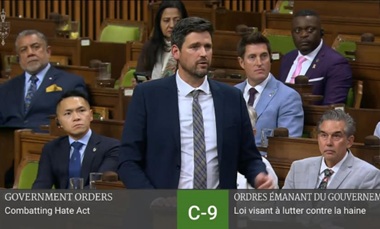
Justice Minister Sean Fraser speaking about Bill C-9, the Combatting Hate Act, in the House of Commons.
The Liberal Party has introduced Bill C-9, the Combatting Hate Act. Critics, including many Christian groups, insist that it would criminalize some religious teachings.
A February 10 article in the National Post describes the current situation. It begins:
The Opposition Conservatives signalled Tuesday that the party would be willing to support a narrower version of the government’s anti-hate bill, as the Liberals struggle to find a path forward for the legislation.
With the parliamentary justice committee set to meet on Wednesday, negotiations between parties remain ongoing for how the Liberals might try to make progress on the legislation. . . .
[T]he bill seeks to create new intimidation and obstruction offences around buildings, like places of worship or anywhere an identifiable group gathers, as well as make it a crime to wilfully promote hate by displaying certain terror symbols.
Controversy erupted when the Liberals struck a deal with the Bloc Quebecois to remove the longstanding religious defences that exist for the sections of the Criminal Code targeting advocating genocide and the wilful promotion of hate through an amendment to the bill, in exchange for the Quebec party helping it through the minority Parliament.
Many Christian and Muslim groups have voiced concerns that the change could lead to a chilling of the teaching and preaching of religious texts
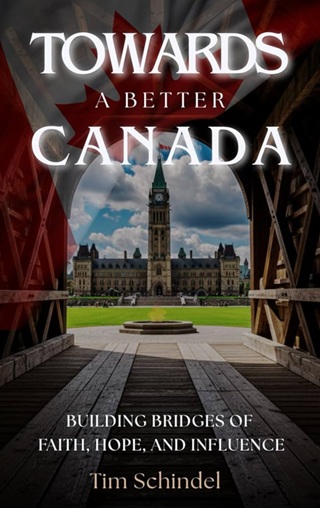
Tim Schindel, President and National Director of Leading Influence, reflected on the situation in the following comment, which is re-posted by permission.
The public response to the recent amendments to Bill C-9 has revealed not only deep concern within segments of the Christian community, but a deeper question that deserves our attention: how should the Church engage power, Scripture and neighbour-love in a pluralistic society?
This moment calls for wisdom – measured, thoughtful and rooted in the way of Jesus.
Questions about freedom of expression, religious liberty and the role of Scripture in public life are serious and warrant engagement. The proposed amendments are troublesome, and the concerns are well-founded.
The questions also require more from us than reaction and outrage. If the Church hopes to speak credibly into this moment, we must begin with honesty – about Scripture, about culture and about ourselves.
Beginning with humility
First, we must acknowledge several difficult but necessary realities.
The Bible contains passages – particularly within the Old Testament, addressed to ancient Israel – that include commands involving violence, warfare and even the apparent destruction of entire peoples. These texts exist within a specific historical, covenantal and redemptive framework, and they are written in accordance with ancient norms of recording history that were often quite different than our norms today; but they are nonetheless troubling when read outside that context.
We must also acknowledge that biblical moral teaching is almost always at odds with contemporary cultural and social norms. Scripture does not always align neatly with modern assumptions around identity, sexuality, power or autonomy.
Given these realities, it is reasonable – though not necessarily correct – that political leaders or policy-makers who are unfamiliar with the whole witness of Scripture could conclude that portions of the Bible appear hateful or dangerous when removed from their theological and redemptive context.
Acknowledging this complexity is not a denial of Scripture’s authority. It is an affirmation that God’s revelation unfolds across history and finds its fullest expression in the life, teaching and self-giving love of Jesus Christ. The problem is not the presence of difficult texts; it is the absence of understanding around them.
A responsibility the Church must own
Here, the Church must be willing to look inward.
If we are honest, much of the confusion surrounding Scripture exists because we have too often settled for shallow formation rather than deep discipleship. We have assumed biblical literacy instead of cultivating it. We have sometimes taught isolated verses rather than the grand narrative of redemption that moves from creation to new creation, and from law to grace.
A widespread ignorance of Scripture’s overarching story did not arise in a vacuum. In many cases, it reflects a failure of discipleship and evangelism on our part.
When Scripture is reduced to proof-texts rather than taught as a coherent story centered on Christ, it becomes vulnerable to misuse – both by those who oppose it and by those who claim to defend it.
That reality should grieve us more than any piece of legislation.
When defending the Bible undermines its witness
In response to Bill C-9, some have chosen to place Scripture at the centre of political confrontation – used as a prop, a symbol of resistance or a prelude to a pointed question or statement in the public square.
While this may feel bold, it is ultimately counterproductive.
When we use the Scripture to score political points, it ceases to sound like good news and becomes a threat.
Such approaches rarely clarify biblical truth. Instead, they harden misunderstanding and reinforce the perception that the Bible is a tool of power rather than a revelation of sacrificial love. They may energize a base, but they do little to strengthen Christian witness in a diverse and pluralistic society.
A helpful question is: Would we be comfortable if a Muslim Member of Parliament used the Qur’an to make a similar political statement or challenge legislation? If not, we should pause before insisting on our own exception.
The challenge before us
Hateful people will always find ways to say hateful things. The Church cannot prevent that. Nor can legislation fully solve it.
It is also true that Scripture can be – and has been – misused by individuals to justify harm. That reality should concern us deeply, not only because it distorts the gospel, but because it wounds our neighbours.
At the same time, the government carries a legitimate responsibility to ensure the safety of its citizens. That responsibility must be taken seriously. It is fair to acknowledge that legislation like Bill C-9 raises questions about whether preaching the full counsel of Scripture could one day be misunderstood or constrained.
This tension is real.
Scripture, however, offers a framework for navigating such moments. The New Testament repeatedly calls believers to consider when laying aside certain freedoms might serve the greater good – particularly when it comes to loving our neighbour, protecting the vulnerable and bearing faithful witness to Christ.
This is not about abandoning conviction. It is about discerning how conviction is expressed.
A different way forward
 If the Church continues to respond to moments like this as a political problem to be solved rather than a spiritual moment to be stewarded, we will continue to miss the opportunity before us.
Perhaps it is time to consider a different strategy.
What if, instead of defaulting to protest, petitions and predictable political escalation, we chose a path of proactive engagement?
What if the Church took the lead in acknowledging the difficult passages of Scripture that are so often weaponized, and offered thoughtful, Christ-centred teaching that explains how those texts fit within the broader story of redemption?
What if we invested more deeply in relationships, education, formation and dialogue – both within our congregations and in respectful conversation with civic leaders – rather than assuming hostility or bad faith?
This approach requires patience, wisdom and a different kind of courage. It does not generate headlines. It does cultivate understanding and trust.
Quiet, courageous influence
God has always worked most powerfully through people who understood the times and knew how to respond.
This moment calls for discernment rather than defensiveness, and for clarity shaped by faith rather than fear. The Church’s public witness is strengthened not through outrage or political force, but through humility, thoughtful engagement and a commitment to deeper formation. When we respond to complex challenges with wisdom and restraint, we create space for the gospel to be seen and heard with credibility.
We have an opportunity to model a confident, courageous faith that is neither combative nor coercive. Quiet, faithful presence has always shaped nations more deeply than loud confrontation.
The invitation before us is simple but demanding: to slow down, to listen well and to trust that God is at work beyond what politics alone can accomplish. That work begins in prayer.

Tim Schindel
We invite you to pray with us and the thousands of others in our prayer networks for wisdom for those who govern, for courage and clarity for the Church, and for God’s redemptive purposes to be at work in Canada. In doing so, we choose a path of faithful witness – one rooted in hope, marked by love, and worthy of the gospel we proclaim.
Tim Schindel is President and National Director of Leading Influence, whose mission is “to provide excellence in chaplaincy care for elected leaders in Canada.” They have a National Prayer Director and chaplains in BC, Alberta, Saskatchewan, Ontario, Quebec and Prince Edward Island.