
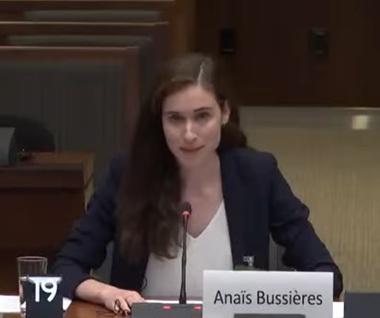
Anaïs Bussières McNicoll of the CCLA warned the Justice Committee last fall that Bill C-9 risks criminalizing protesters. She recently added that attempts to improve the bill “actually made the bill worse by removing the Criminal Code’s good-faith religious defense without putting anything adequate in its place.”
A wide range of Canadian communities are opposing Bill C-9, the Combatting Hate Act, which the Liberal Party is rushing through Parliament.
The Justice Committee tabled its report – modified in the face of opposition – in the House of Commons March 13. The bill creates new offences such as obstructing access to religious and community sites, committing an offence motivated by hate and promoting hatred using terrorist symbols.
Critics generally support the intent of the bill, but are concerned with its definition of hatred, which is not as rigorous as that developed by courts over the years – and could result in members of religious groups being convicted for statements based on their core religious beliefs.
As ARPA Canada put it recently, as part of their campaign against the bill:
Bill C-9 . . . seeks to combat hate by addressing hate propaganda, hate crime and access to religious or cultural places. However, a recent amendment to Bill C-9 removed the good faith religious defence and opened the door to Christians being accused of hate speech for defending biblical morality.
The issue is receiving attention in the media. The introduction to CBC Radio’s The House March 13 stated:
After a series of shootings outside Toronto synagogues this week, the Liberal government’s controversial hate-crimes bill is back in the spotlight. But there are still deep concerns from civil liberties groups and some religious organizations. Why is that?
Host Catherine Cullen breaks down the Combatting Hate Act with the Centre for Israel and Jewish Affairs’ Noah Shack, Anaïs Bussières McNicoll of the Canadian Civil Liberties Association, and Mustafa Farooq, former CEO of the National Council of Canadian Muslims.
Shack seemed sympathetic to the proposed legislation; McNicoll and Farooq, while agreeing that more protections are needed, argued that Bill C-9 is flawed. The interview begins at 36:40.)
Cullen said:
The bill was already contentious, but late last year the heat ratcheted way up when the government proposed a change to the bill, to get buy-in from the Bloc Quebecois. The controversy – right now hate speech laws make an exception when people are expressing a religious belief.
This plan would end that religious protection. That lit a fire under some parliamentarians and faith groups. Conservatives said it would criminalize religious scripture.
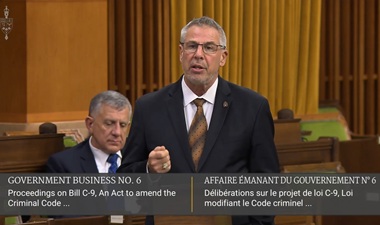
MP Dave Epp addressing issues related to Bill C-9 in the House of Commons.
She played a clip of MP Dave Epp speaking in the House of Commons:
McNicoll and the CCLA had released a statement just the day before that interview: ‘Bill C-9 Was Supposed to Fight Hate. Instead, It’s Being Rushed Through Parliament and Threatens the Rights of Every Canadian’:
Yesterday, the federal government forced the House of Commons’ Justice Committee (JUST) to finish the study of Bill C-9 – the Combatting Hate Act.
No more debate – just get it done, despite the bill’s numerous flaws.
The government is now set to push C-9 through, giving the House of Commons a maximum of two days for the Report stage and Third Reading.
This should alarm every Canadian who cares about democratic practice and free expression.
Antisemitism, Islamophobia and racism are on the rise. Communities across this country are worried, and they deserve protection. But Bill C-9 doesn’t solve this complex issue. Instead, it hands the government a blunt instrument that history tells us will be turned against the very people it’s supposed to help.
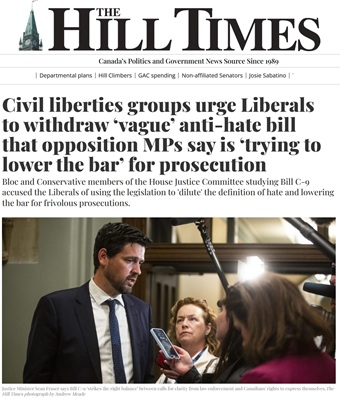 More than 40 civil society organizations, representing communities of various backgrounds, raised serious concerns about this bill back in the fall. They warned that its vague language could be used to criminalize peaceful protest and silence unpopular expression.
Instead of meaningfully addressing these concerns, the truncated Committee process did very little to improve the bill and actually made the bill worse by removing the Criminal Code’s good-faith religious defense without putting anything adequate in its place.
Criminal law changes that affect freedom of expression deserve careful scrutiny, not procedural power plays. By forcing the Committee to wrap up without addressing the concerns raised by dozens of faith-based and civil society organizations, the government is sending a message: getting this legislation passed matters more than getting this legislation right.
That’s not how you combat hate or build trust with communities that are already vulnerable.
Punitive laws that criminalize expression don’t stop hatred. They hand governments a tool that, time and again, gets used against Indigenous peoples, racialized communities, protestors, and dissidents.
We urge parliamentarians to reject any piece of legislation that undermines democratic norms and the civil liberties of people in Canada.
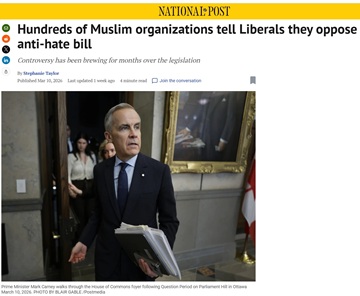 A March 10 article in the National Post (‘Hundreds of Muslim organizations tell Liberals they oppose anti-hate Bill’) begins:
As the governing Liberals push to conclude their study of a controversial anti-hate bill, hundreds of Muslim organizations are voicing their opposition to the pace at which the legislation is moving ahead.
The National Council of Canadian Muslims released an open letter on Tuesday addressed to Prime Minister Mark Carney outlining their concerns, saying despite “clarifications and amendments” made to Bill C-9 that have helped address concerns over civil liberties, that it still has “fundamental flaws as a piece of legislation.”
“We have worked with optimism that the text of the bill could be amended to assuage our concerns, alongside many other faith groups in the Christian, Jewish and Sikh communities,” reads the letter, signed by more than 350 groups.
“However, while we have heard a number of commitments to that end, in our view, the final text of the amendments does not match what has been committed to.”
What’s next?
 A comment on the Evangelical Fellowship of Canada site March 13, following, asked, ‘Justice Committee finishes with Bill C-9, What’s next?’
The Justice Committee’s changes to Bill C-9 were tabled in the House of Commons today.
The next step will be one day of debate and votes on the committee’s changes on Monday, March 23. This is the second last step the bill goes through in the House of Commons.
New changes to the bill can be proposed and voted on at this stage, although the time to do so will be very short.
We’d like to focus on three points about the Justice Committee’s changes.
1. The committee tightened the definition of hate so that it is closer to the high bar that’s been set by the courts. The committee also replaced the requirement that the Attorney General consent to hate crime charges being laid.
These kinds of change were recommended by the EFC and many others. They improve the bill.
2. The religious belief defence was removed. This defence would no longer be available to someone charged with wilfully promoting hatred under section 319(2) of the Criminal Code.
Although it has been rarely used and never successfully, we think this defence is an important safeguard for religious expression.
We think this change made in committee should be rejected by the House of Commons.
3. In response to concerns about the removal of the religious belief defence expressed by the faith community, the committee added a new clarifying clause. This clause underlines that a person is only considered to have wilfully promoted hatred if they intended to promote hatred.
We believe this clause doesn’t provide the clarification or protection for religious expression that is needed if the religious belief defence is removed.
In the House of Commons, the Justice Minister said, rather than having religious belief as a defence to the wilful promotion of hatred, that the government would rather clarify that the ordinary practice of faith is never a hate crime.
He said, “Mr. Speaker, in addition to the very clear and well-established Charter protections that exist, we heard concerns that people wanted more certainty. That is why we were prepared to make further amendments to this bill to make absolutely clear that reading holy texts, participating in one’s community of faith, engaging in services that are part of life as a community of faith, as a religious leader or as a member of a congregation, would all be permitted. We are willing to amend the legislation to put words to that effect directly in the bill, in addition to the Charter protections.” (emphasis added)
However, the clarifying clause added by the committee, as written, doesn’t provide that clarity or protection.
When the Parliamentary Secretary introduced the new clarifying clause at the Justice Committee, she said, “the bill will state in plain terms that nothing in this legislation affects worship, sermons, prayer, religious education, peaceful debate or even the good faith reading and discussion of religious texts.”
However, the clause that the committee added to the bill does not state this in plain terms. It says:
“For greater certainty, nothing in subsection 319(2) or (2.2) of the Criminal Code [the wilful promotion of hatred offence] shall be construed as prohibiting a person from communicating a statement on a matter of public interest, including an educational, religious, political or scientific statement made in the course of a discussion, publication or debate, if they do not wilfully promote hatred against an identifiable group by communicating the statement.”
What’s next?
The EFC is asking for the language in the ‘for greater certainty’ clause to reflect the strong, clear statements that are being made by the Justice Minister and Parliamentary Secretary.
We encourage you to ask your MP to include strong, clear language that protects religious expression in Bill C-9’s clarifying clause when the bill is debated in the House of Commons on March 23.
Find your MP’s contact information here. Call, write or visit your MP to ask for this change. MPs are in their ridings the week before the debate.
Please join us in praying for our country’s leaders, including our local MPs, the Justice Minister and the Prime Minister. Pray also for the good of our country.
Above all, pray that God would be lifted up and honoured in our witness. That his grace, truth and mercy would be evident to all.
See TheEFC.ca/C9 for the EFC’s full list of resources on Bill C-9.
ARPA’s suggestions
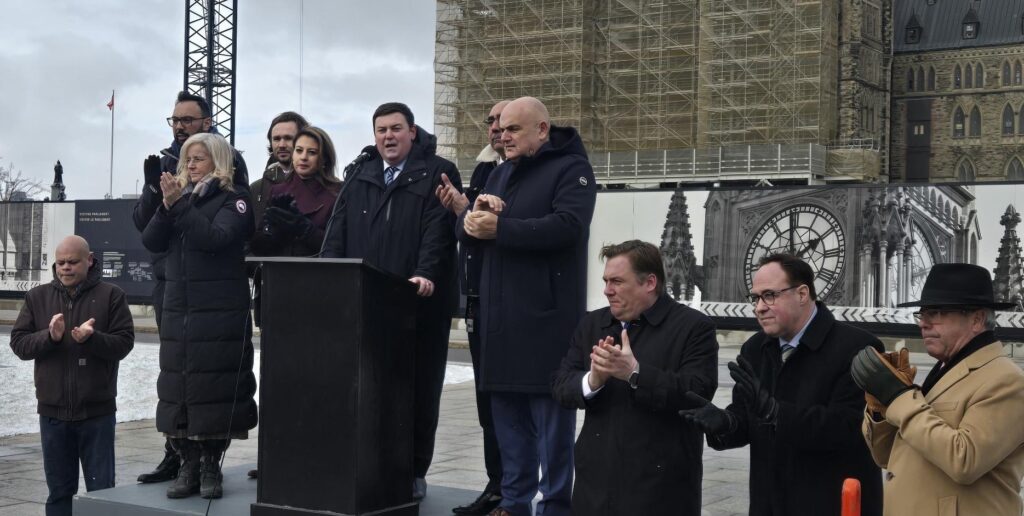
A number of Conservative MPs addressed a rally organized by ARPA Canada.
ARPA Canada hosted a Stop Bill C-9 rally on Parliament Hill last week. They urged their supporters in a March 17 email to keep up the fight:
Parliamentarians have received thousands of emails and phone calls regarding Bill C-9. Hundreds of religious and civil rights groups have criticized the government for the removal of the religious defence to the crime of promoting hatred. . . .
This week, we need to keep up the pressure, calling on Members of Parliament to fix Bill C-9 at 3rd reading.
Now that the Justice Committee has completed their study of Bill C-9, it will go back to the House of Commons on March 23, with a vote at 3rd reading shortly to follow.
That gives us one week to continue emailing, calling, and meeting with Members of Parliament before they send it off to the Senate.
Go here for ARPA’s proposals for action.
Quebec’s Bill 9
Clearly, Quebec politicians are playing a significant role in the promotion of Bill C-9. As the National Post article pointed out:
Criticism of the bill only grew when the Liberals decided to partner with the Bloc Quebecois to secure its passage through the minority Parliament by agreeing to remove existing religious defences for certain hate speech laws.
The think tank Cardus will host a webinar on a related topic (related to Bill 9 in Quebec) March 26. The Long Reach of Laïcité will look at ‘Why Quebec’s Secularism Laws Should Concern Every Canadian.’