

Joanna Dejong Vanhof is Program Director, Education at Cardus
In The Difference a School Makes: 2026 Cardus Education Survey Findings for Canada, new findings from a survey of 3,070 Canadian high school graduates show that independent school graduates consistently match or outperform their public school peers, from the quality of their education to their rates of volunteering and charitable giving.
The authors of the report are Joanna DeJong VanHof, Program Director, Education for Cardus, Lynn E. Swaner, President, US for Cardus, and Albert Cheng, Senior Fellow, Education for Cardus.
Key points
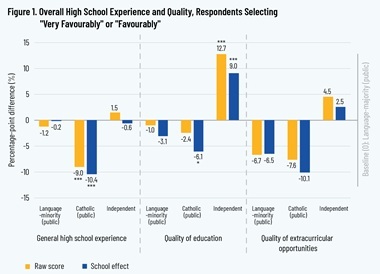
The language-majority public school average response is the baseline (at zero).
- The Cardus Education Survey (CES), conducted in Canada in 2012, 2016, 2018 and now in 2026, examines a range of outcomes for a nationally representative sample of 3,070 high school graduates aged 24 to 39 across the four largest Canadian educational sectors: language-majority public schools, language-minority public schools, Catholic public schools and independent schools. The CES controls for a range of respondents’ demographic background characteristics in order to allow for estimating school effects – meaning, the difference that attending a specific kind of school makes.
- The CES asks respondents about a holistic range of academic, spiritual, cultural, civic and relational outcomes, as well as their life patterns, views and choices, and their contribution to a shared good. This report provides an overview of key findings for each of the sectors.
- Canadian independent schools produce graduates that consistently demonstrate outcomes equal to or greater than their public-education counterparts, including their overall high school experience and preparedness for future education and work. They also evidence elevated rates of volunteering and charitable giving, suggesting that these schools are contributing to the common-good outcomes necessary for life together in a pluralistic society.
- Graduates of language-minority public schools, often smaller in size and community-oriented, demonstrate statistically significant positive outcomes – particularly when it comes the strength of personal relationships and to community orientation. The CES findings for these graduates point to positive outcomes that policymakers should consider within a bilingual country.
- Apart from faith formation, Catholic public school graduates reported below-average outcomes in almost all areas. In prior iterations of the CES, the outcomes for this sector were generally indistinguishable from other public school graduates. Further research is needed to fully understand this phenomenon, though possible explanations are considered in this report.
School types
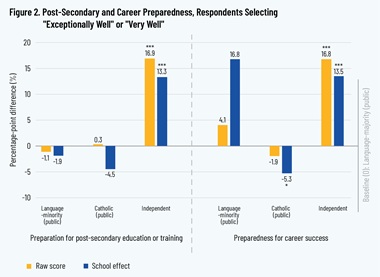
The language-majority public school average response is the baseline (at zero).
- Language-majority public schools: English public schools in all provinces except Quebec; French public schools in Quebec.
- Language-minority public schools: French public schools in all provinces except Quebec; English public schools in Quebec.
- Catholic (separate) public schools: This name reflects the fact that separate schools are usually Catholic, but there are some provinces in which Protestant (separate) public schools may exist (Alberta, Saskatchewan, and Ontario).
- Independent schools: Distinct from public schools in ownership and operation, financing, and governance. Most independent schools offer an education targeted to specific types of students or based on a specific curriculum or pedagogy. Independent schools may be Catholic, Protestant, other religious, or non-religious.
- Other type of school: Schools that do not fit any of the four categories above, such as homeschooling, public alternative school, and public charter school.
[Catholic schools in British Columbia are thus Independent schools, not Catholic (separate) public schools.]
Conclusion
Two important conclusions can be drawn from the Cardus Education Survey results in Canada in 2026.
First, and most obviously, attending a specific type of school can contribute differentially to graduate outcomes. Families should consider these differences as they make decisions about schooling for their children.
Additionally, regardless of economic background, families should be provided the maximum opportunity to choose educational options they deem most suited for their children. In a pluralistic society – where families hold diverse values, beliefs, and priorities – education cannot be one-size-fits-all.
Finally, the Canadian CES provides evidence that the common-good outcomes essential to maintaining democratic vibrancy are being produced by schools of varying types.
School sector, whether public or independent, has no discernible impact on measures of social cohesion, such as how well graduates are prepared for interacting with a range of people in society and what importance they place on community involvement and civic engagement.
Public schools, attended by majority of students, remain important and essential to the common good. But CES results consistently show that for many common-good outcomes, other school sectors match – and in some cases, outperform – public schools.
This verifies that a public school monopoly is not necessary and in fact may be detrimental. Educational pluralism holds promise not only for the flourishing of individuals but also for society as a whole.
For all figures presented, the language-majority public school average response is the baseline (at zero). This decision does not just reflect the reality that language-majority public schools are the largest educational sector in Canada. It also reflects the fact that language-majority public schools are the default schooling option for Canadian families, as these schools are fully funded by the government and, in most cases, students are automatically assigned to a specific school based on their place of residence.
Read the full report here.
In ‘Faith and the Common Good: Outcomes of Canadian Independent Schooling,’ a companion report drawn from the 2026 Cardus Education Survey, graduates of independent Catholic and Protestant schools match or outperform their non-religious independent school peers on volunteering and charitable giving, and show stronger patterns of marriage and family formation.
Read the full report here.