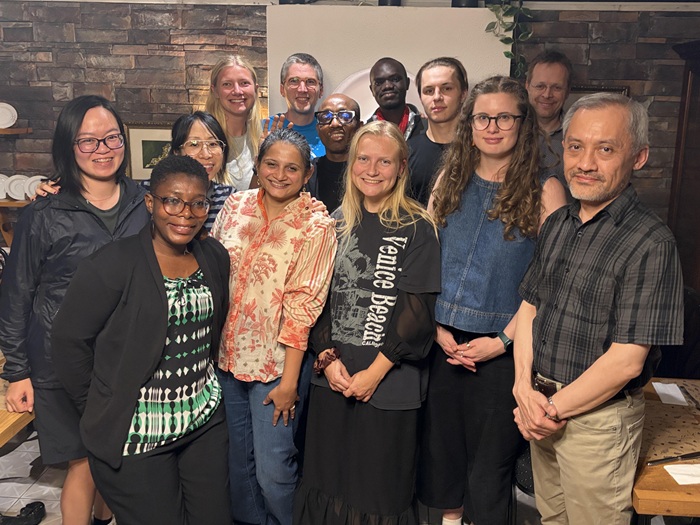
A Rocha’s delegation from five countries, taken at the Christian Climate Observers Program team dinner. Danae is back left, Samuel front right.
Two Vancouver participants at the COP31 gathering in Antalya, Türkiye are disappointed with the result, but retain some hope in the process – and even more in the people and groups they met with while there.
Samuel Chiu and Danae Vanderveen are both connected with A Rocha, which has its Canadian (and BC) base in south Surrey.
Chiu is A Rocha Canada’s Community Engagement Coordinator and also Lead of Engagement to UNFCCC (United Nations Framework Convention on Climate Change) for A Rocha International.
Vanderveen worked for A Rocha on the summer farm team as a farmhand and market lead, and then continued in the winter with the Farm to Families program, helping with some behind the scenes and event work.
A Rocha Canada is part of A Rocha International, “a global family of conservation organizations working together to live out God’s calling to care for creation and equip others to do likewise.”
Chiu has attended several COP events over the past few years, while Vanderveen was taking part for the first time.
No agreement
CBC News described the failure of the UN Climate Change Conference: ‘COP31 climate talks collapse after member states reject deal for not mentioning fossil fuels’:
Climate talks collapsed on Sunday [November 22] at COP31 in Turkey, ending the longest-ever United Nations climate summit with no deal to show for it.
For more than two weeks, representatives from nearly 200 countries, scientists, businesses and more gathered in Antalya, Turkey, for this year’s COP31 conference.
The annual UN Climate Change Conference brings together member states to negotiate – and ideally commit to – climate policies that aim to curb global warming. It’s the main vehicle through which countries coordinate climate action.
But this year, no agreement was reached – despite extending heavily into overtime this weekend following Friday’s deadline – after the European Union and others rejected the draft put forward by Turkey and Australia.
The lack of a deal means there will be no new action on climate disaster and adaptation financing for developing countries hardest hit by the impacts of climate change as the world is expected to overshoot the 1.5 C target set by the 2015 Paris Agreement, nor any further attempts to rein in the main human drivers of the climate crisis.
Some positive signs
 Chiu wrote me November 25:
The failure of achieving a consent on the ‘cover decisions’ at the end of COP31 does not represent ‘collapse’ as portrayed by some of the mainstream media.
There are other smaller agreements which went through, related to the implementation of a number of decisions in the past; agreements and rules are still in effect.
On the overall outcome, the failure this time is not even a first; COP15 in Copenhagen (2008) saw a similar situation. This time the failure represents the fact that countries suffering the most in the recent climate catastrophe no longer yield to the fossil fuels producing powers.
I would quote one of the CCOP (Christian Climate Observers Program) leaders who wrote most eloquently:
[E]ven though the outcome is seen as a failure, in essence the UNFCCC COP process worked as designed. Consensus is vital and it goes both ways. For countries to reject the text was appropriate and powerful. Countries boldly drew lines in the sand and rejected weak language and demanded direct action on fossil fuels.
They didn’t let the oil producing powers win. This also makes the TAFF conferences like the one this April in Santa Marta, Colombia and the upcoming one jointly [sponsored] by Tuvalu and Ireland even more vital and important.
(TAFF is ‘Transitioning Away From Fossil Fuels,’ which is a parallel process started earlier this year, joined by 58 countries, including many of those rejecting the proposed cover texts this time.)
Vanderveen also wrote, November 25:
Many countries claimed that adopting a text that goes against best available science by not acknowledging that fossil fuels are the largest contributor of climate change goes against international law. Thus the refusal provides a positive indicator that many global leaders recognize that action against climate change is imperative.
Impressed
She was impressed by much of what she experienced:
With over 90,000 participants over the two-week COP, the majority are a part of NGOs, INGOs, grassroots movements or leaders in their communities.
These agents of change, while maybe discouraged, are going back into their communities and continuing the good work they have been contributing to – but now with more connections and encouragement.
Certainly for me that is true. While it seems small, that is still tens of thousands of people from every corner of this earth that share a passion for environmental stewardship and creation care.
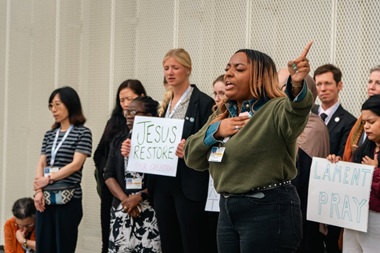
A Rocha International led “a moment of lament and prayer. Participants stood vigil. Some prayed. We were led in song.” Danae Vanderveen is holding the ‘Jesus restore your creation’ sign.
Highlights
She pointed to several highlights:
1) The diversity! How special it was to be in a space where nearly every country in the world was represented! For me, it was an image of heaven where all nations will be together in unity.
2) On Friday, a couple dozen of us were able to do a prayer vigil in the main hallway. This was an opportunity to pray and lament for many places and specific issues that have recently occurred due to climate change, to ask the Lord to redeem His creation and declare Him Lord over all. One major way we can be missional in this space – and secular spaces in general – is to pray!
3) We got to meet and connect with representatives from various organizations such as the Green Climate Fund (a major climate finance agent for the UNFCCC), the Minister for Environment and Climate Change Canada, various NGOs and research organizations. While at times I did not feel like I had enough expertise to contribute much to these conversations, it was amazing to hear their stories and passions, learn about what is happening around the world and create further opportunities for connection.
Looking ahead
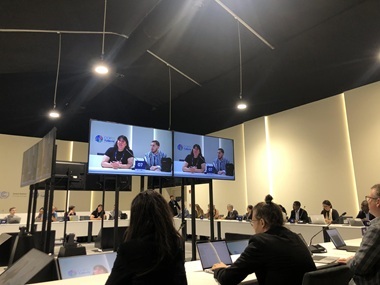 Chiu retains hope:
As in the past – even with my limited time and bandwidth at the conference – I saw and heard many fantastic stories of people pulling together around the world addressing the climate challenges in their respective nations.
There are new pathways to channel needed resources and collaborations to the local communities to make meaningful and significant changes. Even though it’s still a difficult long road ahead, I’m not optimistic but still hopeful, as a witness of Christ’s reconciling all things.
And once again, CCOP brought more than 40 people from close to 20 countries to be nurtured as Christian witnesses, engaging in various ways that would be formative and impactful for their journeys as advocates, professionals or academics.
Encouragement, challenge
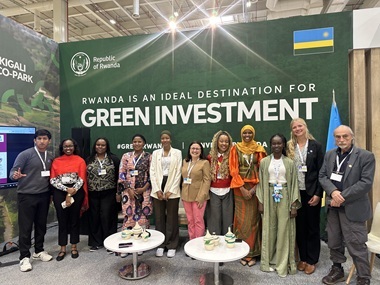
Danae Vanderveen made many good connections while at COP31.
Vanderveen is a fourth year student at University of the Fraser Valley, focusing on global development studies through a social justice lens; she attends Peace Portal Church in Surrey.
She added an encouragement – and a challenge:
After the non-agreement in the closing plenary, the Executive Secretary said “Civil society is vital now more than ever.”
If anything rang true for me was the importance of Locally Led Action (LLA) and the role of civil society.
Yes, lots happens at the governmental level, and arguably that is where the ‘biggest’ change occurs, but within the multilateral or even national processes, it takes lots of time and reform to see the change we want to. COP31 has revealed this.
Civil society means you! Change happens at the community level. Why? Because you are the ones that are experiencing the floods, fires, high grocery bills and gasoline costs, and poor air quality.
Government officials living in Ottawa don’t understand the issues you face more than you do. Which is why when you are informed and have proper tools, you know what the best solutions are.
Ground up solutions is where change starts. We all have spheres of influence, whether at school, work, churches, sport groups or our larger community. You have the ability to inspire change, as small as it may seem in your communities. You don’t need to wait for your municipality to act.
Ask the LORD to soften your heart, to guide you in the places and spaces where change should occur – and how to do it. Look around you for people who are already doing something. See if you can join in, bring new ideas, encourage others to participate.
You don’t have to change legislation to create positive change – but if you want to, by all means go ahead!. So I ask you to reflect and to pray.
CCOP thoughts
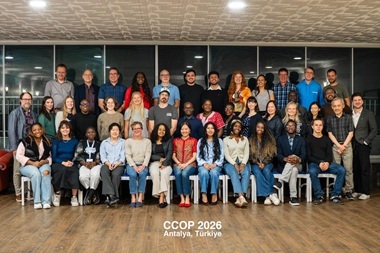
CCOP brought more than 40 people from just under 20 nations to participate in COP31.
Among the Christian Climate Observers Program sponsors, along with A Rocha Canada and A Rocha International, are Lausanne / WEA Creation Care Network, World Evangelical Alliance, SIL Global and BioLogos.
CCOP’s update on the final day of COP31 stated:
We can call it a COP of superlatives:
-
- The largest COP on record: 92,934 registered participants
- The longest COP on record: ending on Sunday after 44 hours of overtime.
- The most number of fossil-fuel, carbon capture and storage, and AI lobbyists:
- 103 fossil-fuel linked groups, 700 CCS lobbyists; Guardian report
- The first truly rejected deal: the proposed ‘Antalya Pact’ fails to achieve consensus and so is shelved.
- Note: COP6 in The Hague was ‘suspended’ and resumed eight months later in Bonn for ‘COP6-bis’ and reached a deal.
- Note: COP15 in Copenhagen, with the last minute intervention of President Obama and Chinese premier Wen Jiabao, produce a ‘Copenhagen Accord’ which the other parties don’t formally adopt, but “take note of.”
 CCOP pointed out that the Antalya Pact was rejected, but offered some perspective:
And to be clear: rejected by some, backed by others, but since the UNFCCC works by consensus, the COP31 Presidency concluded there was no way forward:
-
- Notable rejectors: EU, Germany, UK, Panama, Marshall Islands, Vanuatu, Belize, Canada, Norway, Least-Developed-Nations Negotiating Bloc
- Notable backers: Türkiye, Australia, Russia, Saudi Arabia, China
- Notable responders: the African Negotiating Bloc, represented by Ghana, criticized the text, but felt that ‘multilateralism’ would be bolstered by their accepting it.
Explicitly stated reasons for rejection:
-
- No mention of fossil fuels, and failure to reaffirm a COP28 commitment to transition away from fossil fuels.
- Inclusion of CCUS (Carbon Capture, Utilization and Storage) as an excuse to keep burning fossil fuels.
- No progress on climate adaptation finance
CCOP wrote:
On the final Friday of COP31, our partners A Rocha International arranged with the UNFCCC for an official event in the Blue Zone for CCOP and our faith-based partners. Most of these events are protests or creative media events, but this was a moment of lament and prayer. Participants stood vigil. Some prayed. We were led in song. There has been so much loss in the last 12 months due to climate change. We lament. We pray.
And added that “It may have been our best CCOP program ever.”