
 The term ‘quiet revival’ has become well known, originating from a study published by the British and Foreign Bible Society last April.
It reported on the situation in England, but has become well known in North America, with many suggesting that we are experiencing something similar.
Thus it comes as something of a shock – even at his remove – to learn that there is a problem with the report. A note on the main page of Bible Society site asks, ‘The Quiet Revival one year on: what’s the story?’
Paul Williams, Chief Executive Officer of the Bible Society wrote a statement March 26 which begins:
Earlier this month YouGov informed Bible Society that the 2024 survey sample on which our report The Quiet Revival was based was faulty, and it can no longer be regarded as a reliable source of information about the spiritual landscape in Britain.
We recognise that this news may feel discouraging and we share that sense of disappointment.
The original report
But first, what did the Quiet Revival report claim. Here is how I began an article last April:
It is common knowledge that the church is shrinking in Europe (and in North America). Right? That’s what we’ve been told over and over.
However, a significant new study suggests that the trend may be changing – at least where it was focused, in England and Wales.
The Quiet Revival, a survey commissioned by the Bible Society in the United Kingdom, offers some surprising revelations:
Church decline in England and Wales has not only stopped, but the Church is growing, as Gen Z leads an exciting turnaround in church attendance. Church attendance has risen by 50 per cent over the last six years, busting the myth of church decline.
The Quiet Revival shows that the most dramatic church growth is among young adults, particularly young men. In 2018, just 4 percent of 18 – 24 year olds said that they attended church at least monthly. Today, says The Quiet Revival, this has risen to 16 percent, with young men increasing from 4 percent to 21 percent, and young women from 3 to 12 percent.
I noted a local connection at the time. Paul and his wife Sarah lived in Vancouver and taught at Regent College for years. (Sarah spoke on her new book – When Courage Calls: Josephine Butler and the Radical Pursuit of Justice for Women – as a guest at the Oxford Literary Festival March 27.)
The problem
The report has received careful scrutiny in the United Kingdom, but:
Over a 15-month period, Bible Society repeatedly sought and received assurances from YouGov, regarding both the robustness of the methodology and the reliability of the report’s conclusions. It was only at the beginning of March that YouGov confirmed that it failed to activate key quality control technologies that protect the sample from a wide range of errors and this undermines the reliability of the results.
YouGov’s Chief Executive Officer Stephan Shakespeare has apologized for their error and takes full responsibility for it – and “stresses that Bible Society has at all times accurately and responsibly reported the data we supplied to them.”
Williams adds that “YouGov’s error does not mean that all of the findings were wrong – it means that we cannot reliably support those findings on the basis of this survey.”
What’s in the new report?
 Here is the overview of what is in the new report:
We pulled together polls, reports, statistics and testimonies that show what’s really happening around the Bible and Church in England and Wales. Here’s what the report has to tell us.
-
-
The culture’s changing – from footballers to philosophers, believers are talking openly about their Christian faith
-
Religious identities are more important – nominal Christianity’s declining, but younger Christians are far more likely to practise their faith
-
Young people are a more spiritual generation – widely engaged in spiritual practices and open to faith
-
There’s a Bible boom – sales have soared, and Google searches for it have overtaken searches for Harry Potter
-
There’s a rise in conversions – the Catholic Church, the Church of England and others have all reported increased numbers of adult converts
-
Go here for the 43-page fully illustrated new report. It makes for very interesting, and still encouraging, reading.
And here for responses to FAQs, including this last one:
- What will happen next?
We’ll be running another survey with YouGov at the same scale as the 2024 survey (around 13,000 respondents), later in the spring, and we will also run further surveys – including probability surveys – with other companies, with a view to gaining as accurate a picture as possible of Christianity and the Bible in England and Wales. We hope to report back in the autumn.
The Patmos Initiative
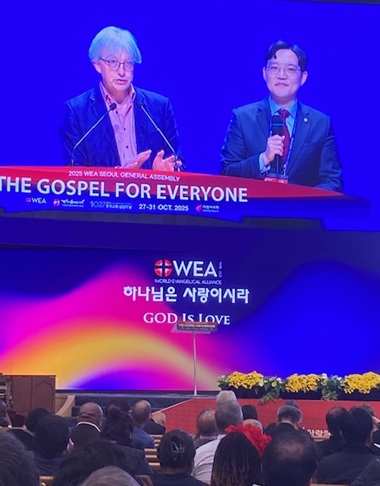
Paul Williams introduced The Patmos Initiative to the WEA General Assembly in Seoul, Korea last October.
The Bible Society is active on a number of fronts. Another major current project is The Patmos Initiative, the world’s largest Bible engagement project.
The United Bible Societies introduced the report when it first came out:
Bible Society in England and Wales, in partnership with United Bible Societies, today launches the findings of The Patmos World Bible Attitudes Survey – the most comprehensive global study of attitudes toward the Bible and faith conducted in a generation.
The research, undertaken by Gallup, surveyed 91,000 people across 85 countries and territories, representing 3.8 billion people worldwide.
It reveals a global religious landscape far more complex and nuanced than commonly assumed, challenging common assumptions about secularism and the decline of belief.
It also identifies seven contexts where countries sometimes separated by geography and nationality share socio-religious similarities.
 Some of the survey’s most striking findings include:
- Even in secular Western contexts, 62% of respondents believe in God or a higher power;
- 240 million non-Christians worldwide express interest in learning more about the Bible;
- Young non-Christians (18 – 25) in secular contexts show a higher interest in the Bible than older demographics do;
- In parts of Asia, 56% of people have never heard of the Bible;
- 70% of all respondents globally, including many non-Christians, agree it is good for children to know Bible stories;
- A surprisingly high number of Christians do not use the Bible regularly or want to find out more about it.
Addressing the World Evangelical Alliance General Assembly in Seoul, Korea last fall, Williams said he hoped the Patmos Initiative would foster greater cooperation on mission around the world.
April 4 note: Paul Williams encouraged people to watch his April 3 interview with Rachel Johnson on Leading Britain’s Conversation, especially the first 15 minutes, “because she asked the right questions.”
There has been much reference to the increased momentum of growth among The Orthodox with the apparent collapse of interest in the younger denominational franchises who took the gimmicky path that catered towards a fluid ‘cultural relevance’ and mirroring.
And then there are others (like myself) who have noted that ‘the ekklesia'(sometimes translated in English as church) is actually a gathered group of people who are NOT the institution, the denomination, the brick and mortar building, the pastor/priest with sermon or eucharist and certainly not The Sunday Morning Church Service/Liturgy. These are all misapplied and maintained as poor substitutes.
The Ekklesia are housed in a variety of institutions in which ‘the observance’ requires that they be muted. Typically only one member functions in the role of Adult and Mouth while the rest exist as the perpetual dependent Child and homogenous Ear. Now if all are Mouth and Ear then where is The Body? In actually there is none. With only two Body Parts present what you have actually stumbled upon is a crime scene for which there are no police to all!
Imagine any family who gathers this way? Only the parent can speak while the children never? How would those children ever grow into maturity and adulthood themselves? Would not Child and Family Services eventually come and remove them to a place in which they might actually grow and into adulthood themselves? Yes I know, some say that they wish to be biblical in doctrine but take absolutely no thought as to what it might mean to be biblical in practise. What we enshrine is a Tradition above Scripture
What does that Sunday Morning ‘observance’ actually train one for after 5, 10, 30 or 50 years? Are church workers actually made there? How so when they are not even allowed to speak and to share from knowledge and experience what God has put in their heart to share? The suggestion is extended each week that only one member has anything of value to share. Those elderly saints who should have much to share and wisdom to extend have no licence to even speak.
Glued on titles and not the functioning of the members is what is bowed to. And somehow the notion exists that after sitting and acquiring knowledge somehow the observers will (upon exiting the doors of the building) go into ‘functioning mode’ upon exiting the building where they are to solicit friends, neighbours and coworkers to return to this building where they too can essentially and forever watch ‘the movie’ as spectators. ‘To build one another up’ cannot occur.
How strange it is that in the 1st century Jesus and The Apostles could speak within synagogues (at least once) where they were often only known as visitors. Yet The Ekklesia, while allegedly ‘a family,’ a “Body,’ are members who remain disconnected, disjointed, socially distanced (aligned to only view the head of the person seated ahead o’ them) and are expected to be non-functioning (except perhaps to somehow pay a ‘user fee’).
This ancient ‘open mic’ policy that we also see in the New Testament church had ceased to be in subsequent church history. We speak of extending Jesus’ commission to ‘the 11’ to all (Matthew 28:18-19) but we remove ‘the commandments of the Lord’ that presumed a functional gathering of Christian members with the intent that all could benefit and understand with a foreign system that offers something other than what should be done ‘decently and in order.’
In contrast (1 Corinthians 12/14; Ephesians 4:11-12)