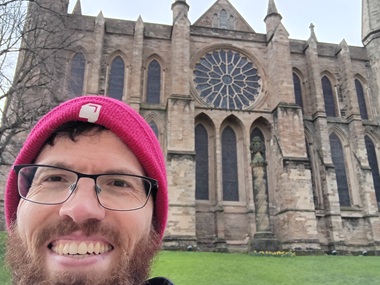
Jason Wood at Durham Cathedral.
Earlier this year I had the opportunity to visit some friends who live in Bishop Auckland, up in England’s northern counties.
Troubled with widespread, endemic poverty now, the area used to be full of thriving mining communities, whose coal powered the Industrial Revolution. The economy has since moved on, but much of the north feels locked in the past, culturally and economically.
At the same time, it’s a frontier sort of place: both politically, as the region where England for years defended itself against the Scots; and religiously, as a home to the bones of the wild St. Cuthbert and other holy men and women, touched by a more earthy, Celtic Christianity than the historically dominant version imported from Rome.
It’s a fascinating land of contradiction. For centuries bishops in County Durham reigned as princes, and great wealth still rises enshrined amid a sea of poverty.
For a weekend I was blessed to immerse myself in this landscape. One Saturday morning I ventured off from Bishop Auckland, intent on following the Way of Life, one of a modern set of pilgrimage trails that converge at Durham Cathedral.
I walked for a good five hours, across fields, over rivers, and through forests, until finally I caught sight of the Cathedral itself. Positioned at the heart of Durham in a bend of the river Wear, it’s an epic piece of architecture, and it offers a complicated testimony to the intertwined legacy of Christian faith and Norman imperialism.
I arrived weary of body and soul, longing to meet God in this sacred space. Instead, due to a civic event taking place that afternoon, visitors were barred from entering past the side aisle. I sat and listened, for a time. But soon the service ended, the Cathedral was closed, and I left dejected and discouraged.
I had worked so hard, walked so far, only to find myself excluded from this place of worship. My efforts had borne such little fruit. What had I come all this way for?
So, the next morning I went back. I hadn’t planned on returning. The possibility that I even could felt like grace. This time the bus carried me directly into Durham, and I walked straight into the Matins service without a hindrance or second thought. And I’m so glad I did.
Listening to the cathedral choir sing the psalms, reading the Christian story depicted in the stained glass which illumines the worship space, praying at Cuthbert’s shrine, where his bones are buried…my wondering soul drank it all in with the parched thirst of a desert pilgrim.
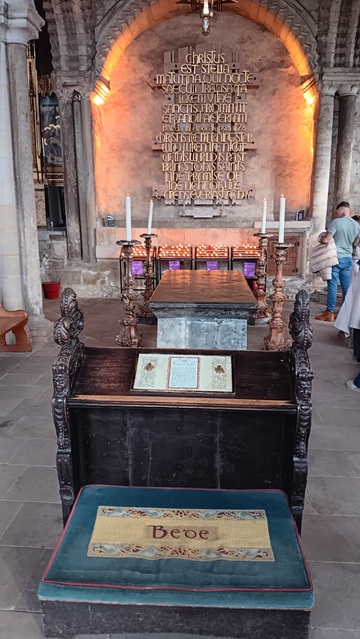
The tome of the Venerable Bede.
The Epistle reading in Matins was from Ephesians 2, where Paul declares “it is by grace you have been saved, through faith – not by works…now in Christ Jesus you who were once far away have been brought near by the blood of Christ.” (vv. 8, 13).
And unlike ever before, I heard those words, not just with my heart but with my body, in the built physicality of this sacred space. I had worked so hard to enter the sanctuary, but it hadn’t been enough. I had been excluded, kept far away, barred from the place of communion.
The power of Paul’s message, written to Gentile Christians 2,000 years ago, came alive. They had been barred from entering the inmost courts of the Jewish Temple. And since then far, far too many others have been excluded from our own Christian places of worship, whether on grounds of ethnicity, social status, language, gender, sexuality or ability.
Yet Christ’s loving sacrifice accomplishes what our human religious systems can not, carrying us into the very heart of God – no matter who we are, what we’ve done, or where we come from.
That’s grace. Good news for all. And the reality of our churches is that we bear this soul-saving capacity to extend God’s gracious welcome, but also to refuse it. Sometimes even in the same breath.
Our hope, then as now, rests not in our ability to always get this right – as much as we are called to try! It rests in the faithfulness of God, whose grace extends even where our welcome fails. Because it will. But thanks be to God, by whose faithfulness we are saved.
Again.
And again.
And again.
And again . . .
Jason Wood and his family are in the United Kingdom for six months, spending time with family members and taking a sabbatical following several years as children, youth and families pastor at St. Laurence Anglican Church in Coquitlam.