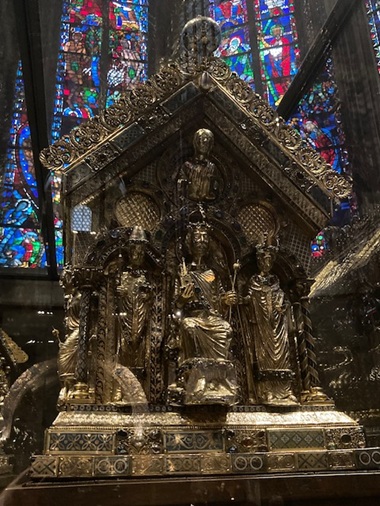
The Charlemagne Shrine is prominently displayed in Aachen Cathedral.
Margaret and I have now been away about a week and a half, but we’ve seen a lot. Thus far we have visited several cities in west Germany and one in the very south of the Netherlands.
We had never been to either country before – though we did meet not too far away, in Switzerland – so it is all new to us. We are gaining some insights into the culture, but because we are generally not staying long in any one place, those are necessarily limited.
I will focus on some of the key religious sights we have seen, having visited at least 10 churches thus far. All have been impressive in their own way.
Most have survived the vicissitudes of the centuries, not least massive World War II bombing,
(We are not entirely one-track, of course – we are dining out, walking the streets of the old towns, cruising, briefly, along the Rhine, playing with grandchildren . . .)
We visited the Imperial Dom of St. Bartholomew in Frankfurt (best viewed across the Main River) and Bonn Minster Cathedral (overshadowed by ubiquitous reference to the city’s native son Beethoven).
Both were impressive, as were the castles and churches we saw as we travelled by train through the Rhine River gorge – but Cologne was a particular highlight.
Cologne
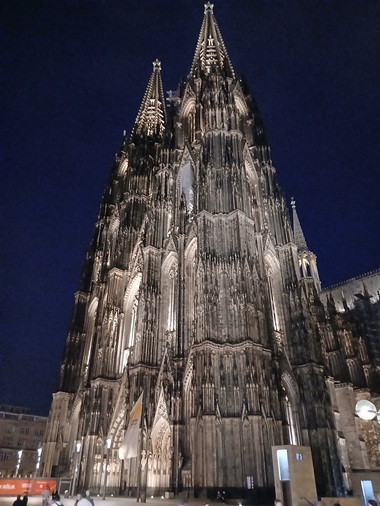
Cologne Cathedral is impressive, day or night.
Cologne Cathedral (Kölner Dom) really has to been seen in person to be believed. It is massive, intricate and awe-inspiring, both outside and in. And continually under construction.
Cologne was reduced to rubble during the Second World War and the cathedral was severely damaged by numerous bombs.
Because it was so well constructed, however, it almost completely withstood the shockwaves. It seemed undamaged in the midst of the surrounding wasteland.
Stained windows, particularly those from the Middle Ages, were taken out and thus protected, while those created during the 19th century were largely destroyed.
The cathedral had a very chequered history even before the war. It appears that the first Christian community met where today’s Gothic cathedral stands in the early 300s, and there is archeological evidence of a church on the site from the 6th century.
Planning for the current cathedral began in 1164 and and the cornerstone was laid in 1248.
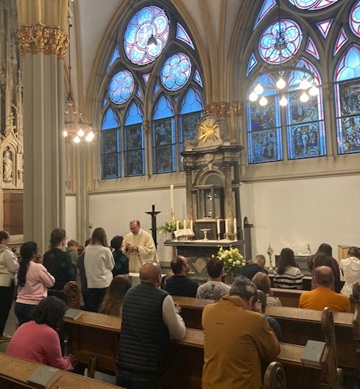
An evening mass at Cologne Cathedral.
However, the cathedral actually took more than 600 years to complete. The cathedral’s choir was finished by the early 1300s. Then building slowed, and ground to a halt after 1520, not to be restarted until 1842.
While construction was carried out over so many centuries by many different builders, they did not deviate from the original architectural plans.
I climbed the 500-step south tower, which had me puffing, but afforded an amazing view of the city and river.
We also took part in an evening mass in a side chapel of the cathedral. ‘Took part’ might be a slight overstatement, given that the service was in German and we could not take communion. But we were there in spirit, very much aware of being part of a worldwide communion of believers.
Jülich

A delicious meal followed the service in Jülich.
We had a similar experience, in a very different setting, when we attended International Christian Fellowship Center in Jülich, where our daughter and son-in-law and their children are worshipping regularly and making friends.
The English-speaking church has strong Nigerian roots, but is increasingly multicultural.
We enjoyed the lively music, the preaching (about shame and restoring relationships, based on Jesus recommissioning Peter following his disavowal of his master) – and, not least, the spicy rice and chicken meal following the service.
Again, we were powerfully aware that the church takes many forms, all over the world.
The church is located in a sort of light industrial area on the outskirts of Jülich, which was, we were told at the museum, 98 percent destroyed during the war.
Fortunately, St. Mariä Himmelfahrt, the most significant church in town (and more than 1,000 years old) has been reconstructed after having been left in ruins after the war.
Aachen
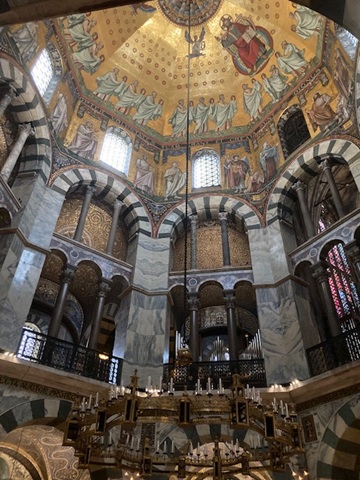
The unique interior of Aachen Cathedral.
Aachen Cathedral (Aachener Dom) was built by Emperor Charlemagne around 800 AD – and his presence is still very much felt. He is buried there, quite noticeably.
The Charlemagne Shrine, containing his mortal remains, is prominently displayed in the choir area of the church. The oak box is decorated with gilt silver, gilt copper and precious stones.
Those who worry about creeping Christian Nationalism in North America might take some comfort in the fact that we are still leagues off from the medieval version.
The end of the Shrine (pictured at the top) features Charlemagne enthroned, beneath the figure of Christ and flanked by (the smaller figures of) Pope Leo III and Archbishop Turpin of Rome.
And to underline the point . . . upstairs is the Imperial Throne, a simple chair on which 30 kings were enthroned after their anointment and coronation at the high altar.
The current form of Aachen Cathedral evolved over 1,200 years; the central feature is the Carolingian octagon, with its surround hexadecagon (16 sides), constructed around 800 AD.
Maastricht
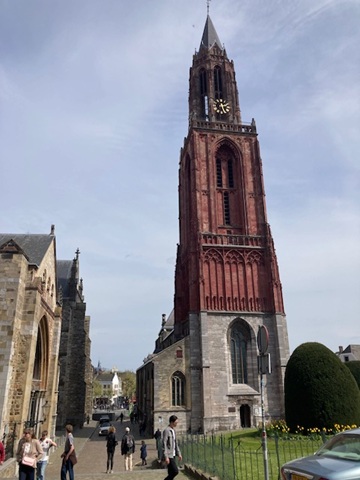
St. Jan’s Church, with a portion of Sint Servas on the left.
Yesterday, we began using our Eurail pass, taking a day trip across the border to Maastricht in the Netherlands.
Like most of the areas we have been through, Maastricht has a strong Roman Catholic presence. We enjoyed looking around the Basilica of Our Lady (Onze Lieve Vrouwebasiliek) especially the enclosed Mary Garden, which featured flowers associated with her since the early centuries.
But the highlight was probably the Protestant St. Jan’s Church (Sint Janskerk, named after John the Baptist). Its red tower is quite distinctive and we were able to climb the climb it for a grand view of the city. In the immediate foreground, right next door, is Sint Servas, which remained Catholic.
Prince Frederik Hendrik of Orange captured territories in 1633 which had previously been controlled by Spain. Generally, all the Roman Catholic churches in such situations had been turned into Protestant churches, but in this case only two churches (including St. Jan’s) changed hands.
Apart from the churches I have mentioned, each village we roll by on the train has at least one very visible church spire.
In the Netherlands in general (due to the significant and sizeable remaining population of Roman Catholic parishioners in almost every city) at least one place of worship remained in the hands of Rome.