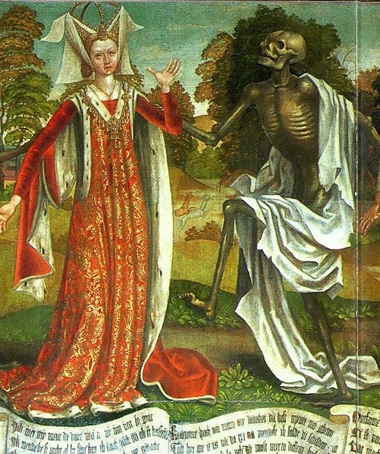
A portion of ‘Dance of Death,’ located in St Anthony’s Chapel of St Nicholas’ Church in Tallinn, Estonia.
Last week I returned from 10 weeks in Europe. Margaret and I covered a lot of ground, but I will focus, given the nature of this site, on a few religious sites and spiritual highlights – and it still surprises me how easily one can find such delights in a continent which is commonly supposed to have succumbed to secularism.
The main elements of the trip:
- We began by staying a week with our daughter Katherine, her husband Michael and their two children in Jülich, Germany (he’s on a sabbatical research break from SFU). I wrote about a few of the highlights from those first few days (including visits to Cologne, Aachen and Maastricht) here.
- Then used our Eurail Pass (and ferries) to visit Denmark, Sweden, Finland, Estonia, Latvia, Lithuania, Poland, Czechia and Austria. A bit hectic, but well worth the effort.
- Stayed with friends for a few days in Switzerland.
- Back to Jülich for another week.
- Margaret returned home to help our fifth child, Elise, deliver her fifth child (Arthur Sigurd).
- I carried on to England and then to Scotland, where our book club met in Scotland.
Here are a few of the sites and moments that stand out:
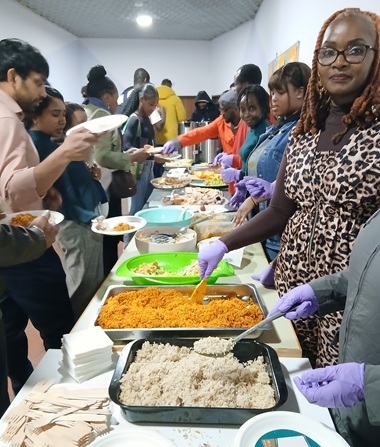
Lunch after the International Baptist Church service in Hamburg, Germany.
* Hamburg, Germany: We visited numerous churches throughout the trip, but we always tried to attend an international, English-speaking church on Sundays.
One favourite, apart from Jülich, was International Baptist Church in Hamburg, a very multicultural congregation, which is the norm in such churches. During the lunch following the service we connected with two young Brazilian women, one working in the shipping business and the other pursuing her PhD.
* Lübeck, Germany: A multitude of churches reflect Lübeck’s leading role in the Hanseatic League, which dominated northern European trade between the 13th and 17th centuries. Rich merchants built churches to demonstrate the importance of Lübeck as a trading centre, and to ensure their legacy would be secure.
The city is well aware of its rich spiritual heritage; its tourist bureau writes:
Lübeck is the city of the seven spires. Five Gothic brick churches form part of the impressive panorama which was considered a symbol of the power and wealth of the ‘Queen of the Hanseatic League.’
From a distance, the seven spires above the medieval sea of houses look like the sharp spikes of a crown even if somewhat askew and incomplete. These red-brick giants were built and modified over several centuries and form part of the UNESCO World Heritage Site. They play a not inconsiderable part in the spiritual and cultural life of the city. The measured ringing of their bells, audible from afar, is an expression of the Lübeck lifestyle just like brickwork and the sea.
The merchants may not have been spiritual giants, but their legacy is impressive.
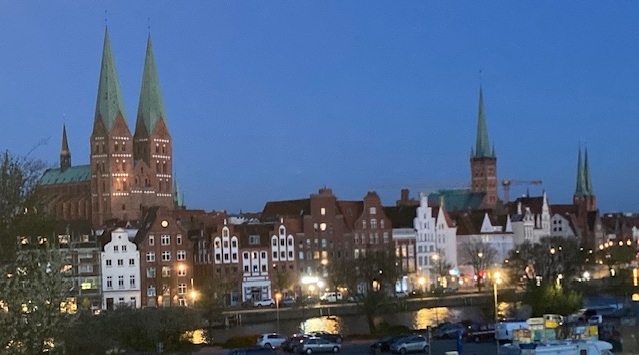
Several of the Lübeck churches visible across the water; the Old Town is on an island.
* Copenhagen, Denmark: We discovered a free afternoon Bach organ concert at Trinitatis Church. The host showed us the best seats for sound and assured us that the event was more than a concert, but really a matter of sharing Christian faith with the broader community. A number of the performers were students of Margaret’s opera singer distant cousin.
* Tallinn, Estonia: We went to Niguliste Museum in St. Nicholas Church. A highlight was Bernt Notke’s Dance of Death , a somewhat macabre (but convincing) painting from the late 15th century.
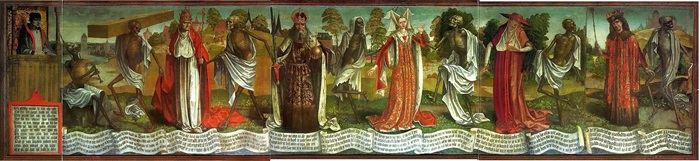
‘Dance of Death’ by Bernt Notke; late 15th century.
The museum describes the work:
The Dance of Death, located in St Anthony’s Chapel of St Nicholas’ Church, is the best-known and most valuable medieval artwork in Estonia. Only a fragment containing 13 figures has been preserved.
Against the background of an autumn landscape, the dance of mortals is introduced by a preacher from a pulpit, followed by figures of Death holding a bagpipe and carrying a coffin. The first dancer is the Pope, wearing a papal tiara. The mortals who follow him are the Emperor, holding a sword and an orb, the beautiful Empress, the Cardinal and the King. In the right-hand corner of the painting, it is possible to see the edge of the robe of the next character, the Bishop.
Under the figures there is a winding band with text, a painted dialogue in verse between Death and the other characters written in the Low German language.
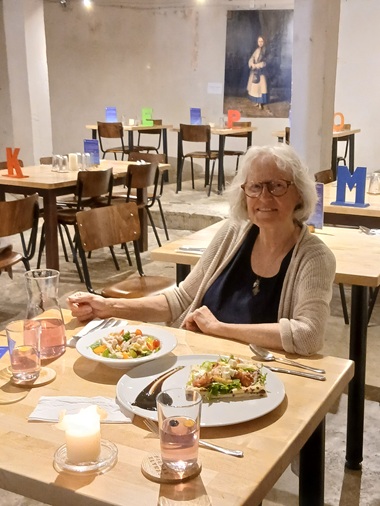
Margaret enjoying a meal at Pirmas Blynas in Vilnius.
* Riga, Latvia: We took a two-hour walking tour of the old city and discovered that our guide is a Pentecostal. His faith came through during his talk. Unfortunately, we got lost trying to find his church the next day.
* Vilnius: Lithuania: One very pleasant surprise as we turned down a side street in the old town was to find a church which hosts a restaurant served by people with disabilities.
Pirmas Blynas takes up the first floor of Ramintoja (St. Virgin Maria’s) Church and “welcomes you to try our sweet and savoury pancakes, daily specials, home made desserts and coffee roasted by our own employees.
The church had been closed by the Soviets, slated for demolition and only saved because it could be used to store vegetables. The church now also runs Alpha programs. (Go here for an inspirational glimpse into how the current work began.)
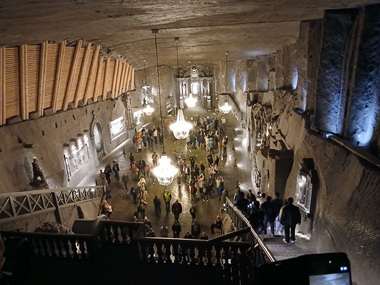
This grand underground cathedral was built entirely out of salt (including the chandeliers) by the miners.
* Kraków, Poland: We enjoyed hearing street preachers in the square out in front of the major Catholic cathedral.
We also took a day trip to the Wieliczka Salt Mine, described on the UNESCO World Heritage site:
The Wieliczka and Bochnia salt mines are located on the same geological rock salt deposit in southern Poland. Situated close to each other, they were worked in parallel and continuously from the 13th century until the late 20th century, constituting one of the earliest and most important European industrial operations.
The two mines include a large ensemble of early galleries which extend to great depths. The residual excavations have been altered, and made into chapels, workshops and storehouses, etc. A substantial ensemble of statues and decorative elements sculpted into the rock salt has been preserved in both mines, along with an ensemble of tools and machinery. An underground tourist route has existed since the early 19th century.
The Wieliczka Salt Mine reaches a depth of 327 metres (1,073 ft), and extends via horizontal passages and chambers for over 287 kilometres (178 miles).
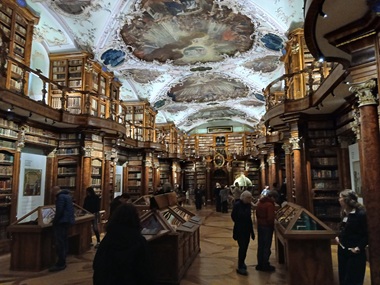
The Abbey Library of St. Gallen in Switzerland.
* St. Gallen, Switzerland: Surely the most beautiful, carefully curated library in the world. The Abbey Library of St. Gallen (Stiftsbibliothek) was a particular treat for a book collector such as myself.
Originally part of a Carolingian monastery, it is one of the oldest monastic libraries in the world. The present library was built in the 18th century.
The library, which still lends books today, has a collection of some 170,000 books, including at least 400 volumes that are more than 1,000 years old.
* Lausanne, Switzerland: We attended International Evangelical Church Lausanne, a small group with links to Swiss L’Abri, the Christian community where Margaret and I met almost 50 years ago.
One of the leaders at the time, Ellis Potter, still preaches at the church once a month and we were given a couple of his books as presents.
We also loved visiting Lausanne Cathedral, a very impressive (and not unduly ornate) building with a commanding view of the city. Lac Léman (Lake Geneva) and the mountains beyond. Lausanne views rival those of Vancouver.
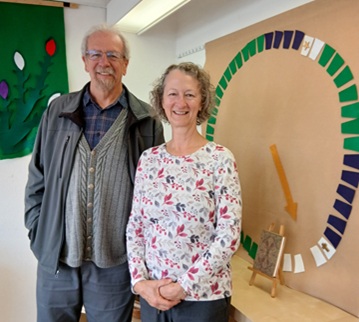
Janet Epp Buckingham, Director of the World Evangelical Alliance (WEA) Office in Geneva, was good enough to introduce us to some of her work.
* Geneva, Switzerland: Not too far along the lake from Lausanne is Geneva, where we visited, not for the first time, The Reformation Wall, featuring huge statues of John Calvin, William Farel, Théodore de Bèze, John Knox and other leading Reformers.
But probably the highlight of the day was visiting the offices of both the World Evangelical Alliance and World Council of Churches, and having a chance to speak with active participants at each place.
* Worms, Germany: Worms is a unique town. It is probably best known for the Diet of Worms. (The unfortunate combination of words belies its historical significance). As Britannica notes:
The Diet of Worms [was a] meeting of the Diet (assembly) of the Holy Roman Empire held at Worms, Germany, in 1521, made famous by Martin Luther’s appearance before it to respond to charges of heresy.
Because of the confused political and religious situation of the time, Luther was called before the political authorities rather than before the pope or a council of the Roman Catholic Church.
Martin Luther was pressed to change the views which had caused Pope Leo X to excommunicate him earlier in the year. He refused, insisting he could not go against his conscience and recant his views (“God help me, Amen!”) He then went into hiding at Wartburg castle.
There is still a strong Catholic presence in Worms. The impressive Worms Cathedral loomed above our hotel window, but they give space to recognizing Luther standing before Charles V right in the Bishop’s gardens, and there is a striking statue of Luther and several other reformers just around the corner. Apparently members of the two branches of the faith get along well now in Worms.
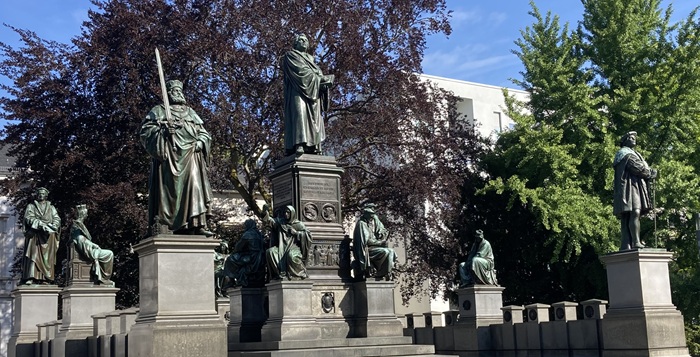
These statues of Martin Luther and other reformers are centrally placed in Worms, Germany.
* Whitby, England: Margaret and I loved our visit to this town in northeast England in 2023, so I decided to go stay again at the hostel in the shade of the ruined Abbey up on the hill.
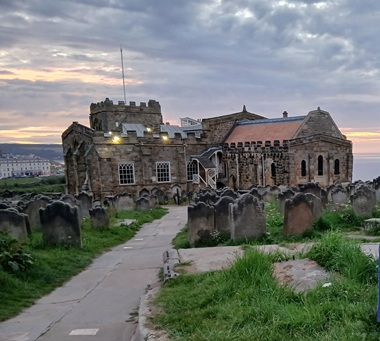
St. Mary’s Church on the hill above the harbour in Whitby, England.
It was a fortuitous decision, and during my one full day there I met two special people.
The first was a teenager I spoke to at the 12th century St. Mary’s Church, right near the Abbey and the hostel. He had become a Christian on his own a couple of years ago and then began attending St. Mary’s just a few months ago.
He loves the sense of tradition, the liturgy and the solemnity of the services. He seems the epitome – though each person is unique – of the kind of young men we hear about being attracted to church, both in England and North America.
After church, I walked about 10 km south along the coast to Robin Hood’s Bay. As I neared the village, I met a woman about my age who asked me if I had seen any seals.
As we chatted, it turned out that she is a consecrated laywoman who had lived in Madonna House in Vancouver for a few months while she considered her future with the Catholic community. And we have a mutual friend in Vancouver, Rudi, who works on the garden at the house.
* Durham Cathedral, England: I had intended to go here, but did not make it in the end. You can read about it in the accompanying article (God’s grace, sacred space) by Jason Wood.
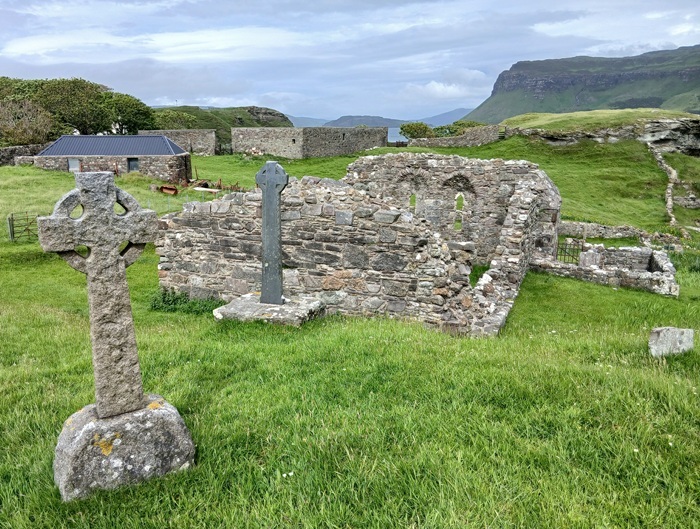
The remains of the chapel on Inch Kenneth.
* Inch Kenneth: Scotland: Our book club spent a really lovely week on Inch Kenneth, an island off of Mull on the west coast of Scotland. We are four couples, though we did (very much) miss Margaret. Though we were there for our 100th book – The Sisters: The Saga of the Mitford Family – we were all affected by the history and spiritual aura of the island.
The Mitfords owned the island for about three decades in the middle of last century before selling it to the Barlow family. Martin Barlow and his wife Colleen McLaughlin Barlow now own the island, along with Martin’s sister.
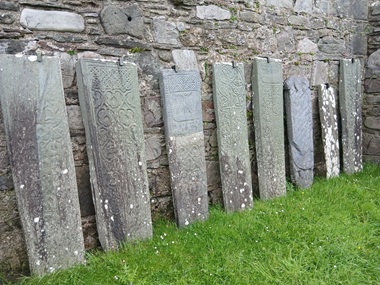
Gravestones in the chapel.
Colleen sent me this brief write-up on the island:
Inch Kenneth is named after Columba’s best friend, Cainech or Coinneach, anglicized to ‘Kenneth.’ Both Columba and Kenneth along with others – probably Pictish converts – had about seven monasteries dotted around the region.
They discovered that Inch Kenneth was the most fertile of all the islands and so it became the breadbox – all the grains, flax for linen, barley, etc. were grown on the island to fuel the monasteries.
There was a nunnery on Inch Kenneth and from 795 – 986 the Vikings repeatedly pillaged Iona [the well known spiritual retreat can be seen from Inch Kenneth] for its riches like manuscripts, silver, carvings, etc. and also attacked the nuns.
By 1000, the Vikings were Christianised. But those early monasteries of Columba in the region flourished between 567 and 795 without any attacks. There is at least one Viking burial on Inch Kenneth; they found a hoard there in 1820.
We had hoped to visit Iona, but the weather was a bit rough on the day we planned to go. No problem though; there was more than enough to absorb us on Inch Kenneth.
* London, England: The day before I came home was a Sunday, and I managed to attend a morning service at St. Luke’s Anglican Church (part of Holy Trinity Brompton), evensong at St. Paul’s Cathedral and an organ recital at St. Margaret’s Church at Westminster Abbey. These were punctuated by stops at the British Museum, Westminster Bridge and Trafalgar Square. Then back to my Earl’s Court hostel and next day out to Heathrow on the Piccadilly Line.