

The major new St. Paul’s Hospital project in the Downtown Eastside will be completed in 2027, but in the meantime the legitimacy of its conduct and even its access to public funding are being challenged.
An important case regarding religious freedom and access to health care began in the Supreme Court of British Columbia Monday (January 12) – but you may need to read judiciously to get an even-handed sense of what is going on.
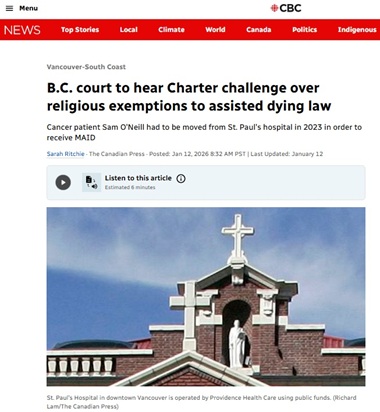
A Canadian Press article by Sarah Ritchie which appeared both on CTV News and CBC News offered considerable commentary from several people who initiated the case, or agreed with them – but virtually nothing, and no interviews, from St. Paul’s, the Catholic church, their supporters or the province.
Here is a portion of the CTV/CBC article:
A trial set to begin Monday in British Columbia’s Supreme Court questions whether publicly funded faith-based hospitals should be allowed to prevent patients from receiving medical assistance in dying in their facilities.
The Charter of Rights challenge is being brought by the advocacy organization Dying With Dignity Canada and the parents of a woman who was forced to leave a Vancouver hospital to receive medical assistance in dying, known as MAiD.
 Sam O’Neill was 34 years old when, in March 2023, she was admitted to Vancouver’s St. Paul’s hospital with severe pain as a result of Stage 4 cervical cancer that had spread to her bones and lungs.
She had been assessed and approved for medical assistance in dying – but because the hospital is run by a Catholic organization that does not allow MAiD, she had to be moved to another facility to carry out the procedure.
In court documents, her family and friends say O’Neill was in intolerable pain in her final hours and did not want to move from her room. She had to be fully sedated and did not regain consciousness before her death.
The statement of claim argues the transfer “caused and exacerbated Ms. O’Neill’s egregious physical and psychological suffering and denied her a dignified death, including the ability to say goodbye to her family and loved ones.”
Dying With Dignity Canada CEO Helen Long said the group will argue that hospitals – unlike individual health-care providers – “don’t have conscience rights.”
The article also quoted Daphne Gilbert, a law professor at the University of Ottawa – and vice chair of the board at Dying With Dignity Canada – at length.
The case, Gaye O’Neill et al. v. His Majesty the King in Right of the Province of British Columbia, Vancouver Coastal Health Authority, and Providence Health Care Society, is scheduled to run from January 12 to February 6 at BC Supreme Court in downtown Vancouver.
The co-defendants in the case are the Providence Health Care Society (the Catholic denominational authority that operates St. Paul’s and many other facilities), B.C. Ministry of Health and Vancouver Coastal Health Authority (VCH).
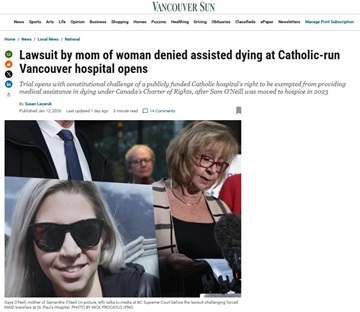 It is possible that CBC and CTV will improve their coverage of the case, and Susan Lazaruk did a better job for the Vancouver Sun on the first day of the trial, giving a fair amount of space to the province’s lawyer Alison Brown.
She wrote, for example:
Brown also said the province’s evidence will include the history of the religion-based providers’ exemption and said it hasn’t deferred to them, but has struck a balance to ensure those providers and the health authority will ensure patient access.
“What B.C. has stopped short of doing is pushing faith-based institutions past a red line and into an irreconcilable conflict with their core mission and values,” Brown said.
In the meantime I would also suggest reading The B.C. Catholic and other reliable sources. Following is a lengthy portion of The B.C. Catholic’s January 12 article on the case:
Central to the defence is a 1995 Master Agreement between the B.C. government and denominational health providers. The agreement formally recognizes the right of faith-based facilities to preserve the spiritual nature of the facility and governs how services incompatible with a facility’s religious identity are handled, typically through transfer rather than on-site provision.
Supporters of the current system argue that this pluralistic model protects the diversity of care available to British Columbians.
The Canadian Conference of Catholic Bishops in 2023 released a statement reiterating its opposition to euthanasia in Catholic hospitals. Vancouver Archbishop J. Michael Miller noted that the bishops had already drawn a line in the sand at their September plenary meeting when they stated unanimously that MAID would not be delivered at Catholic hospitals.
The new statement formalized that stance by saying the bishops “unanimously and unequivocally oppose the performance of either euthanasia or assisted suicide (MAiD) within health organizations with a Catholic identity.”
The case has drawn a large number of interveners, reflecting its potential national impact on the future of denominational health care in Canada.
The Christian Legal Fellowship (CLF) will argue for the protection of associational religious freedom, suggesting that institutions, like individuals, possess a right to collective conscience. CLF has said that forcing a religious community to act against its foundational beliefs has dehumanizing consequences and undermines the purpose for which such institutions exist.
The Canadian Physicians for Life and the Evangelical Fellowship of Canada are expected to focus on the sanctity of life and the integrity of the medical profession, arguing that a health-care system that mandates the ending of life within all its facilities risks failing to protect the most vulnerable.
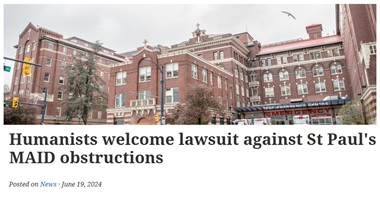 Conversely, the B.C. Humanist Association has called for the provincial government to “tear up” the 1995 Master Agreement, arguing that it undermines the government’s duty of religious neutrality. “No one should suffer needlessly at the end of life,” said executive director Ian Bushfield, adding that the state should not put the interests of religious institutions ahead of individual rights.
The Canadian Civil Liberties Association (CCLA), also intervening, plans to challenge whether a publicly funded organization can claim standalone religious protections independent of its staff. The CCLA will argue that ascribing religious rights to an institution whose primary purpose is health delivery poses inevitable difficulties for state neutrality.
The Delta Hospice Society (DHS) has introduced a distinct legal argument, suggesting that section 7 of the Charter, which protects the right to life, liberty, and security of the person, should protect a patient’s right to access a MAiD-free environment.
“There are many terminally ill palliative care patients who desire to spend their final days without being asked if they want their life ended by their health-care provider,” said constitutional lawyer Allison Pejovic, representing the Society. DHS argues that for many patients, a space free of euthanasia is a requirement for psychological security of the person.
The trial comes as construction continues on the new $2.18 billion St. Paul’s Hospital at the Station Street site. The B.C. government has indicated it remains committed to the project’s Catholic identity, despite the ongoing litigation.
A Catholic mission
 Archbishop Richard Smith, who took on his leadership role last May, made a clear statement last fall about the significance of St. Paul’s Hospital as a Catholic institution, following a tour of the new complex being built in the Downtown Eastside.
Here is a portion of the September 4 article by Nicholas Elbers in The B.C. Catholic:
Archbishop Smith described the chapel as another visible sign of the hospital’s Catholic mission. “It’s a great reminder of who we are and why we do what we do.”
Catholic health care carries forward the healing ministry of Jesus, the Archbishop said. The chapel not only reminds staff and patients of that mission, but its prominent placement near the hospital entrance is “a testament to the faith that inspires everything we are doing here,” he said.
“You see right away who we are. You see this is our identity. This is why we do what we do.” . . .
“When I think of the mission of Providence Health Care as it’s transferred from archbishop to archbishop – 130 years later we are still here serving the people of Vancouver.” . . .
For Archbishop Smith, the innovations are important, but they all point back to the same foundation: a ministry of care rooted in Christ’s healing mission.
Smith recently made some more pointed comments.
‘Deaf to the call of life’
Late last year, at the Archbishop’s Annual Mass for Life at Holy Rosary Cathedral, Smith said, “Much of Western society has become “deaf to the word of life spoken not only by the Church but also by science.”
An article in The B.C. Catholic noted:
Jesus came to mankind “for the life of the world, not its death,” he said. “God’s will is life, and we are drawn into fidelity with that will when we unite ourselves to Christ’s own self-offering through the Mass.”
The Archbishop prayed that hearts everywhere “will be touched by the mercy and love of God” and transformed into “joyful and effective witnesses to the dignity of every human life.”
After Mass, young Catholics shared their perspectives on reverence for life.
“As youth, we are the generation shaping the future,” said Isabella Comuzzi, a Grade 11 student at St. Thomas More Collegiate in Burnaby. “If we don’t stand up for life, for basic human dignity, and for love, who will?”
“Reverence for life is often portrayed as controversial,” she said. “It’s criticized by mainstream media, misunderstood by the public, and definitely not considered cool.”
Being pro-life “doesn’t help you fit in, gain popularity, or avoid judgment. In fact, it often does the opposite.”