

Jonathan Anderson is Eugene and Jan Peterson Associate Professor of Theology and the Arts at Regent College.
Jonathan Anderson leads the Christianity and the Arts concentration at Regent College – but his new book is making an impact well beyond the school.
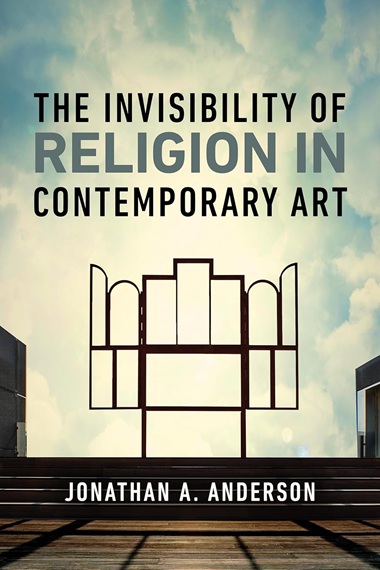
A book launch for The Invisibility of Religion in Contemporary Art (University of Notre Dame Press, 2025) will be held at Regent next Tuesday (October 7).
Following is the beginning of an article composed of lightly revised excerpts from the introduction of the book, posted on the new Regent Vine site
The canonical histories of modern and contemporary art have been written largely without serious consideration of religion.
This does not mean that religion has been absent or irrelevant. Indeed, once one begins looking for it, one finds religious references, concepts and influences woven throughout these histories.
But for various reasons these references, concepts and influences became hermeneutically inaccessible in the dominant discourses about art made in the past 170 years or so. This creates a strange situation:
 Even as religious traditions have shaped many major twentieth and twenty-first century artists and artworks (and the sociocultural contexts in which they are received and circulated), when one turns to the art-historical scholarship about these periods, one finds religion playing little or no constructive role in the writing about these artists and artworks.
This situation has been shifting in recent years. Since the turn of the twenty-first century, there has been a marked increase in attention to religion and spirituality in contemporary art, among artists and scholars alike.
This attention tends to be dispersed across radically different interpretive priorities and vocabularies, often lacking a sustained interdisciplinary discourse that holds up well both as scholarship of art and as scholarship of religion.
An especially strong secularization theory within the scholarship of twentieth century art has obstructed vital understandings of modern and contemporary art histories, and it is also still subtly governing current inquiries into religion and spirituality in those histories.
The Invisibility of Religion in Contemporary Art is a study of this situation and an adjustment to it, offering a detailed rethinking of the historical and theoretical contexts in which the current discourses of religion and spirituality in contemporary art are operating, and an argument for why and how these discourses require more concentrated critical study of the (often implicit) theologies in play in the history, theory, and criticism of contemporary art.
Twentieth and twenty-first century art is deeply enwoven with religious contexts, spiritual concerns, and theological conceptualities, but these various threads remain extremely underinterpreted in the scholarship of modern and contemporary art – to the extent that they are often functionally invisible in this scholarship.
My aim is to understand and revise the ways these dynamics of (in)visibility work.

The Regent Vine: “Contemporary art helps us, without words, to understand the world theologically.”
Go here for the full article, which covers ‘The strangeness of religion in contemporary art’ and ‘Religion, theology and the writing of art history.’
Critical reception of the book has been very positive, with James Elkins, E.C. Chadbourne Professor of Art History, Theory and Criticism, School of the Art Institute of Chicago, for example, writing:
An entirely brilliant book on an intensely difficult subject. The Invisibility of Religion in Contemporary Art is not just for artists, art historians, critics, curators and theologians: it’s for anyone who wants to see what a well-informed, calm, patient, humble, circumspect voice can do with a subject that seems so fraught, so entrenched.
Or Matthew Milliner’s comments in the introduction to an interview with Anderson in Comment:
I expect his new book, The Invisibility of Religion in Contemporary Art, to be the definitive overview of the ways that contemporary art and theology intersect. . . . To adapt the famous remark about Karl Barth’s Epistle to the Romans, I’d call Jonathan’s book a bombshell on the playground of the art historians and art critics.
Go here for other comments and for links to interviews.
I expect October 7 to be a special night (7 – 8:30 pm) at Regent College Chapel and hope there will be a full house to learn more about his important book. One can also connect online via rgnt.net/live.