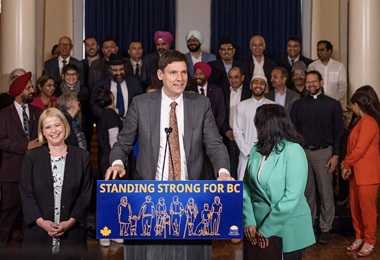
BC Premier David Eby has wide support from faith groups for his proposed legislation to protect places of public worship. Image: David Eby’s Facebook page.
Premier David Eby proposed legislation March 9 that would ban disruptive conduct around places of worship.
He was joined by representatives of the major religions, but has already heard opposition from civil liberties groups and the BC Humanists.
An ‘explanatory note’ on the site of the proposed Bill 13, the Safe Access to Places of Public Worship Act, states:
This Bill protects access to places of public worship by providing for the establishment of access zones around places of public worship and prohibiting conduct in those zones that impedes access, disrupts activities at the place of public worship or causes concern for a person’s physical or mental safety.
The bill is modelled on earlier laws protecting schools and abortion clinics.
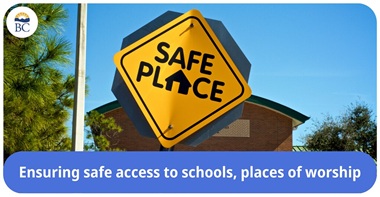 A March 9 release on the BC Gov News site links the protection of schools and religious spaces:
Students, educators and people attending faith services will soon see stronger protections that help ensure public spaces remain safe and respectful, with proposed laws extending safe‑access zones at schools and establishing new ones at places of worship.
“The ability for kids to learn and the ability for everyone to pray without harassment or intimidation is fundamental to who we are as Canadians and British Columbians,” said Premier David Eby.
“Unfortunately, in recent years, we’ve seen people targeting places of worship and schools with threatening and coercive behaviour. These new protections will help ensure people can attend school and gather in prayer and celebration in peace.”
Government intends to table Bill 12, the safe access to schools amendment act, and Bill 13, the safe access to places of public worship act (SAPPWA). If passed, Bill 12 would extend 2024’s Safe Access to Schools Act (SASA) to ensure students, staff, parents and caregivers continue to access learning environments without obstruction.
SAPPWA would create similar protections for people accessing places of worship, such as mosques, temples, gurdwaras, synagogues and churches.
“Children should be able to get to school, and people should be able to visit their place of worship, without facing intimidation,” said Niki Sharma, Attorney General. “These laws would help ensure students, educators and faith communities can access these spaces feeling safe, respected and welcome.”
Following the statement are positive comments by several religious leaders, including Andrew Rosenblatt, rabbi, Congregation Schara Tzedeck, who said:
We thank the B.C. government for introducing this legislation. This is but one of many needed measures to give the Jewish community the confidence to gather safely in places of worship.
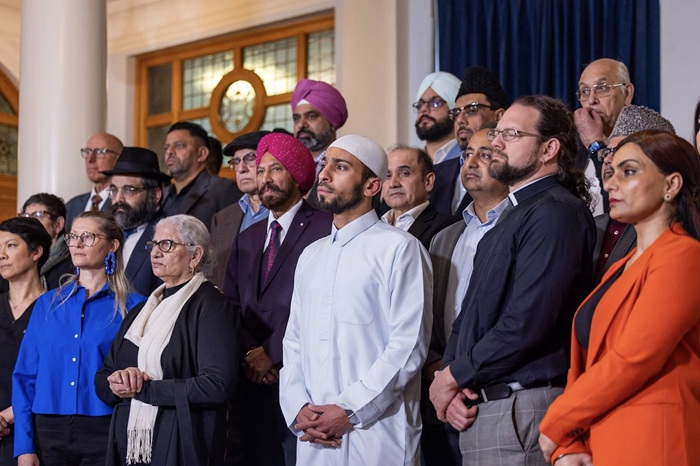
Leaders from the Jewish, Muslim, Hindu, Sikh and Christian communities stood with David Eby. Image: David Eby’s Facebook page.
Also supporting protection for places of worship and schools are:
- Rev. Dan Chambers, co-lead minister, St. Andrew’s-Wesley, Vancouver;
- Hardip Singh Sahota, treasurer, Khalsa Diwan Society Vancouver and Victoria;
- Ebrahim Abdelmaqsoud, imam, Victoria Masjid;
- Dr. Preeti Misra, secretary, Hindu Temple Burnaby;
- Tracy Loffler, president, British Columbia School Trustees Association;
- Kendra Mann, president of the BC Confederation of Parent Advisory Councils;
- Carole Gordon, president, BC Teachers’ Federation;
- Mark Pearmain, superintendent / CEO, Surrey Schools.
The B.C. Catholic pointed out in a March 11 article that “The proposal follows an open letter sent to Eby in April 2024 by religious and cultural leaders, including Archbishop J. Michael Miller, asking the province to extend safety protections to places of worship and community institutions.”
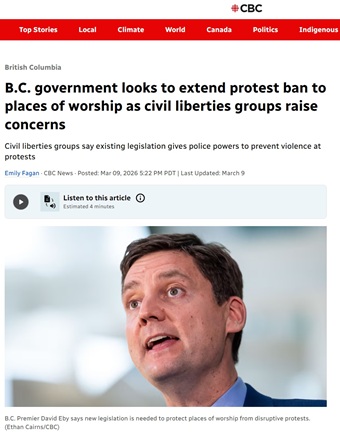 A March 9 CBC News article stated:
B.C. is looking to limit how close disruptive protests can be to places of worship amid concerns from religious leaders, and aims to extend a similar policy that bans protests outside of schools.
If passed, the new legislation would allow places of worship to post signs establishing an access zone that extends to 20 metres of their property line, within which actions that block access, disrupt or “could reasonably be expected to cause concern for a person’s mental or physical safety” are not allowed.
Premier David Eby says the NDP government is introducing this “bubble zone” legislation in response to concerns from religious leaders about violence and vandalism, as well as recent shootings at synagogues in Ontario. . . .
He was joined by BC’s Attorney General Niki Sharma, who said “faith leaders from across the province have shared stories with her of community members being blocked or intimidated away from attending services or events, and religious events that have been drowned out by loud music from protesters.”
“People don’t feel safe to enter because of these disruptions,” she said.
The article quoted representatives of the Canadian Civil Liberties Association and the BC Civil Liberties Association as opposing the ban.
BC Civil Liberties reflected comments in the article by Vibert Jack, litigation director for the B.C. Civil Liberties Association, in a March 11 tweet:
Implementing bubble zones limits peaceful protests and our right to freedom of expression. In a time when having our voice heard is harder than ever, protecting our right to speak out is critical to democracy.
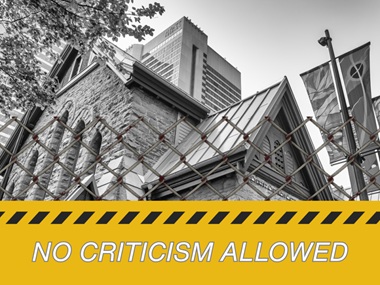
The BC Humanist Association opposes Bill 13.
The BC Humanist Association issued a statement March 11 opposing Bill 13. A more succinct version, encouraging supporters to contact their MLAs, reads:
Bill 13 threatens your fundamental Charter rights to freedom of expression and peaceful assembly.
While framed as protecting access to faith services, this bill creates 20-metre ‘bubble zones’ that prohibit dissent and silence critics of religious institutions.
Why This Matters
The bills broad definitions ban even efforts to ‘persuade’ someone not to enter a building, while the government wants to give itself the power to rewrite the law.
This means protests against MAGA rallies, Palestine real estate seminars and foreign government events can be shielded from protest and public accountability by hosting them at a place of worship.
Freedom of Religion Includes the Right to Criticize
True religious freedom includes the right to dissent. Empowering religious institutions to call the cops on their critics undermines the very freedoms the Government claims to protect. Public sidewalks belong to the public, not to the organizations that happen to be next to them.
Neither statement suggests that the legislation related to schools or abortion clinics ought to be repealed.
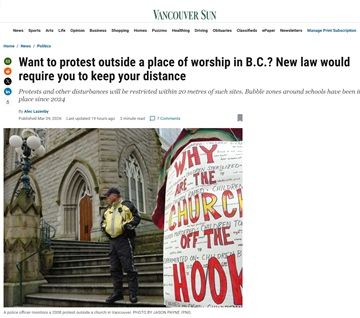 The Vancouver Sun also covered the situation, noting:
Police will be able to ticket people who contravene the legislation or, in extreme cases, arrest them without a warrant for impeding access, disrupting activities or doing anything to “intimidate or attempt to intimidate a person or otherwise do or say anything that could reasonably be expected to cause concern for a person’s physical or mental safety.” . . .
“Regardless of your faith, regardless of how you pray, there’s a fundamental requirement here in the province under our government, that everybody be able to pray and worship as they wish, and to do so without harassment and intimidation.”
Synagogues and mosques have reported increased threats in the 2½ years since Hamas attacked Israel on October 7, 2023 and the subsequent invasion of Gaza by the Israel military. Christians, Hindus and Sikhs have also reported an increase in threats and protests.
The proposed legislation extends protection already offered to schools following protests related to sexual orientation and gender identity (SOGI) teaching in 2024. The bubble zones outside schools have now been extended to 2028 and protection for places of worship will continue until 2030.
The provincial government release also described how the act would work, what behaviour is prohibited and what qualifies a location as a public place of worship:
- How the safe access to places of public worship act would work
The safe access to places of public worship act (SAPPWA) is a response to a rising trend of vandalism and other harmful behaviours targeting religious buildings and disrupting access. If the legislation is passed, it would allow for the creation of clearly defined access zones around places of public worship and would prohibit certain harmful behaviours in those zones.
If protestors engage in specified harmful behaviour within an access zone, officials at the place of worship would, under this proposed legislation, be able to call police to intervene. Police would then be empowered to make warrantless arrests and issue violation tickets. In addition, the legislation would allow the place of worship, the attorney general and others to apply for an injunction in Supreme Court to remove a protest.
Individuals would still be permitted to gather outside a place of worship to exercise their right to freedom of expression, peaceful assembly and association, as long as the activities do not amount to intimidation or interfere with access to the place of worship.
Places of worship that want these protections would be required to put up signage to notify that the access zone is in effect and that certain behaviours are prohibited. This will ensure the public has clear notice of where restrictions apply. In most cases, these access zones would include the building itself, the property on which it sits and a 20-metre buffer zone around the perimeter. Safe access zones would be limited in size and apply only if the place of worship chooses to erect the required sign.
- What behaviour is prohibited
Under this proposed law, protections would be focused on targeting harmful and disruptive behaviours, such as:
-
- using objects to barricade or obstruct access
- using one’s body to physically impede access
- disrupting activities like prayers or meetings occurring at the place of worship
- intimidating or threatening people trying to access the place of worship
- attempting to persuade people not to visit the place of worship
- What makes a place of worship eligible under Bill 13
The proposed legislation lays out which places are covered, based on property-tax exemptions that have been used in other existing statutes like the Community Charter, the Vancouver Charter and the Taxation (Rural Area) Act to define what qualifies as a ‘public place of worship.’