
-
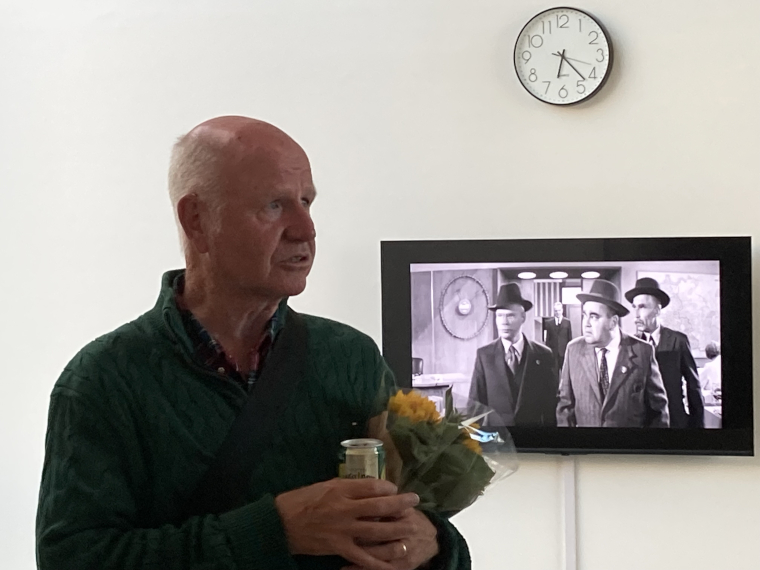
Ron Reed at the opening reception for Numbering Our Days: Time at the Movies.
Numbering Our Days: Time at the Movies (September 16 to November 7, Dal Schindell Gallery at Regent College; see below for Gallery open days / hours)
We live inside a clock. Our lives are measured by the movements of the Earth and Moon, by the rhythms of days, weeks, months, seasons and years. We see and feel the evidence of the passage of time in our bodies and in all of life around us.
We have invented devices to keep track of time from sun dials and calendars to atomic clocks, and methods to divide time into ever smaller units from hours to the split second. We engage in timely rituals. We exist in time and everything we do and experience happens in time.
Time is experienced both as points as well as the intervals between those points. Because we exist in time we experience surprise, anticipation, regret, hope, lament, longing, loss. How we love is affected by time. Time is both linear and cyclical. There is both repetition and uniqueness.
We observe anniversaries, engage in annual celebrations, yet experience the inexorable passage of time as it slips away. We also yearn for something that transcends time.
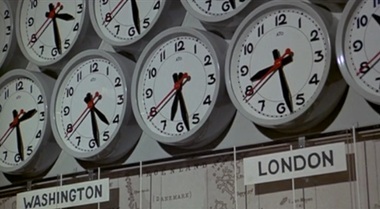
An image from The Day of the Jackal in the TimePiece montage.
Numbering Our Days is a work of art, greater than the sum of its many parts – the thousands of film-clips that make up the montages in this remarkable installation which explores the experience of existing in time.
All art exists in time, is experienced in time. This is most obvious in music, dance, story-telling and theatre. But it also takes time to look at a framed painting hanging on a wall or a sculpture standing in a garden. The art form which reflects our being in time back to us, more than any other, is cinema.
In movies we see clocks and calendars; we read dates in newspapers; we hear characters refer to times as they plan and remember, announce and decide, celebrate and lament. The medium of cinema is even actually geared to the passage of time – initially as “frames per second.”
Like all good art, Numbering Our Days helps us to bring to mind, to bring into focus, what has become all too familiar and therefore more or less invisible or opaque. That makes this installation worthy of our attention.
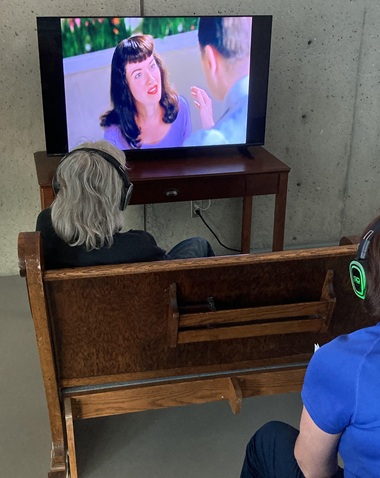
Watching the Cinema Chapel montage.
Numbering Our Days consists of several movie montages, short clips skillfully and mindfully assembled, which allow us to reflect on the experience of being in time in all its manifestations.
In one montage, the focus is on clock-time, a tribute to Chris Marclay’s The Clock, which played a role in inspiring Ron Reed’s efforts in creating these projects.Another, Date Movie, takes the viewer through the year, one month each hour. In other words, it takes 12 hours to see the whole montage.
One way to see and appreciate Date Movie is to imagine the screen clips as fragments (a sampling) of the human story. As we ride our spinning planet around the sun, we live and spin our stories – our hopes and dreams, our celebrations and dramas. If you ease your mind into a kind of soft focus, what passes before you on the screen becomes a kaleidoscopic glimpse into that human story which is also your story.
There is also a shorter Cinema Chapel, which shows people in prayer – prayer being one way in which we seek to transcend time or a way in which we remind ourselves that we do indeed exist in time, that we are mortal. One montage shows audiences reacting to movies, displaying many of the expressions mentioned above: surprise, anticipation, longing and so on. There is more; with good art there is always more to explore, more to discover.
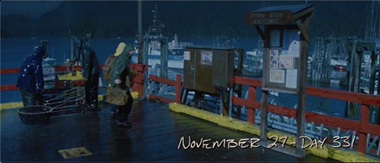
An image from The Big Year in Date Movie.
The phrase ‘numbering our days’ expresses both our tendency and ability to measure and keep track of time by using numbers (on clocks and calendars and in our vocabulary) as well as the truth that there is always more to time and to our experience of time which cannot be captured through numbers.
It will, of course, take time to truly appreciate this installation. I intend to visit the gallery more than once in order to experience as much as possible of these meditations on time in cinema. I urge you to make time, to take time, to spend time, to delve into the experience of this remarkable and unique work of art and allow it to work on you.
The Dal Schindell Gallery is upstairs at Regent College, 5800 University Boulevard (corner of University Boulevard and Wesbrook Mall) on the UBC campus.
Gallery Hours: Monday to Thursday, 9 am – 8 pm; Friday, 9 am – 6 pm; Saturday, 10 am – 4 pm.
Ron Reed will offer an Artist’s Talk October 2, 7:30 – 9 pm in the Regent College Chapel.
Following is the comment on the Dal Schindell site, including Ron Reed’s artist statement and a brief overview of his life’s work.
Featuring a series of meticulously constructed video artworks, Ron Reed’s Numbering Our Days: Time at the Movies is a playful but powerful meditation on how cinema shapes our sense of being in time. Assembled from thousands of clips from feature films, Ron’s works reprocess the temporality of cinema through unexpected ordering principles – dates, times of day, an endless sequence of staircases, etc. – in ways that make conspicuous not only the medium of film but the time of the lives we’re living.
Artist statement
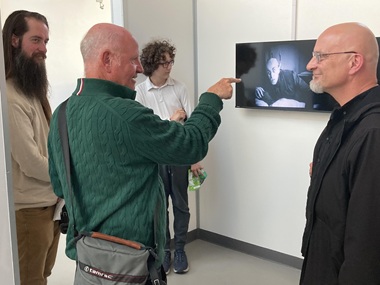
Ron Reed discussing his work with guests.
“[It is] the mission of art to rescue the world from transience and corruption, to capture moments and events in time and space before they slip into the irretrievable past, and so bear witness to the hand of God in creation.” – Steven D. Greydanus on André Bazin
This video installation is the culmination of a project begun on June 6, 2004. It is an act of oblation that offers up the overwhelming multiplicity of human experiences in seven film montages, considering time and eternity through the lens of world cinema.
The 12-hour Date Movie moves day by day through the 12 months of the year, celebrating the array of human experience in more than 3,500 film clips. TimePiece compresses 24 hours of clock time into 60 minutes, a tribute to Christian Marclay’s celebrated work The Clock(2010), while the Cinema Chapel contemplates our never-ending conversation with God as portrayed in movie prayers spoken and silent, whether devout, desperate or profane.
Other works in this exhibition celebrate the movies themselves. Marquee presents a history of cinema through theatre marquees. Screens / Watchers Deconstruction watches people watching movies, dislocated from time and sequence. Studio Credits gives credit where credit is due, in chronological order. And the Endless Staircase offers a vertiginous moving picture of humans ascending and descending in an infinite cinematic pilgrimage.
For Dal Schindell and Loren Wilkinson
About the artist
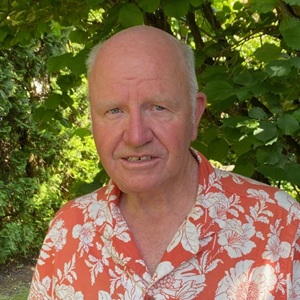
Ron Reed
Ron Reed is an actor, playwright, and director based in Vancouver. He graduated from Regent College and holds an MFA (Acting) from the California Institute of the Arts. In 1984, Ron founded the Pacific Theatre in Vancouver, where he served as Artistic Director until becoming a freelance artist in 2021.
Ron taught acting at Trinity Western University from 1988 to 2010, and he has taught or co-taught numerous courses at Regent College, including Christian Imagination and the Vocation of the Artist seminar, as well as summer school sessions at the Oregon Shakespeare Festival.
Ron wrote film criticism for the online edition of Christianity Today and the regular ‘Arts Seen’ column for Vancouver’s Christian Info newspaper. Current projects include performances of his one-man play The Top Ten Thousand of All Time and the podcast Soul Food Ghost Light, a late-night pirate radio show.