
Version 1.0.0
When asked about tips for child-rearing (as we are, from time to time, when people hear that we have five children and 12 grandchildren), I sometimes say that we had just two rules – that everyone should treat each other respectfully and that each child must read at least half an hour each day from parent-approved books.
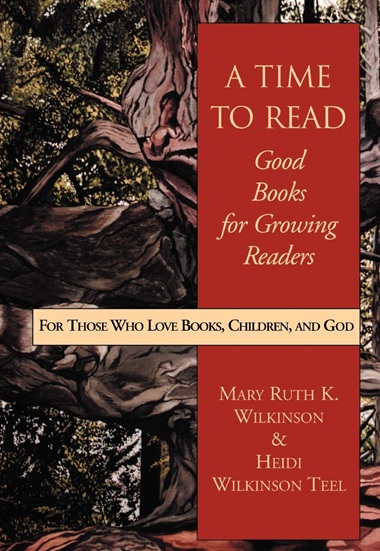
One of our main sources of inspiration, when the children were young, was a valuable book called A Time to Read: Good Books for Growing Readers, by Mary Ruth Wilkinson and her daughter Heidi. They combined a guide to children’s books with “essays on the nature of children, families, literature and story.”
So it was a pleasant surprise when I noticed that the Regent Vine had just posted a comment by Mary Ruth which, as the title makes clear, expresses some of her views on ‘Children, Books and Being Human.’
Thank you for the further insights, Mary Ruth. Maybe we can incorporate them as we interact with our grandchildren. In the meantime, we have shared your book so widely over the years that we’re not quite sure where it is right now.
Following are portions of the comment, Go to the Regent Vine site for the full piece.
If we whole-heartedly accept that radical and, to our society, unconscionable claim of Jesus, “I am the Way, the Truth and the Life,” where do we begin some ‘course correction’ in our lives?
Where better than at two of our most significant beginnings: with stories and with children? Stories are one of the oldest tools of human speech. Children, as we nurture and guide them in the way they ought to go (Proverbs 22:6), are beginning their growth into the fullness of their own unique ‘being.’
The focus on children is probably the most obvious place to start. Most of us have heard some form of the adage, “Give us a child till she’s seven, and we’ll have her for life” – attributed in varying forms to Aristotle, Ignatius and Francis Xavier.
That adage probably contains more truth than we usually ascribe to it. Child psychologists agree that the early years, especially from birth to five, are the most important in the development of a child. Those are the years during which nurturing parents set patterns of deep, empathic and loving relationships.
In a Christian home, these will include a relationship to the God of relationships, whose very identity is described relationally – “God is love” (1 John 4:8). We and our children need stories that will foster a loving relationship with people, with creation, and with God.
We need stories that, as Elizabeth Goudge says, “must be everywhere . . . twisting together, penetrating existence.” Stories are, she goes on to say, where “every action and every thought is a tiny thread to mar or enrich that tremendously tapestried story that man weaves on the loom that God has set up.”
Alasdair MacIntyre tells us in his book After Virtue:
It is through hearing stories about wicked stepmothers, lost children, good but misguided kings, wolves that suckle twin boys, youngest sons who receive no inheritance but must make their own way in the world . . . that children learn or mis-learn both what a child and what a parent is, what the cast of characters may be in the drama in which they have been born and what the ways of the world are.
Deprive children of stories and you leave them unscripted, anxious stutterers in their actions as in their words.
Of course, nurturing people in relationships that are both quotidian and cosmic shouldn’t stop at age five or seven (or even 75!); the pattern keeps being lived and therefore taught as long as we and our children are alive – and on to our children’s children.
As Neil Postman puts it in his book The Disappearance of Childhood, “Children are the living messages we send to a time we will not see.”
If children are messages we send to the future, stories encapsulate and demonstrate the messages we want to give to our children.
As Eugene Peterson puts it in The Message, Jesus was always telling stories; that was his teaching method (Matthew 13:34–35, 53; 22:1; Mark 12:1). One of the stories told about Jesus, appearing in three of the four gospels, is his strong defence of the importance of children: “Don’t push these children away. Don’t ever get between them and me. These children are at the very center of life in the kingdom” (Mark 10:14–16 MSG; see also Matthew 19:14–15; Luke 18:16–17).
And all of Jesus’s stories are concerned with the effects of human action – especially those seemingly insignificant “small things with great love,” as Mother Teresa might put it. The stories Jesus told were tethered firmly to the ‘earth’ of daily life: stories of lost coins, unequal pay, the biggering of barns to hold more and more (an older equivalent of offshore accounts) and the costly gift of a poor person’s last pennies.
His audience had an advantage over most of us; they and their ancestors had been listening to stories for centuries. . . .
But we concerned parents rarely follow the storytelling method of Jesus. We do a disservice to stories and to our children when we try to explain what we see as the message of a story in an effort to make sure they ‘get it.’
We impose on them our interpretation of the story, which is a way of politicizing it with our own particular understanding of the heart of the story. We take away from children their chance to explore the story with wonder, delight, and a gradual awakening of understanding, geared to their age and stage of development.
(As Robertson Davies is often quoted as saying, “A truly great [story] should be read in youth, again in maturity, and once more in old age.”)
The child may well ask questions, but the desire for explanation, if it comes from the child’s own exploration, should not be used as a rationale for flooding that search with the whole range of dos and don’ts that we adults may want to convey.
If a child is not ready, the child may well reject it all. The effect of a story derives from its hints and clues, its tantalizing of the imagination. Jesus, and George MacDonald, as we will see, understood the value of story for the imagination. . . .
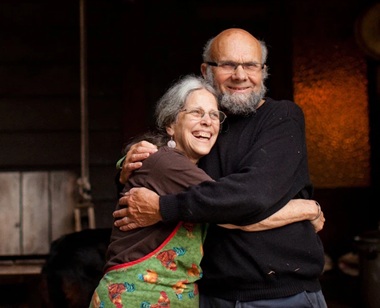
Mary Ruth and Loren Wilkinson, from the Regent College site.
Mary Ruth has been married to Loren Wilkinson, Regent College professor emeritus, since 1965. They joined the faculty at Regent College in 1981. For many years she taught a popular course called ‘Books, Children and God.’
In 1988 they moved to a community-owned farm on Galiano Island. From their home on Galiano she and Loren have organized and taught together Wilderness, Technology and Creation (the ‘Boat Course’); Food: Creation, Community, Communion; and Gardening the City of God.
They have written together the book Caring for Creation in Your Own Backyard. Loren and Mary Ruth have two grown children, three grandchildren, and a great-grandchild.
Regent College announced the Loren and Mary Ruth Wilkinson Chair of Interdisciplinary Studies this spring.
This full comment was posted on the Regent Vine June 10; it originally appeared in the Spring 2018 issue of CRUX (Vol. 54, No. 1).