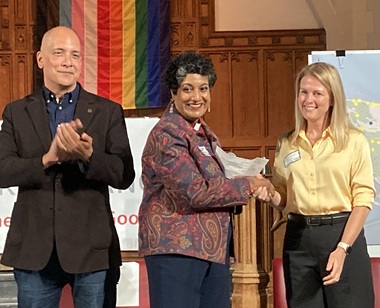
MVA representative Rev. Aneeta Saroop shaking hands with Rebecca Bligh, confirming her commitment to remove barriers to housing development on faith land. Saroop had just done the same with Pete Fry.
Premier David Eby’s announcement of a provincial election has directed attention away from the municipal elections to be held October 17.
But that didn’t prevent more than 300 people from attending the Metro Vancouver Alliance (MVA) Municipal Election Assembly at St. Andrew’s-Wesley Church September 23.
Four of the five main mayoral candidates in Vancouver took part in the gathering:
- Pete Fry, Green Party of Vancouver
- Colleen Hardwick, TEAM for a Livable Vancouver
- Kareem Allam, Vancouver Liberals
- Rebecca Bligh, Vote Vancouver
Mayor Ken Sim of ABC Vancouver declined to participate. His absence was highlighted throughout the evening by an empty chair with his name on it.
Those who came expecting a debate would have been disappointed, but the feeling in the room was far from negative. In fact, there was a remarkable amount of agreement and recognition of common ground.
That good will, no doubt, resulted from the serious preparation undertaken by the MVA team.
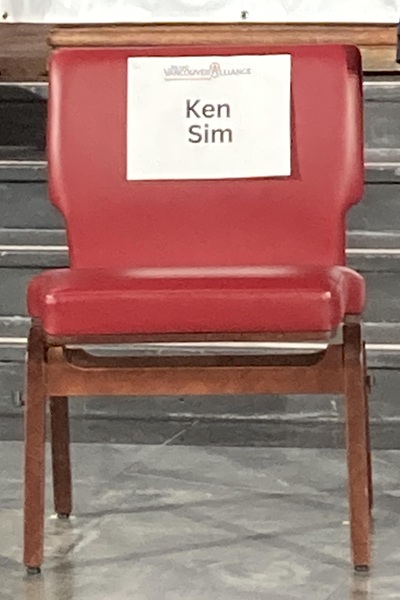
Ken Sim’s absence was noted.
All the candidates had met with MVA representative before the Assembly and had had time to look over their proposals. They knew they were there to present a short reflection – and then to respond to those proposals and make a commitment before a large crowd of witnesses.
Following brief introductions by representatives of MVA organizations and several ‘member testimonials’ (relating to a number of issues, including housing, unsafe traffic conditions in the Downtown Eastside, youth unemployment and climate issues) the four candidates each made brief statements.
None critiqued the others – they’d been asked not to – but Ken Sim did not escape unscathed. In fact, Pete Fry described the mayor and council as “unspeakably cruel” for some of their policies.
All were positive about MVA, with Rebecca Bligh saying it was not her first MVA meeting and commending the movement for the way it connects people.
Five questions
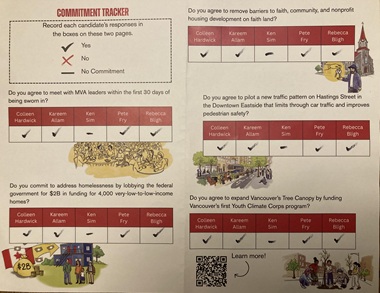
The MVA ‘Commitment Tracker’ records the candidates’ answers.
The evening was designed to do more than allow the candidates to expound on their various platforms.
Over the past year the MVA has gathered participants from its member groups to respond to specific issues:
We’ve invited mayoral candidates to make clear, public commitments on four concrete proposals that address deeply affordable housing and climate – the concerns our members are experiencing in their communities.
MVA sought these five commitments from each candidate:
- Do you agree to meet with MVA leaders within the first 30 days of being sworn in?
- Do you commit to address homelessness by lobbying the federal government for $2B in funding for 4,000 very-low-to-low-income homes?
- Do you agree to remove barriers to faith, community and nonprofit housing development on faith land?
- Do you agree to pilot a new traffic pattern on Hastings Street in the Downtown Eastside that limits through traffic and improves pedestrian safety?
- Do you agree to expand Vancouver’s tree canopy by funding Vancouver’s first Youth Climate Corps program?
Candidate commitments
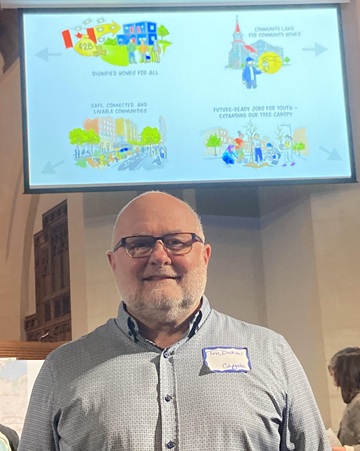
Tim Dickau is particularly keen on the removal of barriers for faith-based housing.
All four candidates were clearly supportive of MVA and its goals. They all agreed to all five questions.
The closest any came to disagreement was when Colleen Hardwick responded to the ‘traffic pattern’ question by saying she agrees “in principle, yes.” Following right after her, Kareem Allam said “enthusiastically yes.”
For each of the five questions, an MVA representative asked the candidates in turn whether they would commit to it – and then had them shake hands to underline that commitment.
Tim Dickau, co-chair of MVA’s housing research action team, said of the Assembly:
The Metro Vancouver Alliance’s 25-plus organizations, including many churches, garnered commitments from four mayoralty candidates on our campaign to remove barriers for faith-based housing.
This is a huge step forward for churches who want to develop their land for community benefit.
I hope that people will support those candidates who declared their support for this campaign. This evening’s gathering showcases the value of Metro Vancouver Alliance and the power of broad based organizing.
What is MVA?
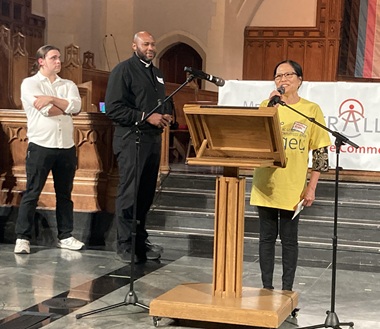
MVA members introduced their organizations.
Metro Vancouver Alliance is a unique network – not a Christian organization, but it does involve many Christian groups:
MVA is a grassroots coalition of community, faith, labour and nonprofit organizations. MVA develops community leaders and brings organizations together across differences to take collective action on issues affecting their members and communities.
Through listening, research, relationship-building and public action, the Alliance works to achieve practical, systemic change and strengthen the role of organized civil society in public life.
More than one-third of the member organization are denominations, churches or ministries, including CityGate Vancouver, the Anglican Diocese of New Westminster Justice and Peace Unit (the Diocese is a Sponsoring Organization), The Presbytery of Westminster (Presbyterian Church of Canada), Spirit of Life Lutheran Church and St. Joseph the Worker Catholic Church.
Other members include unions such as BC General Employees’ Union and CUPE Metro Vancouver District Council, along with Jewish, youth, housing, environmental and transit groups’

Follow-up
There are many commentators on the civic elections – and do keep an eye on Metro Vancouver Alliance – but here are some other sites and articles I have found helpful thus far:
- CityHallWatch
CityHallWatch , which describes itself as nonpartisan, is tireless in providing background articles and information on civic elections, as they have been doing since 2011.
Go to their 2026 civic election page for all kinds of links – to the candidates / parties websites, to many ‘Getting to Know the Parties’ articles and much more.
Thus far they have profiled four of the five main candidates; I will include brief portions of their comments, which are quite extensive:
- Rebecca Bligh & Vote Vancouver:
Vote Vancouver describes itself as centrist and pragmatic, with an emphasis on evidence, fiscal responsibility, practical solutions and rebuilding trust at City Hall. Its policy document is considerably more detailed than those of some of the other parties we have profiled, covering housing, transportation, public services, education, community safety, arts and culture, parks and economic development.
At the same time, Rebecca Bligh brings an unusually substantial municipal record for the leader of a new party, having served on Council since 2018. That experience gives voters considerably more information to work with than they would have with a completely new political candidate, but it also means that Vote Vancouver’s campaign promises can be compared directly with Bligh’s record of decisions at City Hall.
Go here for the full article.
- Kareem Allam & Vancouver Liberals:
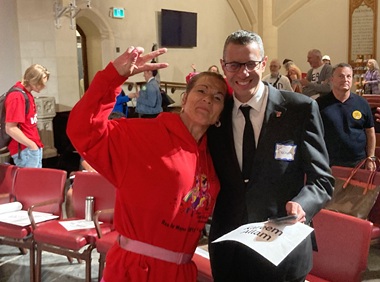
Kareem Allam with Rollergirl, a keen participant in municipal politics.
The party is new, but its founder is not new to Vancouver politics. Allam was the campaign manager who helped lead Ken Sim and ABC Vancouver to their sweeping 2022 election victory and subsequently became Sim’s chief of staff. He is now seeking to defeat the mayor he helped elect.
That history makes the Vancouver Liberals particularly interesting to examine. What exactly does this new party represent? How different is Allam from the political organization he once helped lead? And does his considerable experience in political strategy and public affairs provide the kind of executive and elected-government experience required to lead a city with billion dollar budgets and thousands of employees?
Go here for the full article.
- Pete Fry & Vancouver Greens
The Greens have built their reputation around environmental protection, social justice, sustainable communities and grassroots democracy. They have also had a significant presence at City Hall for more than a decade. That history gives voters a substantial record by which to evaluate the Greens and their incumbent candidate in 2026.
The party’s mayoral candidate, Pete Fry, has served on Vancouver City Council since 2018, including the entire 2022 – 2026 term. His record includes important work on renter protections, transparency and accountability, but also support for several major development and planning decisions that have generated significant public controversy.
Go here for the full article.
- Ken Sim & ABC Vancouver
Ken Sim did not take part in the MVA Assembly.
ABC Vancouver was founded in 2021 and swept to victory in the 2022 municipal election, electing Mayor Ken Sim, seven City Councillors, a majority of the Park Board and representatives to the School Board.
Because ABC has held a governing majority throughout this Council term, it has largely determined the City’s priorities, policies and direction over the past four years. Unlike opposition parties, ABC’s record is measured not only by its promises, but also by the decisions it has made while governing.
Supporters credit ABC with accelerating housing approvals, reducing permitting times, prioritizing public safety, strengthening relationships with senior governments and pursuing a more business-oriented approach to municipal government.
Critics argue the term has been marked by diminished public consultation, increasing centralization of decision-making within the Mayor’s Office, inconsistent policy positions, a series of governance controversies and an increasing lack of transparency.
Go here for the full article.
No doubt CityHallWatch will soon include Colleen Hardwick & TEAM for a Livable Vancouver
2. Articles
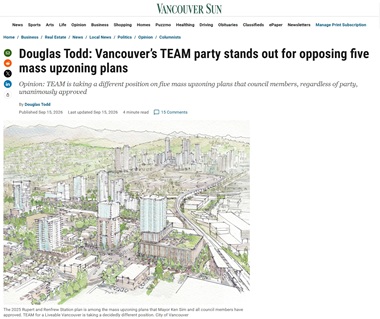 In the meantime, the Vancouver Sun has posted a couple of interesting articles about TEAM. I will include brief excerpts here:
- Douglas Todd: ‘Vancouver’s TEAM party stands out for opposing five mass upzoning plans’
TEAM is taking a decidedly different position to five mass upzoning plans that Mayor Ken Sim and all council members, regardless of party, unanimously approved in the past four years.
To begin, TEAM, which is putting forward former councillor Colleen Hardwick for mayor, has announced it will repeal the updated Broadway plan, which has led to more than 150 mostly tower projects being slated for 500 city blocks.
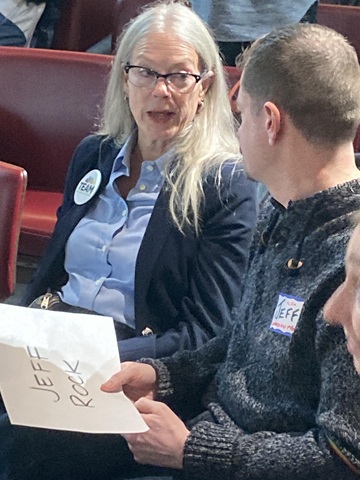
Colleen Hardwick is the TEAM candidate for mayor.
Saying such strategies mostly drive up land prices and don’t provide affordable housing, TEAM would also repeal the 2025 Jericho plan, which gave the green light to 60 residential buildings, mostly highrises, on Indigenous-owned land in Point Grey.
In addition, TEAM would reverse the 2025 Rupert and Renfrew Station area plan, which upzoned 200 city blocks, mostly quiet side streets in northeast Vancouver, for apartment blocks up to eight storeys.
TEAM would also repeal the citywide Vancouver plan of 2022 and the 2026 Vancouver official development plan, the latter a 30-year blueprint to boost population density, including by prohibiting public hearings on many proposed residential developments.
Go here for the full article.
- David Ley: ‘Voting at Vancouver city council: a puzzle, a vexing puzzle’
[W]hat is puzzling to Vancouver residents is that on significant housing and development issues, the outstanding legacy of this council, government and opposition have coalesced into a single voting bloc. When we examine city hall voting on development issues, including the most important, the Broadway plan (2022), the Vancouver plan (2022) and the current official development plan (2026), the progressive councillors have been absorbed into ABC’s priorities.
Among Vancouver’s municipal parties, only TEAM for a Livable Vancouver has consistently opposed these plans, calling for gentle development, and plan review and replacement.
Go here for the full article.
3. First United
First United Church has not only provided a list of the 2026 Vancouver municipal elections events, but it has described “what we’re mobilizing for.” They urge their supporters to attend those events and ask questions, particularly on these issues:
- Zoning and housing
- Harm reduction and saving lives
They are endorsing:
- Housing access
- public washrooms
Go here for a fuller description of their approach.
4. ARPA Canada
ARPA Canada posted an article earlier this year on ‘Why local politics are important.’ Here is a brief excerpt:
While local cities and towns, municipalities and districts, hamlets and villages don’t make criminal law or dictate health or education policy, local mayors and counsellors are increasingly forbidding speech that articulates biblical principles. And ARPA (with our Let Kids Be and We Need A Law campaigns) is increasingly embroiled in legal disputes with local governments over these restrictions on freedom of speech.
Go here for the full article