
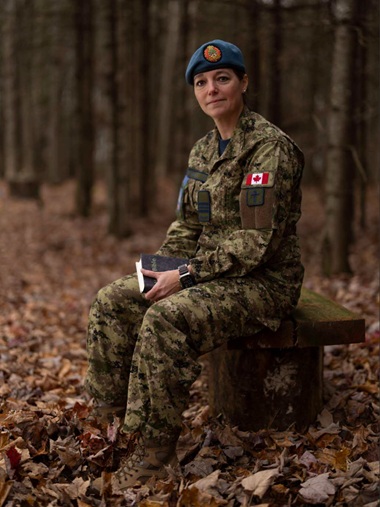
“Chaplains in the Canadian Armed Forces serve as a vital source of care, guidance and resilience.” (CAF Facebook)
Military chaplains are free to be as spiritual as they like in public, as long as they don’t make specific references to God.
A July 29 Canadian Armed Forces (CAF) post on the Government of Canada site stated: ‘This instruction is respected by Department of National Defence (DND) employees engaged by the CAF to provide spiritual or religious services to CAF members.”
‘Military Personnel Instructions on Spiritual Reflections in Military Settings’ continued:
Spiritual reflections (réflexions spirituelles)
In military settings, spiritual reflections are inclusive public addresses to a group of individuals that nurture resilience by fostering meaning, purpose and spiritual well-being, especially within a culture of care and service.
Note 1 – Spiritual reflections do not use religious specific language, including references to God, etc. They reflect upon lessons learned, beliefs, values and experiences to inspire gratitude, remembrance, hope and integrity. These principles are grounded in a respect for freedom of conscience and religious expression, while upholding the dignity and value of diverse spiritual traditions.
Note 2 – It is recognized that one can be spiritual or engage in spiritual reflection without being religious.
This statement is included under ‘Context’:
Under subsection 2(a) of the Charter of Rights and Freedoms (‘Charter’), CAF members have freedom of religion. This includes the freedom to have no religious belief whatsoever. In addition, the CAF has a duty of religious neutrality. It cannot favour certain beliefs to the exclusion of others. Th CAF must uphold and respect the Charter rights of our members and members of the public by maintaining religious and spiritual neutrality in the exercise of our public duties.
The instructions cover a wide range of events:
4.3 This policy applies to events or military parades, such as, but not limited to:
-
- graduation parades
- change of command ceremonies
- ship commissioning
- ribbon-cuttings / dedications for infrastructure projects
- honours and awards ceremonies
- festive / seasonal or mess dinners
- other military institutional commemorations (for example, Remembrance Day, Battle of Britain, Battle of the Atlantic)
Widespread reaction
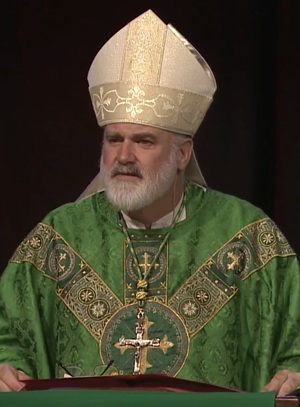
Bishop Scott McCaig
An August 18 statement on the Canadian Conference of Catholic Bishops (CCCB) site objects to the new policy:
Bishop [of the Military Ordinariate of Canada] Scott McCaig states that, for many people, “meaning, purpose and spiritual wellbeing” cannot be separated from God. He argues that the new policy requires precisely such a separation and therefore conflicts with the Charter’s protection of the fundamental freedoms of conscience and religion.
The CCCB stands in solidarity with Bishop McCaig as he raises these concerns on behalf of the Catholic faithful entrusted to his pastoral care. The Conference is studying the new policy and will continue to follow its implementation, particularly with regard to its implications for freedom of conscience and religion and for the place of religious expression within the Canadian Armed Forces.
At this early stage, the CCCB encourages the faithful and all people of goodwill to become informed about these developments and to pray for the CAF, its members, chaplains and families, as well as for Bishop McCaig in his pastoral ministry to Canada’s Catholic military community.
The Evangelical Fellowship of Canada released a statement July 31 which began:
The EFC is deeply concerned over a new national policy that forbids military chaplains from not only praying, but from using words, actions or symbols tied to a specific religious or faith tradition or making any reference to God or the divine in public spiritual reflections.
“This policy goes beyond banning prayer and prohibits even the acknowledgment to those gathered that some may believe in the divine and others not,” said Bruce Clemenger, Senior Ambassador and President Emeritus of the EFC, and member of the Interfaith Committee for Canadian Military Chaplaincy.
“This exclusion restricts the spiritual reflection of chaplains to a secularist and characteristically humanist expression.”
An article by Jerry Pierce on the Decision site (of the Billy Graham Evangelistic Association) quoted several critics, who “chastised the military for relegating meaningful religious speech to private worship spaces and diminishing the unique role of military chaplains.” An August 12 article in Christianity Today is titled ‘Canadian Military Chaplains Can’t Mention God in Public.’
Local reaction
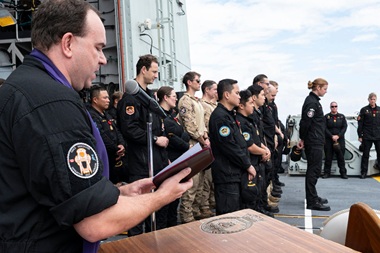
Chaplains in the Canadian Armed Forces. (CAF Facebook)
Jack Taylor wrote an August 16 article for Light Magazine in which he quoted BC-based chaplains:
A Vancouver based chaplain with the Forces says that “with our government increasingly focused on equality and inclusion, Chaplaincy is becoming another area of the CAF under renovation.
I entered the Chaplaincy knowing that I would be called to care for all members, regardless of their religious beliefs or background. That responsibility I gladly embraced. What I did not anticipate was the continual movement toward removing Christian traditions and expressions from military life.” . . .
The Vancouver based Chaplain says, “I have heard from many members of my unit, both Christian and non-Christian, who are frustrated by some of these changes. Chaplain prayers are not simply Christian expressions; in many cases, they are also deeply rooted in naval and military tradition. For generations, chaplains have prayed before and after meals, and certain prayers have accompanied significant occasions such as the Battle of the Atlantic commemorations and Change of Command ceremonies. Many members, regardless of their personal faith, have valued these traditions.
“Beyond the removal of prayers and references to God from military ceremonies, there have also been discussions about removing faith identifiers from chaplains’ uniforms. If implemented, this could mean that I would no longer be permitted to wear the cross that visibly identifies me as a follower and representative of Christ.” . . .
The Vancouver based chaplain concludes this way. “My approach to military chaplaincy has always been shaped by Daniel’s example in Babylon. Daniel faithfully served under King Nebuchadnezzar in a government that did not worship the true God. He served with excellence, respected those in authority and faithfully carried out his responsibilities. At the same time, he never compromised his convictions or his devotion to the Lord.
“I continue to meet regularly with sailors in my unit who are asking some of life’s biggest questions. Some are Christians with whom I have the privilege of praying and reading Scripture. Others are exploring faith for the first time. Some simply need someone to listen. As long as I am free to minister to people in these ways, I will continue to serve faithfully in this unique mission field.”