

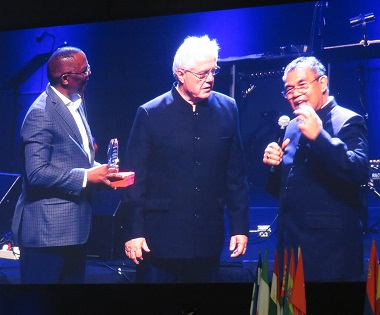
Botrus Mansour (right) was inducted as secretary general of the World Evangelical Alliance during its recent General Assembly in Seoul. WEA image
He’s from Nazareth.
In recent months, while the World Evangelical Alliance (WEA) sought a new secretary general, I bothered the search committee with a suggestion: “Go down to Bethlehem and find a David, someone no one knows, but one the Spirit has appointed.”
Smiles greeted my metaphorical reference to the Old Testament story.
Well, surprise. They didn’t go to Bethlehem but to Nazareth, where they found an Evangelical who is a Palestinian lawyer with an Israeli passport. His name is Botrus Mansour.
His induction as secretary general took place at a massive Presbyterian church in Seoul in late October. While leaders from scores of countries looked on, this unknown lawyer calmly and bravely shouldered the task of leading the largest global network of Evangelicals, made up of 165 national alliances, millions of congregations, and untold agencies and ministries.
Evangelicals are a curious lot. We have nothing equivalent to the Vatican; instead, our organizational structures are horizontal. We have many denominations, but most authority is located in churches, congregations, agencies, and ministries. When someone decides that something needs to be done, or that a church needs to be planted, up pops a ministry, an agency, or an NGO, (non-governmental organization) on its own initiative.
It is fair to say we are entrepreneurial. People don’t wait for instruction to plant a church or create a ministry; they do it, often mixing church styles to fit their community, theology, or the younger generation’s style or musical preference. Thus, you might attend a Presbyterian church service, and it sounds as if you’re in a Pentecostal church.
Changes of style and reshaping of organizational and worship patterns are taking place as the Evangelical movement grows. In Western countries, the widespread assumption is that Christian affiliation and church attendance are dropping like a stone worldwide; however, the opposite is true.
Today, of the world’s 2.5 billion Christians, a quarter are evangelicals. In 1960, there were an estimated 90 million evangelicals worldwide; today that number is closer to 650 million. In the midst of this rapid growth, independent, self-generating ministries and the multiplying of smaller denominations and organizations keep moving forward.
Recall that the evangelical alliance in the 1800s began in the wake of an uprising to dismantle slavery as a pillar of Western society. This movement had a very prominent leader in the Parliament, William Wilberforce. Church leaders wanted to set aside denominational identity, find fellowship around a biblical theology, press governments to respond to persecution of Christians, and undo child labour with a vision rooted in a conscious presence of the Spirit, fostering unity in Christ.
Today, evangelicals tend to be driven outward by a centrifugal force of ideas; personalities drive agendas, churches are planted, and agencies are created independently, leading to a growing sense of disunity. WEA’s motto commits it to offset this outward push, with the hope that a centripetal counterforce, underscored by prayer and strategic initiatives, will generate growing unity.
Which brings me back to Nazareth. As we celebrate the 2,000th year since the death and resurrection of Jesus, I suggest we ask ourselves again how we might respond to Jesus’ prayer in John 17 that we be one, this at a time we’ve elected a Nazareth-born Palestinian Christian with Israeli citizenship to lead.
May we listen to Botrus Mansour, this chosen leader from Nazareth, as he leads us in both celebration and commitment to a unity that was born and bred in his backyard.
Brian Stiller has been centrally involved with the World Evangelical Alliance for many years, including at the Seoul gathering. Here he is pictured at the last (2019) General Assembly in Jakarta, Indonesia, with Goodwill Shana and Efraim Tendero, both of whom have served as general secretary of the WEA.
Since July 1, 2011, Brian Stiller has served as Global Ambassador for the World Evangelical Alliance, a global alliance which serves some 600 million evangelical Christians.
He has served as Canadian president of Youth for Christ and was President of the Evangelical Fellowship of Canada, which gave him a national profile as a voice for people of biblical faith. He also served as President of Tyndale University College & Seminary.
He is founder of Canada’s national magazine, Faith Today, has written a number of books and hosts the evangelical 360° podcast.
BOTRUS MANSOUR
I’ll be very interested where the new Secretary General of the WEA, Botrus Mansour, will take its mission of ‘The Gospel for Everyone by 2033.’ It will be very interesting to see what a leader with his background brings to his work. What will he have to say to the non-Christian faiths of today?
Certainly, Jesus came for ALL. If the world could only believe that Jesus’s Gospel message was one of unconditional love for ALL – one that would indeed bring peace, justice and righteousness! I personally believe that Jesus’s ‘ALL’ included those following the non-Christian faith traditions of today as well.
Will it be possible to help existing faith traditions understand and accept this Jesus? What will it take for non-Christian faiths to accept Jesus as He is portrayed in the Gospel? How can the Jesus we believe in be shown to be an example for ALL faiths? How can those who follow Christ persuade non-Christian faiths of Jesus’s unconditional love?
I don’t think it would be hard at all.
But I find it hard to believe that Jesus would tell anyone to abandon the religious faith they have held for generations – faith that is near and dear to them, in the way the Christian faith is near and dear to Christians. Religious faith is a big part of people’s culture. It has made them who they are.
Did Jesus’s message not encourage us to accept and love all, in the way He showed us to even be accepting of the ‘Samaritan’ in our midst?
Humbly – from a person who loves and accepts the Muslim Rohingya refugees of today. A people who have no country of their own. Like Jesus, with nowhere to lay His head (Luke 9:58; Matthew 8:20). Forgotten by the world.