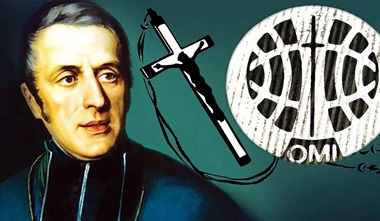
St. Eugène de Mazenod founded the Missionary Oblates of Mary Immaculate. From the OMI site.
An Anniversary Mass at St. Augustine’s Catholic Church in Kitsilano celebrated the 200th anniversary of the Oblates of Mary Immaculate (OMI) February 17 – exactly 200 years since the missionary congregation was formally approved by Pope Leo XII.
British Columbia was still a remote land when the Oblates of Mary Immaculate arrived on its coast with their mission – to evangelize the poor. That same pioneering spirit is alive and well as the Oblates follow in the footsteps of the early missionaries.
Their work is as relevant today as it was more than 150 years ago, when the first Oblates traveled to the West Coast. They journeyed from Oregon to Vancouver Island, then to the vast wilderness of mainland BC to establish native missions. . . .
- St. Augustine’s Parish;
- Holy Rosary Cathedral downtown;
- St. Paul’s Squamish Nation Church on the North Shore;
- St. Peter’s Parish in New Westminster.
Faith and reconciliation
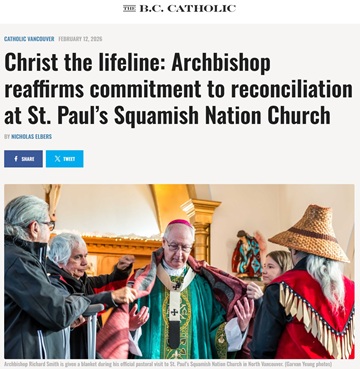 Archbishop Richard Smith visited St. Paul’s Squamish Nation Church recently to recognize its roots and reaffirm his commitment to reconciliation.
An article in The B.C. Catholic noted:
Archbishop Richard Smith drew on Indigenous imagery to speak about faith and reconciliation at St. Paul’s Squamish Nation Church in North Vancouver, telling parishioners that Christ is the weaver who binds humanity together. . . .
Archbishop Smith met with Squamish Nation elders, a meeting he personally requested. “We talked and shared stories for almost two hours,” he said.
“The non-Indigenous – our country broadly – has so much to learn from Indigenous ways, from the traditions, from the culture, from the learnings.” . . .
As he finished his homily, he reaffirmed the Archdiocese of Vancouver’s commitment to truth and reconciliation.
“I want you to know – I want the people to know – that I am committed, and the Archdiocese is committed, to that ever-closer interweaving among ourselves,” he said.
Love and dedication
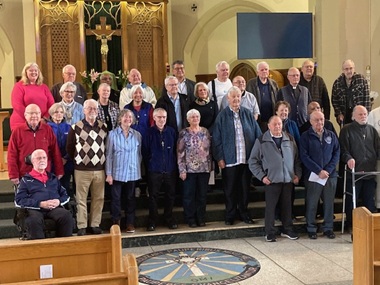
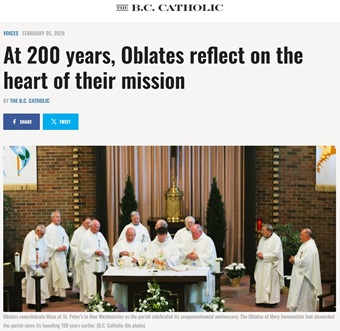
Oblate missionaries, associates and supporters took part in the February 17 Anniversary Mass at St. Augustine’s.
Fr. Kenneth Foster, former Provincial of OMI Lacombe Province, spoke at St. Augustine’s during the February 17 Anniversary Mass.
He said many of the Oblate missionaries were from Europe and were well educated. They were keen to learn, work in and translate scriptures into the local languages.
As Fr. Luis Ignacio Rois Alonso, OMI Superior General, said during a January 24 homily focused on the Oblates at St. Peter’s Church in New Westminster:
When [OMI founder] Eugène de Mazenod and his companions chose to preach the Gospel in the local dialect, they were doing more than adopting a missionary strategy.
They were placing the poor, their language and their culture before every pastoral technique. They chose to respond to the needs of the poor by becoming one with them.
This is not about doing things for the poor from offices or classrooms, even within Church structures. It is about being one with the poor and allowing them to become protagonists of the mission.
 While Foster recognized that “we might feel pain and shame” for some things in retrospect – residential schools, sometimes a lack of generosity and consistency, for example – he also pointed out that many Oblates protested the unequal treatment accorded to the Indigenous peoples.
For example, he said Oblate missionaries such as Fr. Charles Grandidier objected to the fact that individual First Nations people were only allotted 20 acres per person in reserves, while settlers received more than 10 times as much land.
The Williams Lake Indian Band decision of the Specific Claims Tribunal in 2013 included this excerpt from Grandidier’s letter of August 28, 1874, which was published in the Victoria Daily Standard newspaper.
The whites came, took land, fenced it, and little by little hemmed the Indians in their small reservations. They leased the land that they did not buy and drove the cattle of the Indians from their old pasture land.
Many of the reservations have been surveyed without their consent, and sometimes without having received notice of it, so that they would not expose their needs and their wishes. Their reservations have been repeatedly cut off smaller for the benefit of the whites, and the best and most useful part of them taken away till some tribes are corralled on a small piece of land, as at Canoe Creek or elsewhere, or even have not an inch of ground, as at Williams Lake.
The natives have protested against those spoliations, from the beginning. They have complained bitterly of that treatment, but they have not obtained any redress.
Foster added, “Let us not question the love or dedication of the Oblates to the people they had befriended.”
Four churches
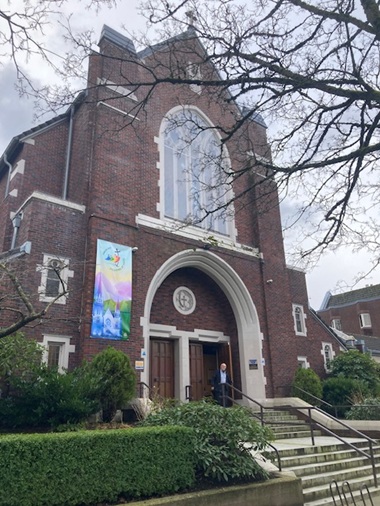
St. Augustine’s Church hosted the Anniversary Mass.
Four key local churches were created by the Oblates.
- St. Augustine’s Church
St. Augustine’s Church was founded in 1911. The current church building, modelled after a church in Bruges, Belgium, was competed in 1932.
- Holy Rosary Cathedral
Heritage BC offers some background for Holy Rosary Cathedral:
Located at 646 Richards Street, Vancouver, this historic place is valued for its association with Archbishop Augustin Dontenwill, of the Missionary Oblates of Mary Immaculate.
Dontenwill was born in France and came to the US as a child, then was educated at the college that became the University of Ottawa. He became the first archbishop of Vancouver.
The dedication of the religious order to their ministry is evident in the funding source for the construction of this church, which required a mortgage to be put against the order’s headquarters in France.
- St. Paul’s Squamish Nation Church
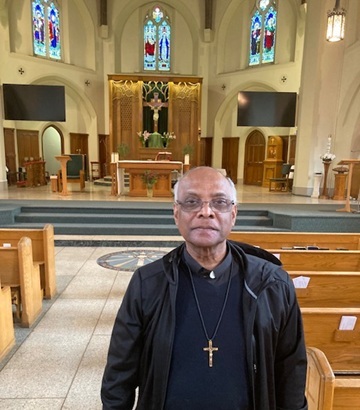
Fr. Tap Kurudeepan of St. Paul’s Squamish Nation Church, took part in the Anniversary Mass.
Heritage BC writes of St. Paul’s:
This mission reserve, established in 1864, was the first non-Indigenous permanent settlement in the area now known as North Vancouver.
The original chapel dating from the mid-1860s was replaced in 1884 by a larger frame church with a projecting front steeple. The current St. Paul’s church, which incorporates the walls of the 1884 church, was extensively remodeled and expanded with the addition of twin spires in 1909.
The church was reopened in 1910 and named St. Paul’s in memory of Father [Pierre-Paul] Durieu, the first Oblate missionary in the area.
Saint Paul’s Roman Catholic Church was designated a national historic site of Canada in 1980. It is the oldest surviving mission church in the Vancouver area that has long been a focal point of the mission reserve, and is an example of the Gothic Revival Style in Canada.
- St. Peter’s Church
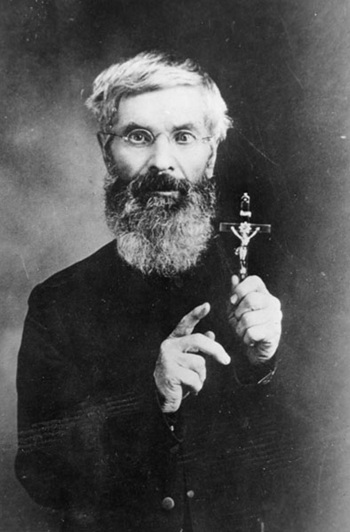
Léon Fouquet pastored the mission in New Westminster.
St. Peter’s Church is the oldest Catholic parish in the Lower Mainland, and celebrates that fact through an excellent page devoted to its history, complete with many photos related to various stages of the church’s life.
Here is a brief portion:
In 1860 the Oblates founded the mission in New Westminster which was the beginning of what would become St. Peter’s parish. New Westminster was the capital of the territory of British Columbia.
The first Oblate missionaries came from France. Later they were joined by other Oblates from Eastern Canada and Ireland. The first ‘pastor’ of the mission was Father Léon Fouquet who arrived with Father Grandidier . . . .
It seems strange to us today that there were two churches; the First Nations people needed a separate church where they could remain for days and weeks at a time as they prayed and learned together. The Oblate mission which included the two churches, was called St. Charles Mission.
From New Westminster the missionaries ministered to people in present day Hope, Mission and North Vancouver. The mission included about 5,000 First Nations people and 200 settler Catholics. It was the headquarters for the Oblates on the Mainland.
St. Casimir’s Catholic Church in east Vancouver, which still conducts the majority of its weekly services in Polish, also has Oblate roots, and the Oblate community owns an office/house in the Shaughnessy neighbourhood of Vancouver.
Residential schools
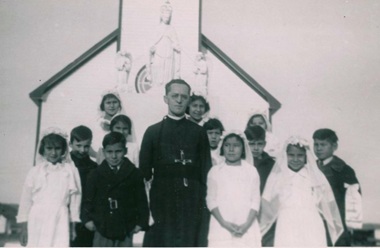
One of the images on the National Centre for Truth and Reconciliation’s ‘Oblate Priests’ page.
Heritage BC says of the Oblates:
The Missionary Oblates of Mary Immaculate came to Canada from France in 1841 to promote Christianity to Indigenous people and settlers.
While many of their contributions were celebrated in the past, they have more recently issued apologies for their role in the residential school system and for the part they played in the ‘cultural, ethnic, linguistic and religious imperialism’ towards Indigenous people.
The Oblates ran two residential schools in this area, St. Paul’s in North Vancouver and St. Mary’s in Mission.
A page devoted to the Oblate Priests on the National Centre for Truth and Reconciliation site notes, in part:
The Oblate Order played a fundamental role in Canada’s residential school system, particularly in the West and North, operating 48 of these institutions . . . Despite the close collaboration between the Oblates and the federal government in establishing these schools across Turtle Island, comprehensive record-keeping of the Order’s activities was inconsistent, complex and dispersed across many offices. As a result, locating Oblate records related to residential schools is no simple task.
For several years, the National Centre for Truth and Reconciliation (NCTR) has worked in collaboration with OMI Lacombe to acquire Oblate residential school records from various archival sources and expedite access to critical historical documents, including personnel files of Oblate members who worked in residential schools in Canada. These records are vital for families and communities as they continue their research on residential school Survivors and the children who never made it home.
 Some critics, such as Bernadette Howell, have asked why there is still confusion and whether the Oblates are “still dragging their feet with the NTRC.”
A Q&A page on the OMI Lacombe site answers several questions about residential schools, including: Did the Oblates run Indian Residential Schools?, Have the Oblates apologized?, Why have the Oblates refused to release their records? and Will the Oblates pay compensation?
On the first question:
Yes, due to the long history of Oblate presence with Indigenous peoples in Canada since their very arrival, the congregation opened and administered Indian Residential Schools across Canada.
There were four churches in Canada that historically accepted government invitations to open and administer Indian Residential Schools: Catholic, Anglican, United (Methodist) and Presbyterian churches.
Roman Catholics established over 70 of these 130 schools, and Oblates ran the majority of these schools.
Go here for the full list of questions and responses.
St. Eugène de Mazenod
The OMI site offers a biography of Eugène de Mazenod’s life; here is a portion:
Eugène began his ministry by rejecting a prestigious diocesan position to reach out to the poor, the workers, the youth, the sick and the imprisoned of Aix [Aix-en-Provence in France]. Overwhelmed by the demands and possibilities of this ministry, he soon realized that he needed to gather a group of zealous priests to work with him.
The goal: to awaken “a faith that had all but died in the hearts of so many”.
In September 1815, he experienced another “impulse from without” that set him firmly on the path of apostolic action. He gave himself body and soul to the realization of his plans to establish a society of missionaries. On January 25, 1816, the society of the Missionaries of Provence was born.
Father de Mazenod invited his companions “to live together as brothers” and “to imitate the virtues and examples of our Saviour Jesus Christ, above all through the preaching of the Word of God to the poor.” He urged them to commit themselves unreservedly to the work of the missions, binding themselves by religious vows.
Because of their small number, they initially limited their zeal to the neighboring countryside. Their fondest wish, however, was “to embrace the vast expanse of the whole earth,” as the founder had written in 1818.
Pope Leo XII on February 17, 1826 formally approved the newly founded Congregation of the Missionary Oblates of Mary Immaculate. Its motto: “He has sent me to evangelize the poor” expressed both its charism and way of life.