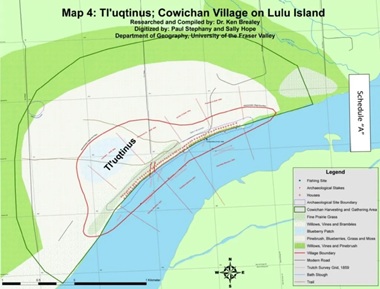
A B.C. Supreme Court judge has granted the Cowichan Nations a portion of a 1,846-acre land claim on Lulu Island.
Controversy over the Cowichan court case continues, so it is good to see that Jodi Spargur is assessing the decision in detail on her Repair Cafe Substack site.
Following is the second comment of the (currently four-part) series, with one more to come.
Welcome to Repair Cafe, where we look at reparations and theology in the Canadian context. Currently we are in a series regarding the Cowichan court decision of August 2025 which is causing huge ripple effects in the conversation about landback, Indigenous rights and right relationship.
In the series we are looking to separate fact from fiction. Today we look at the court decision itself. Next week we turn to the implications for private homes.
Backgrounder
Fun-fact: The Cowichan Nation v. Canada court case was launched in 2019 but with pre-trial elements that go back to 2017. It has been reported to be the longest running trial in Canadian history.
Case: Cowichan Title and Fishing Rights at Tl’uqtinus (Richmond, BC)
- BC Supreme Court: What this case was about
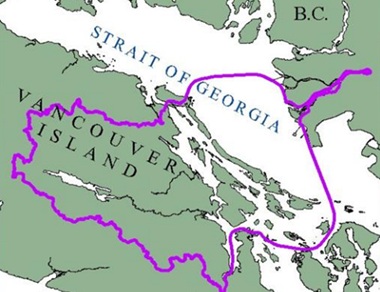
A map of ‘Core Traditional Territory’ on the Cowichan Tribes site.
The Cowichan Nations sought recognition of:
- title to their historic fishing village site Tl’uqtinus (including some surrounding and submerged lands), and
- a right to fish for food in the south (main) arm of the Fraser River.
1. What the Court decided
a. Aboriginal title was proven – to a defined portion.
The Court declared Cowichan nation (including Cowichan Tribes, Stz’uminus, Penelakut, Halalt) have Aboriginal title to part of the claim area called the “Cowichan Title Lands.”
b. Determined government actions wrongly interfered with that title.
The Court declared that historic Crown actions – including:
- Crown grants of fee simple1 interests within Cowichan Title Lands, and
- Crown vesting of certain highway lands to Richmond unjustifiably infringed on Cowichan title.
c. Government land titles were declared “defective and invalid.”
The Court declared that some specific fee simple titles and interests held by:
- Canada (certain lots, excluding the YVR Fuel Project portion), and
- the City of Richmond (Lot E and Lot K)
are defective and invalid.
d. Fishing rights were recognized.
The Court declared Cowichan descendants have an Aboriginal right to fish for food on the south/main arm of the Fraser River, protected by s. 35 of the Constitution Act, 1982.
2. Who was affected
Affected parties:
- Cowichan descendant communities: Cowichan Tribes, Stz’uminus, Penelakut, Halalt (and descendants of the historic Cowichan Nation)
- Governments: Canada and British Columbia
- Local government: City of Richmond
- Crown agents / land managers: Vancouver Fraser Port Authority (VFPA)
- Neighbouring First Nations with interests in the area: Musqueam and Tsawwassen First Nation (TFN), especially regarding fishing and overlapping interests
3. Immediate legal effects (what changes now)
a. Aboriginal title is formally confirmed (constitutional level protection).
Cowichan title is now legally recognized by the court for the Cowichan Title Lands under s. 35 of the Constitution.
b. Some government-held titles are not legally reliable in those specific areas.
Canada’s and Richmond’s fee simple interests in the specified lots are declared defective and invalid. We will look at this issue in greater detail next week.
c. Governments now have court-mandated duties to negotiate in good faith.
The Court declared:
- Canada must negotiate in good faith to reconcile its interests in the YVR Fuel Project lands with Cowichan Aboriginal title.
- BC must negotiate in good faith to reconcile:
- third-party Crown-granted fee simple interests, and
- the Crown’s vesting of highway soil/freehold to Richmond
with Cowichan Aboriginal title (honour of the Crown).
d. The fishing right for food is confirmed.
Cowichan descendants have a recognized Aboriginal food fishing right in the south arm of the Fraser River.
e. The decision requires negotiation – not immediate disruption.
The judge emphasizes that while the court has made declarations, much remains to be resolved through negotiation and reconciliation moving forward

Those are the broad strokes of the decision. Next week we will unpack some of the most pressing implications, especially, what happen to private land owners.
1 Fee simple may not be a term that is familiar to everyone but it is the concept that underlies private property. Historically, it came from the feudal system and spoke to the inherent duties of a tenant to his landlord/king. The tenant was granted the land which he could work and pass on to his descendants but he owed service to the king in times of conflict, or he owed a percentage of the food grown on his land. If someone owes no service to the one who grants them land then it is fee simple and there are no restrictions. It can be mortgaged or sold, passed on to heirs or profited from. It is worth noting that reserve land in Canada is not fee simple but is “held in trust” by the Crown.
The Repair Cafe series thus far:
- Responding to ‘Canada’s $1 Billion Question’: Addressing the fears in the Cowichan decision;
- A Three Minute Summary: What the court actually decided about Cowichan Title;
- Homeowner Fears: Exploring the myths and facts about the Cowichan decision;
- The Douglas Treaty and the Mainland???: Understanding how the Cowichan decision references a Vancouver Island treaty from 1853.
- Due February 17: “I want to suggest some ways that Settler / non-Indigenous folks can help drain the fear from this conversation.”
Jodi Spargur
Jodi Spargur is a settler of Nordic/German heritage living and working on the unceded territory of the Squamish, Musqueam and Tsleil-Waututh Peoples.
She is founder of Red Clover, which utilizes a wide network of relationships with Indigenous leaders to partner locally on the ground.
She has an MDiv from Regent College and is a PhD candidate with NAIITS, an Indigenous learning community exploring Indigenous theology and Christian ethics. Her recent book, Mend: An Invitation from Jesus to Return to Land-based Repair (New Leaf Press), grew out of her studies with NAIITS.