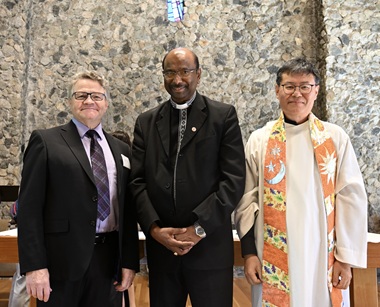
VST President Richard Topping (left), with WCC General Secretary Jerry Pillay and VST Associate Professor Hyuk Cho. Photo: Marcelo Schneider/WCC
Representatives of the World Council of Churches (WCC) met in Vancouver last week. Members of the WCC Reference Group for the Pilgrimage of Justice, Reconciliation and Unity (PJRU) gathered at the Vancouver School of Theology on the UBC campus September 17.
They continued their meetings until the 22nd, focusing both on “local processes of truth and reconciliation” and on work of the PJRU itself. They also hearkened back to the 6th Assembly of the World Council of Churches, which was held at UBC in 1983.
WCC General Secretary Rev. Prof. Dr Jerry Pillay took part in the gathering, which was sponsored by VST and the Canadian Council of Churches. He said, “WCC is one fellowship with many pilgrimages.”
During a sermon on the opening day, Pillay . . .
. . . challenged Christians to cultivate the capacity to live with difference without allowing disagreement to become division.
Drawing on Jesus’ call to love one’s neighbour and enemy, the sermon highlighted the need for people who can “hold convictions without hatred,” speak truth without cruelty and build bridges across divisions, amplifying the call to justice, compassion, humility and hope.
Rev. Karin van den Broeke, co-moderator of the WCC Pilgrimage Reference Group, said:
It is impressive to hear how theology in the Vancouver School of Theology is informed and transformed by walking with Indigenous people, and how walking together is transforming injustices done to Indigenous peoples. And this ‘walking together’ is exactly what the pilgrimage is about.
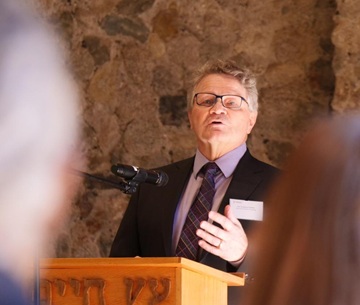
VST President Richard Topping was interviewed for the WCC site on ecumenism. Photo: Marcelo Schneider/WCC
An article on the WCC site asked Rev. Dr. Richard Topping, President and Vice Chancellor of VST, “to reflect on the nature of ecumenism at the Vancouver School of Theology, what it means to host the WCC gathering and his hopes for stronger ties with the Ecumenical Institute at Bossey [in Switzerland].”
He said:
Being an ecumenical institution means that the three main relationships – with The United Church of Canada, the Presbyterian and the Anglican churches – are not just ecumenical as a theoretical commitment but it means having regular conversations about the needs of the church and where theological education is headed.
It means listening to them as people on the ground who know what’s happening within their denomination. . . .
We see the analogies, the strengths, the opposites and what we have to offer one another in that process. For example, the Anglican Church in Canada is now in dialogue with the Mennonites of Canada.
Anglicans, United and Presbyterians – we’re used to being sort of mainline official churches. We’re all learning how to be missionaries to cultures we thought we owned. The Mennonites have a lot to teach us about how to do church without privilege, without the bulwark of culture reinforcing your place in it. . . .
It’s been a joy to have the group here at the Vancouver School of Theology. In some ways, the World Council of Churches coming to Vancouver about reconciliation is of great value to us. It kind of reminds us who we are. We were born in 1971 in the heyday of ecumenism of a certain sort that aimed more at organic kinds of ecumenism.
What we are now here is more receptive ecumenism, and this is about reconciliation, that listening to the other for what they can offer, that none of us has all the gifts, that denominations have charisms and together we bear a common witness to the gospel. I’ve come to take that quite seriously for the work that we do here – serious in a quite grateful way. We’re not in it alone.
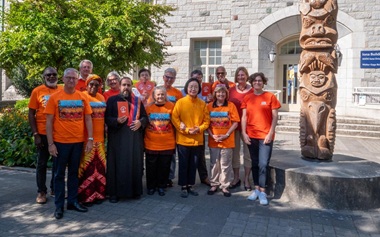
Participants of the Vancouver meeting wore orange September 22 to express solidarity to the ‘Every Child Matters’ campaign. Photo: Marcelo Schneider/WCC
Another article on the WCC site quoted van den Broeke recalling “that Vancouver was where the WCC 6th Assembly was held, and where the conciliar process of justice, peace and integrity of creation started.”
The article continued:
“This time we deepened our understanding of ‘walking together’ and of ‘companionship,’ both being at the heart of the Pilgrimage of Justice, Reconciliation and Unity,” she said.
“We experienced how, in church and at the university, gratefulness was expressed to the Indigenous peoples that took care of the un-ceded land we were meeting at, for thousands of years.”
Those gathered heard about the process of truth and reconciliation Canada went through with Indigenous peoples. “And although we realized that there is still a strong legacy of injustice, there are signs of hope,” said van den Broeke. “We met with Indigenous people, proud of their culture, open to share on their culture.”
Participants took part in a prayer walk September 20 which included stops at the Indian Residential School History and Dialogue Centre and the Reconciliation Pole. An “ecumenical collaborative document” addressing spiritual violence against Indigenous peoples in Canada was presented by the United Church of Canada.
Rev. Dr. Hyuk Cho, an Associate Professor at VST, gave a presentation to the PJRU group. He said:
As a Korean Canadian minister and teacher, I explored companionship through histories connected to the place where I live and work.
At the centre of my reflection was the Two Row Wampum Belt. I placed two local stories alongside it. The first is the friendship between Musqueam families and Chinese vegetable gardeners. The second is the life of William Scott (1886 – 1979), who responded to racism by working alongside Korean Christians during Japanese colonialism in Manchuria and beyond.
Go here for the full presentation.
6th Assembly, Vancouver 1983
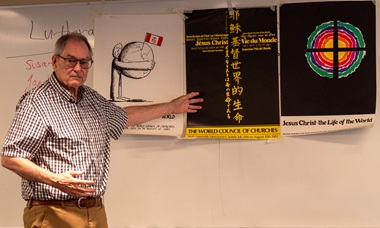
Gordon How, coordinator of the WCC 6th Assembly in Vancouver with some posters from the gathering. Photo: Marcelo Schneider/WCC
Some 4,000 people – delegates, observers, advisors and others – descended on Vancouver from around the world July 24 to August 10, 1983 for the WCC’s 6th Assembly.
As (then) General Secretary Philip Potter wrote in the preface to David Gill’s book about the assembly (Gathered for Life):
There representatives of the over 300 member churches of the World Council came together to celebrate the theme: ‘Jesus Christ: the Life of the World.’
Along with many others they deliberated on the implications of the theme, and they wrestled with the issues facing the churches of the world, arising out of the work of the Council since the 5th Assembly in Nairobi in 1975.
They grappled with the burning concerns of people around the globe where life is threatened and death reigns. And they sought to discern the tasks to be undertaken by the churches and the Council in the coming years.
Among the key issues were:
- disarmament and the nuclear threat (anti-nuclear advocate Dr. Helen Caldicott addressed the Assembly);
- greater inclusion of women (there was a space reserved only for women);
- ‘Third World’ participants argued that unity required greater justice and liberation;
- church unity (the Lima Document on Baptism, Eucharist and Ministry) was debated.
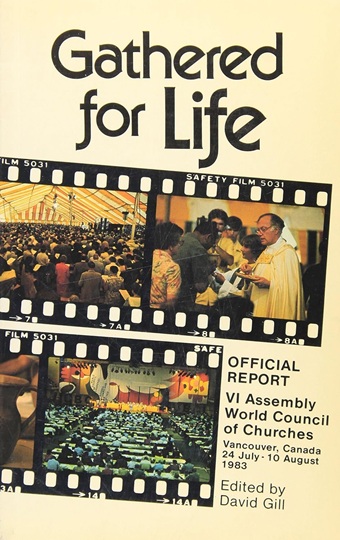 Gill wrote, as part of his personal appraisal:
What then are we to make of the Vancouver event?
The significance of the 6th Assembly lies not with its particular strengths or weaknesses, not with things that were said or decisions made.
It lies with the nuances – the deep gratitude for the Church and yearning for its unity, the hunger for peace and the hands outstretched towards all people everywhere, the rediscovery of old certainties, the taste of bread and wine, the dream of a renewed Church for a renewed world . . .
Those nuances, taken together, point to a healing of a spiritual schizophrenia that too long has run through our churches, our ecumenism, our own souls.
That midnight scene in the tent, when thousands keeping vigil for justice and peace offered their heartfelt praise to the Lord of life, said it all.
There have only been 11 assemblies since the founding of the WCC in 1948:
- Amsterdam, Netherlands, 1948
- Evanston, Illinois, United States, 1954
- New Delhi, India, 1961
- Uppsala, Sweden, 1968
- Nairobi, Kenya, 1975
- Vancouver, BC, Canada, 1983
- Canberra, Australia, 1991
- Harare, Zimbabwe, 1998
- Porto Alere, Brazil, 2006
- Busan, South Korea, 2013
- Karlsruhe, Germany, 2022
Personal reflections
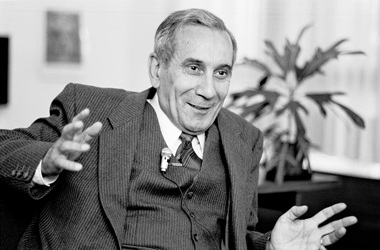
I chatted with Emilio Castro, who succeeded Philip Potter as General Secretary of the WCC.
The 6th Assembly of the World Council of Churches had quite a significant effect on me. As a fairly young Christian, and having travelled quite widely, I felt a keen interest in the global church. So when I heard it would be meeting in my hometown, I was determined to take a closer look.
I remember having been directed to the bottom floor of the old VST building to be interviewed by Rod Booth, Chair of the WCC Communicators’ Network. He seemed a little dubious, noting that I was attending a nearby evangelical church which was not affiliated with any mainline church bodies.
In fact, many of my fellow church members were outside protesting the Assembly, if I remember correctly, while I was volunteering at Ploughshares, a coffee house where peace and justice concerns were aired throughout the Assembly.
One of their main concerns, I believe, was that the WCC was turning a blind eye to persecution in the Soviet Union, in deference to their Orthodox members. Some attending the gathering shared those views.
Apart from simply playing a tiny role in a historic gathering, I retain some fond memories of specific interactions. For example:
- While critically observing some very Marxist looking materials presented by a group from India (and I had been a Marxist of sorts, so I was clear about their nature) I mentioned my concerns to a man standing nearby. He turned out to be Emilio Castro, who took over as the WCC’s fourth General Secretary when Philip Potter stepped down in 1985. He sympathized, but encouraged me to remember their colonial history and to take the long view. (He is also known for having forged stronger ties with non-WCC church bodies, particularly evangelicals.)
- Sitting back to back with Allan Boesak at the Student Union Building pub; the South African church leader made a strong impression at the Assembly and was highly regarded.
- Meeting with Ron Sider, Orlando Costas and other evangelical leaders, who gathered to create ‘Evangelicals at Vancouver: An Open Letter.’ Richard Lovelace described the evangelical experience at the Assembly in a Christianity Today article.
- Chatting with Christians from all over the world while helping out at the coffee house.
One of my sons still wears a t-shirt from the Assembly.
I have attended a number of large ecumenical gatherings since 1983, though sadly, not another WCC Assembly (I had been accepted as a media participant for Karlsruhe, but ended up not being able to go):
- World Evangelical Alliance (WEA) General Assembly, Abbotsford, 1997;
- Lausanne Forum for World Evangelization, Pattaya, Thailand, 2004;
- Third Lausanne Congress on World Evangelization, Cape Town, South Africa, 2010;
- World Evangelical Alliance General Assembly, Jakarta, Indonesia, 2019;
- Fourth Lausanne Congress on World Evangelization, Seoul-Incheon, Korea, 2024
All have shared many similar goals and aspirations for greater unity in the worldwide church, and all have been very encouraging in my faith journey. I visited both the WCC and WEA offices when I was in Switzerland this spring.