
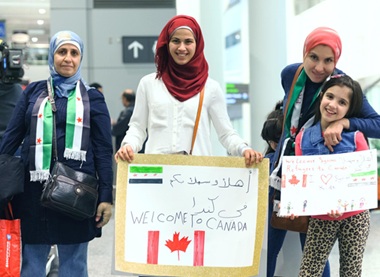
New Hope Community Services and many churches welcome refugee to Canada.
When you look at Servan managing his own tailoring business in the Valley Fair Shopping Mall on Lougheed, you might not think of him as a refugee sponsored by Ridge Church.
You might not readily label Harpreet at Subway, or Grace at Tim’s, or Anand at Home Depot or Harwinder at Ridge-Meadows hospital.
One thing is clear. God is bringing the individuals of the world to our neighbourhood and we have been gifted to welcome them.
For thousands of refugees arriving in Canada, escaping war, persecution and violence is only the beginning of a difficult journey.
Canada has a longstanding reputation for welcoming people seeking safety, yet refugees arriving today face rising housing costs, economic uncertainty, employment barriers and increasingly restrictive immigration policies.
New Hope
New Hope Community Services was started in 2004 by Faith Fellowship Baptist Church in Vancouver, along with its sister church Tabernáculo El Redentor, and was supported by the Fellowship Baptist denomination in BC.
It has set up apartment buildings in New Westminster and Surrey to provide a temporary bridge as refugees arrive – to orient and prepare them as they enter schools, workplaces, homes, churches and communities in the Lower Mainland.
They are helping churches navigate the wave of newcomers into the valley.
Refugees desire to plant roots and to make a difference in their communities. According to Immigration, Refugees and Citizenship Canada (IRCC), 74,979 refugees and protected persons became permanent residents in 2023, followed by 76,685 in 2024. These figures include people already living in Canada who received permanent residence, not just new arrivals.
British Columbia has experienced substantial refugee settlement. More than 2,700 government-assisted refugees arrived or relocated to BC in 2023. In 2025, the Immigrant Services Society of BC reported supporting 2,159 new government-assisted refugee arrivals during its reporting year.
Many more refugees were sponsored by churches who eased them into living here. Surrey remains a major settlement destination, which is why New Hope is headquartered there.
Recent refugees come from countries including Afghanistan, Syria, Sudan, Somalia and the Democratic Republic of the Congo. They flee armed conflict, political and religious persecution, ethnic violence, threats from authoritarian regimes and widespread human rights abuses. In BC’s 2023 government-assisted refugee arrivals, Afghans represented 54 percent, followed by Syrians at 18 percent.
The struggle to begin again
The greatest challenges are affordable housing, employment, language acquisition and mental health. Many refugees arrive with professional qualifications that Canadian employers do not immediately recognize. Others carry profound trauma from war, displacement and separation from family.
If we stop to reflect long enough, most of us understand the longing for belonging, the grief of loss, the desire for community, the hope for welcome and hospitality. Canada’s 2026 – 2028 Immigration Levels Plan aims to stabilize permanent immigration at 380,000 annually, with approximately 13 percent of admissions allocated to refugees and protected persons.
The government argues that immigration must better reflect housing, infrastructure and service capacity while maintaining humanitarian commitments.
Stories behind the statistics
In January 2026, Global News reported that Ukrainian mother Alina Tymoshchuk and her six sons faced homelessness in Kelowna after losing affordable accommodation. Her experience illustrated how quickly displaced families can become vulnerable even after finding safety in Canada.
CityNews Vancouver also documented refugee claimants entering homeless shelters as settlement organizations struggled with overwhelming demand.
These stories remind Canadians that successful resettlement requires more than permission to enter the country. It requires community, stability, employment and belonging.
How churches can respond
For Christian congregations, welcoming refugees is both a humanitarian opportunity and an expression of biblical faith. Leviticus 19:34 calls God’s people to love the foreigner as themselves, while Matthew 25:35 identifies hospitality toward strangers as an expression of love for Christ.
Churches can make a practical difference through five commitments:
- Provide hospitality: Welcome refugee families into homes, shared meals and community activities.
- Support housing: Assist with rental deposits, furnishings, household supplies and housing searches.
- Help with employment: Offer language conversation groups, résumé assistance, mentoring and professional connections.
- Support children and families: Provide tutoring, transportation, school supplies and friendship.
- Partner with settlement agencies: Support experienced organizations through volunteers, fundraising and coordinated sponsorship.
Refugees do not simply need charity. They need dignity, opportunity, friendship and the freedom to rebuild their lives. Churches can help turn Canada’s promise of refuge into the lived experience of belonging.
If your church is engaged in welcoming the world around you, and you need additional insight or information, there is help around the corner:
- Immigration, Refugees and Citizenship Canada (IRCC): This official federal government department manages Canada’s refugee and asylum programs.
- Canadian Council for Refugees (CCR): This is the leading national non-governmental umbrella organization dedicated to defending the rights and protection of refugees.
- UNHCR Canada (The UN Refugee Agency): As the national branch of the United Nations’ refugee agency, it works closely with the Canadian government and local organizations to facilitate resettlement.
Three of the most prominent Christian agencies doing this work in Canada are:
1. Mennonite Central Committee (MCC) Canada
- What they do: MCC signed Canada’s very first formal Private Sponsorship of Refugees agreement with Ottawa back in 1979. They have a massive national network that walks churches and community groups through the legal paperwork and the actual logistics of resettling families.
2. World Renew
- What they do: Operating as the humanitarian and disaster response arm of the Christian Reformed Church, World Renew has helped sponsor more than 11,000 refugees to rebuild their lives in Canada since 1979.
3. The Presbyterian Church in Canada (PWS&D)
- What they do: Through Presbyterian World Service & Development (PWS&D), the denomination acts as a major federal Sponsorship Agreement Holder.
Jack Taylor served as a missionary in Kenya for 18 years and as a pastor of a multicultural church in Vancouver for 23 years. He is the founder of New Hope Community Services Society and currently works as the academic coordinator between Trinity Western University and Kurumbuka Leadership Solutions in Rwanda. He is the author of 30 books and is a credentialed marriage coach (1heartcoaching.com). He has been married to Gayle for 50 years. See jackataylor.com