
 A study released March 23 considers the role and self-understanding of women in the church.
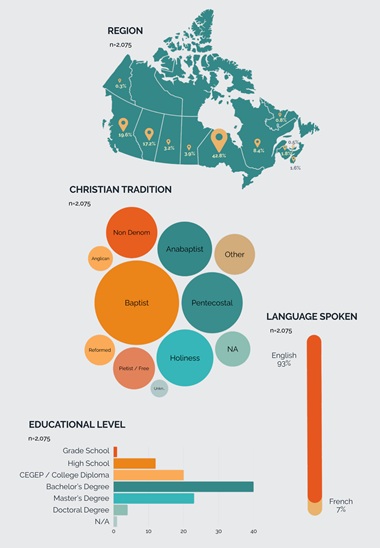
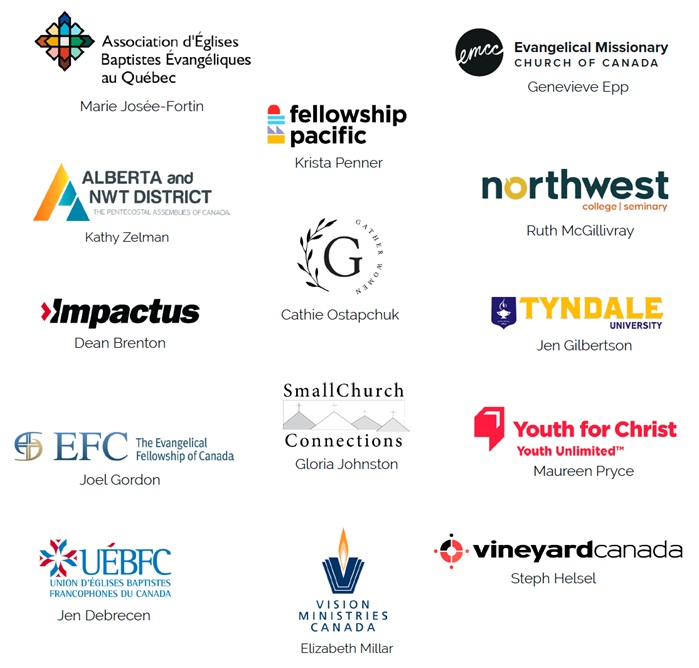
The National Study on Women in Canadian Evangelical Churches (WCEC) was prepared by a partnership of 14 organizations and denominations which surveyed 2,075 women and interviewed 49.
WCEC Research Partnership Chair Ruth McGillivray (Executive Vice President of Northwest College & Seminary in Langley) wrote the Forward for the 72-page report.
She began:
Three years ago, I set out to begin a personal research project on women in the Canadian church. My first question seemed straightforward: how many women were serving in pastoral leadership in evangelical churches across Canada?
The answer shocked me – not because the number was discouraging, but because the number didn’t exist. There was no data.
Around the same time, the organizers of a small 2022 study on the experience of Canadian Christian women approached the Evangelical Fellowship of Canada (EFC) to consider expanding that work into a national study.
EFC invited its affiliates to participate in a research consultation in August 2023 to discern a research question. By November, our research partnership had been formed, and I was honoured to be appointed its Chair.

Ruth McGillivray is Chair of the WCEC Research Partnership.
She added:
Even with more than 2,000 voices represented, participants remain a small fraction of Canada’s regular church attenders. Their experiences, while meaningful, do not speak for the whole.
It is remarkable that nearly 100 women who rarely or no longer attend church chose to participate. Many kept their faith while leaving the institution and still cared enough to share what that journey had cost them.
I grieve for those who left and said nothing. Their silence is not absence of experience. It is, perhaps, the loudest data point of all.
(It is interesting – though not in any way directly connected to this report – that Northwest College & Seminary is an agency of Fellowship Pacific, which last month removed eight of its churches following a complex set of disagreements over the issue of women in leadership and how those issues should be handled.)
Following is the Conclusion of the report:
Our guiding question asked: How do evangelical Christian women in Canada understand their roles and participate in the local church? The literature review, interviews and national survey reveal a textured portrait: women’s participation is anchored in shared evangelical convictions while shaped by diverse interpretive lenses, congregational cultures, life stage and relational dynamics.
Women consistently affirmed Scripture’s authority and expressed a strong desire to contribute to their local churches, yet the form and visibility of that contribution varied.
Theologically, the familiar labels ‘complementarian’ and ‘egalitarian’ retain some explanatory power, but definitions were often unclear and understanding varied. Furthermore, they did not reliably predict practice on the ground. Many congregations blend convictions and customs, and women themselves often locate meaning in lived experience as much as in formal positions.
In practice, gaps between stated policy and everyday practice shaped women’s sense of belonging more than labels alone. This helps explain why some women feel deeply valued in churches with offices reserved for qualified men, while others encounter obstacles in churches with egalitarian policies but constrained pathways.
Women framed their ‘role’ less as a description and more as contribution. They show up where gifts, relationships and congregational needs meet. Patterns of participation spanned caregiving and prayer to worship leadership, teaching, administration, technology, and governance.
 Pathways to participation were not always equally accessible; access was shaped by what women had seen modeled, whether leaders invited them into responsibility and whether they experienced psychological and spiritual safety.
Generationally, women described a shift from ‘behind‑the‑scenes’ to more public forms of ministry, with younger women gravitating toward platformed, tech, peer discipleship and community‑facing service. At the same time, many still carry substantial work, school and caregiving loads, which can limit capacity and shape choices.
Marital status, immigration experience and language also intersected with opportunity as women navigated honour‑shame dynamics, time pressures and community expectations.
Our analysis of the obstacles, safety and practice & policy only surface the importance of trust, confidentiality and integrity in leadership cultures. Women associated ‘safety’ less with fragility than with relational trust and the ability to ask questions, disagree or disclose vulnerability without jeopardizing belonging.
Experiences of abuse or pressure to endure harm, uneven responses to domestic violence and norms like the ‘Billy Graham Rule’ were cited as factors that sometimes constrained participation. Conversely, when leaders built transparent, trustworthy systems, participation broadened and deepened.
Finally, women who stay and women who leave often cite the same drivers in opposite directions. Teaching, doctrine and community draw many in; poor teaching, misalignment, lack of care or limited opportunities can nudge women out.
Notably, a portion of rare‑attenders retain vibrant personal faith and serve actively outside local churches, underscoring that women’s callings and contributions are larger than any single venue. For churches attentive to these signals, the pathway forward is not uniform policy but congregation‑specific discernment that aligns convictions, culture and practice.
The co-authors of the report are Lindsay Callaway and Marie-Josée Fortin. These are the partner organizations:
For more information about the WCEC research study contact:
Lindsay Callaway, Lead Researcher
EFC Centre for Research on Church and Faith
research@theEFC.ca
613.233.9868 x324
Go here for a 17-minute video, which features Lindsay Callaway introducing highlights from the report.