
Our greatest public witness may not be only what we say, but how we say it and how we treat those who disagree with us.
If you’re like me, you may be feeling overwhelmed with politics right now – especially with a provincial election coming right on the heels of municipal elections.
Yet whether we like politics or not, government decisions affect virtually every area of our lives. And as citizens and taxpayers, we have both the opportunity and responsibility to understand who is asking to represent us, what they believe and how their decisions may affect our families and communities.
The word politics can make people uncomfortable. Politics can become angry, divisive and deeply partisan. Christians themselves may disagree strongly about candidates, parties and public policies.
One of my professors at Trinity Western University, Dr. Robert N. Thompson, once served as national leader of the Social Credit Party and ran for Prime Minister in 1962, against three other national party leaders who also identified as Christians but held very different political philosophies.
All four candidates for Prime Minister – Tommy Douglas (NDP), Lester B. Pearson (Liberal), John Diefenbaker (Conservative), and Dr. Robert N. Thompson (Social Credit) – claimed to be a Christian, but they all had different worldviews. The lesson is important: simply identifying as Christian does not mean everyone will arrive at the same political conclusions. Worldview matters.
A better question, therefore, may be: How can Christians faithfully serve their neighbours and communities in the public square? Throughout Scripture, God’s people are called to seek justice, care for the vulnerable, pray for those in authority, speak truth, pursue peace and be a light in the world.
Dr. John Redekop writes in Politics: God’s Other Arena [see accompanying Around Town column] that Christian citizenship includes using our time and resources for the well-being of our neighbours and that serving in political office can itself become an opportunity to strengthen society.
Our faith should shape not only what we believe on Sunday morning, but how we treat people, exercise citizenship and contribute to the communities God has placed us in.
Several years ago, a church in Surrey invited all the federal candidates in its riding to an all-candidates meeting so its congregation could become better informed. During the discussion, one candidate stated his belief that religious freedom in Canada was secure so long as religion stayed within the walls of the church.
That raises an important question for Christians because biblical faith has never been intended to apply only inside a church building. Our faith influences how we live, work, raise our families, serve our neighbours and participate in society.
According to Statistics Canada’s 2021 Census, 1,684,870 British Columbians identified as Christian – 34.3 percent of the province’s population. Imagine the positive influence Christians could have if we intentionally brought biblical principles of truth, justice, mercy, integrity, compassion and neighbour-love into public life.
Canada itself carries a reminder of its biblical heritage. Our national motto, A Mari Usque Ad Mare – ‘From Sea to Sea – comes from Psalm 72:8: “He shall have dominion also from sea to sea.” Scripture verses are engraved everywhere into the stone and on the stained-glass windows of Parliament.
Government service is not about power; it is about authority. All authority in Canada is delegated and comes first from God . . . and in a democracy – it comes from the people.
Since it is not practical for all 41 million Canadians to go to Ottawa, we choose / elect people to represent us. That is their job – to represent the people. We must never forget that our elected representatives work for us – we do not work for them.
10 reasons to care
Here are 10 biblical and civic reasons Christians should care about public life.
1. We are called to seek the good of our communities.
When God’s people were living in Babylon, the prophet Jeremiah told them: “Seek the peace and prosperity of the city to which I have carried you . . .” (Jeremiah 29:7). Christians are not called simply to withdraw from society. We are called to contribute to the well-being of our neighbourhoods, schools, cities, provinces and country.
The decisions made by elected officials affect real people – families, children, seniors, newcomers, people with disabilities, businesses and those struggling to make ends meet. Seeking the good of our community is one practical expression of loving our neighbour.
2. Government decisions affect our neighbours.
Governments make decisions about education, health care, housing, taxation, public safety, transportation, social services, religious freedom and countless other aspects of everyday life. Elected officials decide how your money – that you and your family have paid through your taxes – will be spent. When those decisions affect our neighbours,
Christians have good reason to pay attention.
Serving your neighbour is one of the two great commandments. Jesus said: “Love your neighbour as yourself” (Mark 12:31). Political involvement does not have to be about power or partisanship, but simply another way of asking: How will this decision affect my neighbour?
3. Scripture calls us to speak for the vulnerable.
Proverbs gives us this powerful instruction: “Speak up for those who cannot speak for themselves… defend the rights of the poor and needy.” Proverbs 31:8–9 Throughout Scripture, God’s people are repeatedly reminded to care for the poor, the widow, the orphan, the stranger and those who are vulnerable.
Public policy can have profound consequences for vulnerable people – including the unborn, children, seniors, people with disabilities and those experiencing mental illness. Christians have good reason to understand the laws being proposed and to speak thoughtfully whenever human dignity and the protection of vulnerable people are at stake.
For Christians, some convictions are not simply political preferences but matters of biblical truths, such as the dignity and protection of human life; marriage as a covenantal union of a man and a woman; and our responsibility to protect children’s safety, innocence and well-being and to remind them that they are loved by God and created with dignity and purpose. Any legislation and policies that do not protect these biblical absolutes need to be challenged.
4. Christians are called to be salt and light.
Jesus told us that we are called to be “the salt of the earth . . . and the light of the world” (Matthew 5:13–14). Salt preserves. Light illuminates. Christians can bring honesty, humility, courage, compassion, civility and integrity into public conversations – whether serving on a school board, volunteering in the community, writing an elected representative, attending a council meeting, working in government or simply having a respectful conversation with a neighbour.
Being salt and light means paying attention to what is happening around us and bringing biblical truth and graciousness into the conversation.
5. We are commanded to pray for our leaders.
We need to pray for leaders we voted for – and leaders we did not vote for. The Apostle Paul wrote: “I urge . . . that petitions, prayers, intercession and thanksgiving be made for all people – for kings and all those in authority . . .” 1 Timothy 2:1–2 Christians should never allow political disagreement to become an excuse for contempt. We can disagree, advocate and hold leaders accountable while still praying for them.
6. Citizenship carries both privileges and responsibilities.
In a democracy, citizens have remarkable freedoms. We can vote, ask questions, attend public meetings, contact representatives, advocate for causes, volunteer in campaigns and even seek public office ourselves.
Those privileges also bring responsibility. Christians, like all citizens, should learn about the candidates, examine their records and stated policies, and vote according to conscience and biblical conviction.
If we do not feel called to run for office ourselves, we can encourage qualified people of integrity to consider serving. We can volunteer for them, support them and pray for them. After the election, our responsibility continues. We should encourage what is good, communicate respectfully when we disagree and hold all public officials accountable to serve with integrity.
7. Christians can help restore civility to public life.
Our political culture desperately needs people who know how to disagree without hatred. Jesus taught, “Do to others as you would have them do to you” (Luke 6:31).
Imagine applying the Golden Rule to politics: tell the truth, listen before speaking, refuse to spread rumours, do not dehumanize opponents, apologize when wrong, and treat every person with dignity – including those with whom we strongly disagree.
Christians should not only be known for what we stand for, but also for how we stand for it. Our greatest public witness may not be only what we say, but how we say it and how we treat those who disagree with us.
8. Biblical figures served in government.
Scripture is filled with kings, rulers, judges, governors, laws, taxes, nations, authority, justice and questions about how people should govern and be governed.
Joseph advised Pharaoh. Daniel served successive kings and governments while remaining faithful to God. Esther used her position to advocate for her people.
Nehemiah served a king before becoming governor and helping rebuild Jerusalem.
Their circumstances were very different from our modern Canadian parliamentary democracy, but their stories demonstrate that faithful service to God can include responsible involvement in public leadership.
9. Public leadership should be understood as service.
Why do we call elected officials “public servants?” Why do we use titles such as Minister of Health, Minister of Education and Prime Minister? The language itself reminds us that leadership is meant to involve service, not merely power.
Jesus taught: “Whoever wants to become great among you must be your servant” (Matthew 20:26). For Christians, public office should therefore be understood as stewardship – an opportunity to seek the good of our neighbours, protect the vulnerable, act with integrity and use authority responsibly. That is one reason
Christians should care about who serves in government – and why some Christians may themselves feel called to public office.
10. If we don’t get involved in politics, others with a different worldview will.
There is a cost to disengagement. Plato is often paraphrased as saying that one of the penalties for refusing to participate in politics is being governed by those less qualified than ourselves.
The principle is worth remembering: if people of faith, wisdom and character withdraw from public life, public decisions will still be made — by those who do show up. If Christians do not bring a biblical worldview into the public square, other worldviews will inevitably shape our laws, institutions and culture.
As the late Rev. David Mainse often reminded Canadians, “The nation goes to those who show up.” If Christians withdraw from the public square, the decisions will still be made – by those who do show up.
Six practical ideas
So, what can Christians practically do? Here are six ideas.
1. Get informed.
Research the issues, candidates and voting records. There is no perfect candidate or political party, so prayerfully consider which candidates most closely reflect your convictions and priorities. Offer to start a “Civic Action” or “Salt and Light” group at your church to help research issues in Canada for your pastor.
2. Host conversations.
Churches can host nonpartisan all-candidates meetings. Invite every candidate and give each a reasonable and equal opportunity to participate. Offer to host a coffee ‘meet and greet’ in your own home and invite neighbours over to meet a candidate you support.
3. Build relationships.
Meet respectfully with municipal councilors, MLAs, MPs, and their staff – before, during and after elections. Share your concerns, ask questions and offer constructive solutions.
4. Get involved.
Volunteer for candidates who share your worldview and help them with their campaign, advocate for causes or even consider running for public office yourself.
5. Vote.
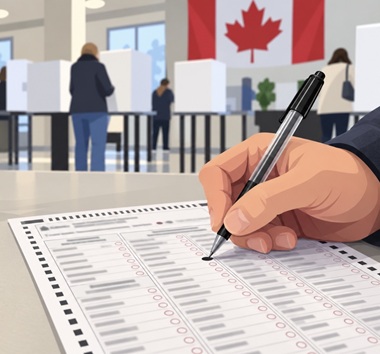
Never underestimate the importance of exercising your democratic responsibility — and encourage others to do the same. Many elections are decided by just a few votes. Maybe your vote could be the deciding vote. Remember, by your vote, you are hiring someone to run your city or school board, or to represent you in the legislature or parliament, so hire the best candidate, since you are paying the salary of whoever wins.
6. Pray.
Pray faithfully for those in authority, whether you supported them at the ballot box or not.
Engage, with love
Our churches can equip Christians to think biblically about public life and become informed, engaged citizens. Each of us can research, pray, vote, speak up, serve, support good candidates – and perhaps even answer the call to public office ourselves.
If Christians withdraw from the public square, the public square will not remain empty. Others will bring their worldview, values and convictions to the decisions that shape our families, schools and communities. So let us participate – not out of anger or a desire for power, but with courage, wisdom, civility and love.
Our greatest public witness may not be only what we say, but how we say it and how we treat those who disagree with us. Because ultimately, Christian involvement in public life should be about loving God, loving our neighbour, and faithfully serving the community God has entrusted to us.

Judi Vankevich
Note: I really appreciated this video by Troy Van Vliet, the businessman who had the vision to build St. John Paul II Academy in Surrey, and who himself is willing to serve in public office.
Troy recorded this video to help Christians understand the opportunity and responsibility Christians have to get involved in the public square.
Judi Vankevich has a passion to inspire and equip families to “love God and love others.”
With her master’s degree in law and government, Judi has served in Ottawa and Washington and wrote the political biography of Dr. Robert N. Thompson, Christian Statesman in Canadian Politics.
She is also known as Judi The Manners Lady, award-winning singer and family entertainer and author, inspiring and equipping children and teens to live with character and kindness.