 Women were major players in the missionary movement, and several recent books tell their stories in a number of ways.
Here I look at nine such books – biographies, academic studies and more.
This is the 16th part in the ‘Christianity: a missionary religion’ series.
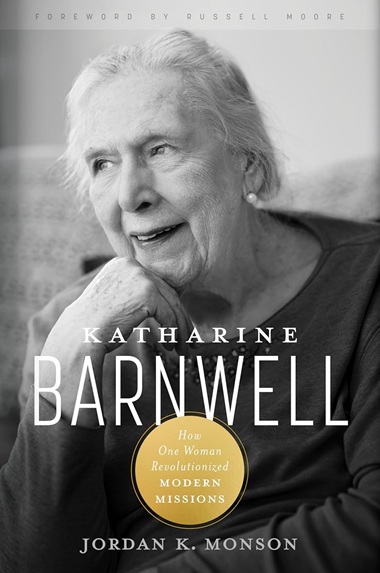
- Jordan K. Monson: Katharine Barnwell: How One Woman Revolutionized Modern Missions (B&H Publishing Group, 2025)
When Katharine Barnwell passed away last fall at the age of 87, a memorial on SIL Global (a key organization with minority language communities, founded by William Cameron Townsend) stated:
Described by many as the “mother of modern Bible translation,” Katy’s translation methodology and training curriculum have equipped thousands of translators, many without formal linguistic degrees.
The publishers of Katharine Barnwell expand on her accomplishments:
What if Mother Teresa or Billy Graham lived and worked – and nobody knew their names? What if one of the church’s most influential missionaries went almost unnoticed?
Meet Katharine (Katy) Barnwell. Within Bible translation, she’s a legend. Outside of Bible translation, few have heard of her. But not even Billy Graham holds a candle to what God did through Katy. . . .
In fact, there may be no ‘great’ in all of church history who matches Barnwell’s level of influence.
All around the world, hundreds of millions of new believers read and hear Scripture in their own language because of Barnwell’s work, books and language training. By some estimates, about 3,000 completed or in-process Bible translations swim directly downstream of her work. Since she rebuilt The Jesus Film Project’s methods, more than 300 million viewers around the world have become followers of Jesus.
Given such accomplishments, one might expect Barnwell to be arrogant or aloof, and yet those who know her best report sweet surprise at how warm, endearing, patient and feisty she is.
Her African colleagues call her Mama Katy, and such a name is fitting.
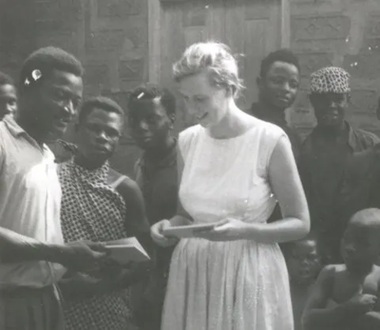
Barnwell showing a booklet written in Mbembe to speakers reading their language for the first time, 1965
A review of the book in Christianity Today describes her decades spent in Nigeria, beginning in 1964 – often in danger, from fighting during the Biafran civil war, from thieves and from diseases like malaria – noting her crucial role in shifting missions from the ‘west to the rest’ to empowering local believers:
As more and more translation leaders began exploring the idea of training nationals, Barnwell was asked to turn her course into a book. In 1975, she published Bible Translation: An Introductory Course in Translation Principles.
Not everyone in the translation world was smitten with the idea of equipping first-language workers to lead projects. William Cameron Townsend, who founded both Wycliffe and SIL, rejected the notion of having “tribesmen” take charge of translation efforts, believing that Westerners had an obligation to lead the work and not “pass the buck [and] let the nationals do it.”
But in Nigeria, the government was forcing Western hands. And no one was as well positioned as Barnwell was in 1976, when Nigeria purged itself of lettered Western linguists, for the monumental training task that lay ahead of her.
Nearly half a century and four editions later, Barnwell’s book is still the gold-standard manual for training first-language translators (formerly called mother-tongue translators) the world over. I used it in my trainings overseas when I worked as a translation consultant. So has every Bible translation worker I interviewed for this article. (Danjuma Gambo was teaching from Barnwell’s text in Nigeria when he stepped away to speak with me via Zoom.)
Jordan Monson is an author and the Professor of Missions and Old Testament at Huntington University. He also directs Huntington’s Center for Faith Integration and Vocation.
- Jennifer Trafton: If Only We Could See: Reimagining Creativity, Compassion and Calling Through the Extraordinary Life of Lilias Trotter (B&H) Publishing Group, 2026)
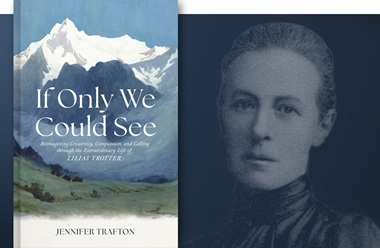
Lilias Trotter, like Katharine Barnwell, is an overlooked missionary hero – though one who has always had her admirers.
The publisher of If Only We Could See writes:
In the late 19th century, Lilias Trotter stood at the threshold of artistic fame, her extraordinary talent praised by the renowned critic John Ruskin.
Yet, at the height of her promise, she made a radical choice that would define the course of her life. Turning away from worldly recognition and social convention, she forged her own path – one that led her through the roughest streets of London and, ultimately, to the deserts of North Africa.
There, her artistic and spiritual journeys intertwined as she expanded the many-coloured canvas of her creativity to embrace not only the sweeping vistas of the Sahara, but also the lives of the Arab people she loved.
Blending biography, personal engagement and theological reflection, Trafton takes readers on an intimate journey with Lily, as her friends knew her – a visionary who saw the world with an artist’s eye and a missionary’s heart, and whose imaginative empathy and creative compassion transformed the lives of those she encountered.
More than the story of one remarkable woman, this book is an invitation to experience the beauty of creation with fresh wonder, to look at our neighbours through new lenses, and to discover what “beautiful possible life” awaits each one of us as we follow the call of the Divine Artist.
Trotter’s artistic prowess was recognized early. She and her mother met John Ruskin while staying at a hotel in Venice; her mother sent him a note with some of her daughter’s drawings.
Jennifer Trafton writes of the famous man:
This was the great John Ruskin – the man who, in his five-volume manifesto Modern Painters, had completely rocked the English-speaking world with his views on the nature of beauty and the role of art. It’s hard for us to comprehend today what kind of fame an art critic could possess in that era. Ruskin wasn’t just a respected intellectual, he was a celebrity. . . .
Ruskin sought to ground the definition of beauty in the eternal character of the Creator. . . .
Among Ruskin’s friends was C.S. Lewis’s literary and spiritual guide, George MacDonald, and G.K. Chesterton considered him “the last of the prophets.”
Ruskin was impressed with Lily’s drawings and mentored her. However, their priorities were not the same. He was “asking for a kind of consecration of her life” to art, but she said, “I cannot give herself to painting in the way he means and still continue to ‘seek first the kingdom of God and His righteousness.'”
In the end, Trotter decided to got to North Africa, where key missionary leaders came to admire her and her spirit.
Trafton notes that although her initiatives with women and children fit well with generally accepted ideas of ‘women’s work,’ she was not typical in other ways:
She was the first Protestant woman to found and lead her own mission organization and her focus – and till the end, the Algiers Mission Band’s primary calling – was itinerant evangelism. . . . Their first converts were men. . . .
Lily was praised and respected for her methods by the foremost male mission leaders of that time. Samuel Zwemer, known as the ‘apostle to Islam,’ called her a “preacher of the gospel” – remarkable for a woman of that era. When John Mott wrote about the kind of godly Christian leadership desperately needed, he named Lilias Trotter in the same breath as Hudson Taylor.
It is interesting to note, given the next book, that Trotter worked for years with the YWCA in London and drew on that experience in North Africa:
But at the same time, Lily recognized their limitations, as Westerners, to address such widespread cultural problems [women physically abused, driven out of their homes with no shelter . . .] – if there was to be real change in the condition of Algerian women, Algerian women would need to lead the way.”
Trotter did not give up her art when she became a missionary.
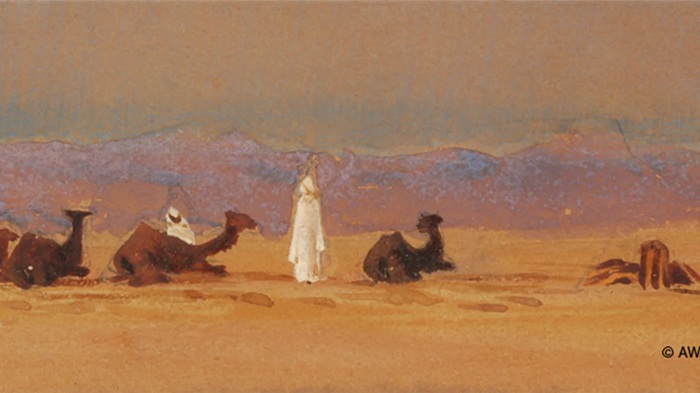
As Rebecca Pate wrote in her review of the book for TGC:
Lilias was an artist and a missionary. Her legacy includes innovative missionary methods, many beautiful paintings and dozens of written works, including 40 years of daily journals rich with details of daily life, mission struggles and her inner life with God. My camel ride, following Lilias’s path decades later, convinced me of the courage and endurance she showed through her life and work as a missionary.
What Lilias accomplished as a missionary is impressive. But If Only We Could See helps us appreciate who she was as a person and how that identity bled like watercolor into everything she did. For Lilias, being a missionary wasn’t about achieving conversion goals or establishing a replicable program.
Instead, “being a missionary was about bearing joy; she looked out upon a world that had not yet heard the news and couldn’t wait to tell it to them.” Her work in North Africa was an outpouring of the love and joy she herself experienced in God.
Jennifer Trafton is “a storyteller and artist with a passion for exploring the intersections of faith, creativity and the arts.” Her first two novels for children, The Rise and Fall of Mount Majestic and Henry and the Chalk Dragon, received starred reviews and multiple award nominations, and she has since collaborated on or contributed to a wide array of projects including The Wingfeather Tales, The Lost Tales of Sir Galahad, Every Moment Holy, Vol. III: The Work of the People and J.R.R. Tolkien and the Arts: A Theology of Subcreation.
Kudos to B&H Publishing Group for giving us top notch books about two impressive women.
- Elizabeth A. Littell-Lamb: The YWCA in China: The Making of a Chinese Christian Women’s Institution, 1899 – 1957 (UBC Press, 2023)
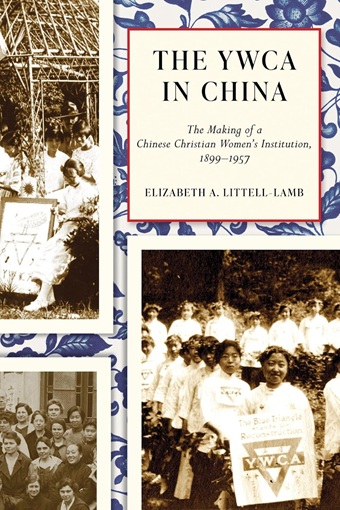
Elizabeth Littell-Lamb has written fairly extensively on the Young Women’s Christian Association (YWCA) “as an example of a Western-inspired women’s organization that has empowered local women and then been domesticated by those women to make it relevant to their own lives and society.”
In the Introduction to The YWCA in China she describes three themes, or threads “that connect the scholarship on the Chinese YWCA movement in China with the larger body of scholarship on Chinese Christian women”:
- “The legitimacy of the study of religion as a historical topic, especially the study of Christianity in non-Christian lands. This is particularly relevant when studying Chinese Christian women”;
- “To ‘restore’ Christian women to the master narrative of the history of Christianity in China, from which they are largely missing”;
- “The importance of bringing to light the diversity of what it meant to be a Chinese Christian woman.”
She points out that major works such as Daniel Bays’ A New History of Christianity in China “make few references to Chinese Christian women or their organizations.”
The publisher describes the book:
The YWCA arrived in China as a cultural interloper in 1899 [making it the oldest women’s organization in China]. How did activist Christian Chinese women maintain their identity and social relevance through the tumultuous first half of the 20th century?
The YWCA in China explores how the Young Women’s Christian Association responded to the needs of Chinese women and society both before and after the 1949 revolution ushered in a communist state.
Western secretaries originally defined the Chinese YWCA movement, but successive generations of Chinese leadership localized its Western-defined organizational ethos. Over time, ‘the Y’ became class conscious and progressive as Chinese women transformed it from a vehicle for moral and material uplift to an instrument for social action and an organizational citizen of China.
And after 1949, national YWCA leaders supported the Maoist regime because they believed the social goals of the YWCA aligned with Mao’s revolutionary aims.
The YWCA in China is a fascinating investigation of the lives, thinking, and action of women whose varied forms of Christian and Chinese identity were buffeted by historical events that moulded their social philosophies.
As Littell-Lamb points out, the YWCA was representative of one stream of Christianity in China. Certainly, more conservative groups would have viewed their work with suspicion, and that suspicion would have been mutual.
Margaret Outerbridge, the Canadian wife of a United Church medical missionary, for example, wrote “The Fundamentalist women, so strict and narrow with their long hair, no make-up and dowdy dresses . . .” in her diary (Beyond the Moon Gate: A China Odyssey, 1938 – 1950, adapted by John Munro).
Littell-Lamb writes:
The YWCA entered China as a foreign transplant and cultural interloper, carried by the currents of the missionary enterprise and the expansion of the World YWCA overseas.
Editorial department secretary Helen Thorburn acknowledged in her 1925 annual report that the Chinese YWCA had grown out of “the mission impulse,” admitting it would have been better “if the association here could have been started in the first place out of the genuine desire of Chinese women.”
Chinese women did soon begin to take a major role in the organization.
British YWCA secretary Margaret Garvie stayed on after the Chinese Communists took over, and reflected a radical view of Christianity:
Garvie complained that conservative Christian churches in Shanghai and elsewhere were attacking new ideas. Even though Christian fundamentalists were not politically motivated, they were vulnerable as they encouraged divisiveness at the very time progressive Christians were trying to demonstrate that all faiths, Christians, materialists and so on could unite to build the nation.
She criticized pastors who attacked the YMCA and YWCA for facing the new political reality, recognizing that there was no going back and most important, trying to find new ways to express Christian life in China’s new society.
Elizabeth A. Littell-Lamb is an associate professor of history at the University of Tampa, where she teaches world and East Asian history. She wrote an extensive article for Asia Pacific Perspectives this year: ‘The YWCA Goes to the Countryside: The Rural Work of the Chinese Young Women’s Christian Association, 1926 – 1947.’
UBC Press also published Spreading Protestant Modernity: Global Perspectives on the Social Work of the YMCA and YWCA, 1889 – 1970 (in 2022): “Although their agendas have been characterized as predominantly religious, both the YMCA and YWCA were also known for their new vision of a global civil society and became major agents in the worldwide dissemination of modern “Western” bodies of knowledge.”
- Ingie Hovland: Life in Language: Mission Feminists and the Emergence of a New Protestant Subject (University of Chicago Press, 2025)
The publishers write:
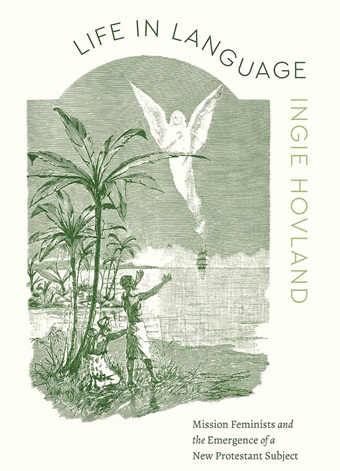 The language of the Bible is a powerful lens through which many Protestants understand themselves and their world, and its prohibitions on women’s speech pose complicated challenges to women.
Nevertheless, women frequently serve as vocal leaders in Protestant organizations, including the early 20th century Norwegian Mission Society.
In Life in Language, Ingie Hovland offers a unique biography of Henny Dons, a leader of the society’s so-called mission feminists, that grapples with ways Protestant women crafted innovative, expansive self-understandings through Christian language.
More than their male peers, the mission feminists turned to religious speech to express material, as well as heavenly, desires for paid work, voting rights and more, and Hovland argues that these experiments in women speaking, reading, writing and listening paved the way for a new way of being in the world.
Ingie Hovland is assistant professor of religion and women’s studies at the University of Georgia and author of Mission Station Christianity: Norwegian Missionaries in Colonial Natal and Zululand, Southern Africa 1850 – 1890.
- Svante Lundgren & Maria Småberg: Three Scandinavian Missionary Women and the Armenian Genocide (Lund University Press, 2026)
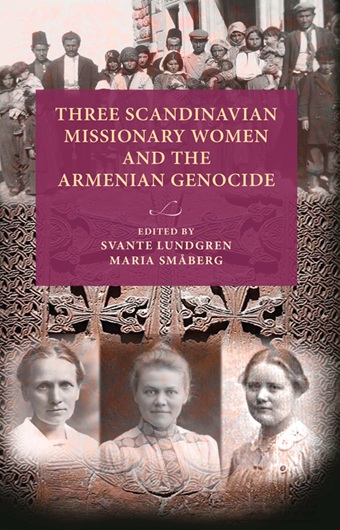
The publishers write of Three Scandinavian Missionary Women & the Armenian Genocide:
This edited volume tells the story of three Scandinavian women missionaries who dedicated their lives to helping Armenian women and children.
They became eyewitnesses to the 1915 Armenian genocide and continued to work among Armenian refugees during the ensuing decades in Lebanon, Syria, Greece and Soviet Armenia.
On the basis of these women’s transnational lives and narratives, the book explores humanitarian aid to Armenians from a Scandinavian angle – biographical sources, perspectives and methods serving as points of departure.
Three Scandinavian Missionary Women and the Armenian Genocide also investigates the transnational, religious and gendered dimensions of relief work.
The importance and the dilemmas of small-scale translocal projects and humanitarian networks are examined; so are religious motivations and missionary practices in humanitarianism as well as the complex role played by women as victims and agents in wars, encompassing their vulnerability and their ‘caring power.’
Svante Lundgren is a researcher at the Centre for Theology and Religious Studies at Lund University in Sweden. Maria Småberg is a researcher in history and senior lecturer in Peace and Conflict Studies at Lund University.
- Julie C. Ma: The Holy Spirit, Women & Mission (Pickwick Publications, 2026)
The publishers say of The Holy Spirit, Women & Mission:
This book examines how Pentecostal and charismatic women develop as leaders, how they actively engage in ministry and mission and how the Holy Spirit enables them to carry out God’s work more effectively.
Although the leadership and missional abilities of women are not adequately accepted and acknowledged in the churches, many Pentecostal / charismatic communities have recognized and embraced them.
And as the scope of women’s ministry has broadened from local contexts to a global one, it has greatly influenced both the church and its missions.
Despite still struggling for equal recognition of their service in the gospel, nothing and no one is able to stop the essential work of Spirit-led women in Christian leadership and ministry.
Julie C. Ma (MA and PhD in Intercultural Studies, Fuller) served as a Korean missionary in the Philippines (1981 – 2006), and as Research Tutor of Missiology at Oxford Centre for Mission Studies, Oxford, UK. She is currently Associate Professor of Missiology and Intercultural Studies, Oral Roberts University. Among her publications are When the Spirit Meets the Spirits: Pentecostal Ministry Among the Kankana-ey Tribe in the Philippines (Peter Lang, 2000), and (with Wonsuk Ma) Mission in the Spirit: Towards a Pentecostal / Charismatic Missiology (Oxford: Regnum, 2010).
- Simona Gorton: Better than We Dreamed: The Story of Elaine Townsend (Christian Focus, 2018)
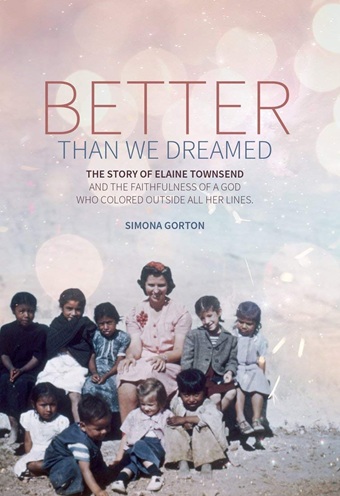
From the publisher:
Read the story of a life lived safely within the lines, that God turned upside down. From social star of 1930s Chicago to a Wycliffe missionary in South America and the USSR, Elaine Townsend’s life was far from boring.
Meet the woman who became Cameron Townsend’s wife, and discover how a life can be filled with adventure, by simply saying ‘yes’ to God.
Through each stage of Elaine’s life her trust and dependence on her Saviour shines as an example to believers everywhere, yet there are also weaknesses with which we can all identify.
This account of her struggles and successes is filled with stories gathered from those who knew Elaine best, as well as insights into the mission work that renewed a generation’s passion for Bible translation.
Both encouraging and challenging, this thorough biography leads the reader to rightly recognise Elaine Townsend as one of the great Christian women of the 20th century – a demonstration of what God can do with a willing heart.
Simona Gorton serves as International Project Manager for 9Marks.
- Yun Zhou: The Woman’s Messenger: Evangelical Literature and the Missionary Movement in Republican China (Penn State University Press, 2025)
The publishers describe The Woman’s Messenger in this way:
Throughout the first half of the 20th century, China underwent tumultuous times – from nation building and the New Culture Movement to the Japanese occupation and the renunciations accompanying the Korean War.
As Yun Zhou argues, this transformative period cannot be fully understood without considering the evolving role of women and Christianity in Chinese society.
At the turn of the 20th century, American missionary women established Nü duo (The Woman’s Messenger), a Christian women’s magazine based in Shanghai whose publication spanned four decades of changing values around feminine virtue.
Tracing the magazine’s evolution across its three editors, Zhou shows how growing intellectualism among the magazine’s staff and readership challenged a homogenous ideal of womanhood.
While Nü duo began under the editorship of a white American missionary championing traditional domestic values, the Chinese editors who went on to lead the magazine in subsequent decades broadened the boundaries of Christian gender ethics, emphasizing matters of indigenous agency, leftist thinking, theodicy and personal spiritual elevation.
Zhou shows how the magazine’s trajectory points to a subtle yet profound process wherein the women involved – navigating ideas concerning God, gender, nation, warfare and even the details of everyday life – became agents of historical change rather than mere recipients of it.
Drawing from a wide range of sources from China and the West, The Woman’s Messenger makes an important contribution to the fields of women’s studies, print culture, modern Chinese history and world Christianity.
Yun Zhou is Lecturer at the College of Asia and the Pacific at The Australian National University.
- David Hempton: Christianity at the Crossroads: The Global Church from the Print Revolution to the Digital Era (Cambridge University Press, 2025)
Christianity at the Crossroads is not primarily about women, nor about missions, but one chapter does offer valuable and relevant insights.
David Hempton writes in the Introduction:
Chapter 5, ‘Women’s Networks: Opportunities and Limitations,’ aims to address the reality that most religious traditions and movements have majorities of women, but most are led by men and are based on deeply embedded patriarchal assumptions.
That underlying paradox is played out in multiple different Christian traditions and shapes the subsequent contests for power, representation and influence.
This chapter is animated by a primary question from which other questions naturally flow: What are the characteristics of the religious networks constructed by women and to what extent do they function differently from those built largely by men?
In attempting to answer that question, I will identify five distinct kinds of networks, representing different varieties of female leadership and participation.
During the fifth in a series of six Gifford Lectures delivered at the University of Edinburgh, Hempton described the five networks:
The first are those networks that operate mostly within religious denominations or traditions, as expressions of piety, fellowship, community and mutual support. These networks, some of which were established by men at their very beginning, are generally not designed to challenge male hegemony, directly, or undermine religious traditions.
There are multiple examples within mainstream denominations of all kinds and ethnic backgrounds and still others, like Aglow international, which are transdenominational, transnational and are held together by a shared theology and vision.
A second category of networks are those that were not established by women for a particular feminist purpose, but came either to be dominated by women or were utilized by women, in ways that shape their cultural outcomes and impacted the experiences of their female participants in major ways.
Examples include the Protestant missionary societies and organizations, like The Student Christian Movement, both of which opened up a wide range of transnational experiences for women.
A third category are those transnational networks of women that enable them to create nodes, in which they got to call most of the shots, but in which they also had to operate within pre-existing structures and spaces of maleness, colonialism, race and economies.
Examples include the female Catholic religious orders, like the Ursulines, which established networks of spiritual economies throughout the world, in the colonial era.
A fourth category are those female networks that are created specifically to put pressure on male-dominated religious traditions, to promote change and equality.
These include the Catholic feminist movement of the 20th century, formed by women to end or modify an all-male priesthood or campaign for female reproductive rights.
Finally, there are networks fashioned by women on the margins of religious tradition to promote solidarity and community, in the face of patriarchal theology structures and control mechanisms, which women find unacceptable.
Examples include female progressive movement within conservative religious traditions, such as conservative religious traditions, like American evangelicalism and Mormonism.
The fourth and fifth categories enunciated here, often allied into one another.
Women’s networks sometimes start as attempts to pressurize male hierarchies to change their theologies and policies. Sometimes, they meet with partial success. And sometimes, they just fail.
Even when their primary objective fails, however, and many of these networks adapt by creating new spaces for women to thrive beyond the reach of male establishments, while still affirming their commitment to the faith, traditions, they badly want to change.
Go here for the fifth lecture.
Alec Ryrie has written a good review of Christianity at the Crossroads for History Today.
I wrote about several other books featuring women in missions in an earlier ‘Christianity: a missionary religion’ column:
- Gina A. Zurlo: Women in World Christianity: Building and Sustaining a Global Movement (Wiley Blackwell, 2023)
- Daniel L. Akin: 10 Women Who Changed the World: Inspiring Female Missionaries Who Fulfilled the Great Commission (B&H Books, 2024)
- Gale L. Kenny: Christian Imperial Feminism: White Protestant Women and the Consecration of Empire (NYU Press, 2024)
- Mary F. Ehrlander & Hild M. Peters: Hospital and Haven: The Life and Work of Grafton and Clara Burke in Northern Alaska (Bison Books, 2023)
And about three other compelling figure – Gladys Aylward, Betty Stam and Sophie Newton – here:
- Gladys Aylward with Christine Hunter: Gladys Aylward: My Missionary Life in China (Moody Publishers, 2024)
- Andrew Montonera: By Life or By Death: The Life and Legacy of John and Betty Stam (Moody Publishers, 2024)
- Robert Banks, Linda Banks: In the Province of the Dragon: A Pioneer Deaconess in Southern China from the Boxer Uprising to the Communist Insurgency (Pickwick Publications, 2025)
Actually, there are stories about numerous impressive missionary women scattered throughout the first 15 Christianity: a missionary religion articles.
The ‘Christianity: a missionary religion’ series:
• Introduction
1. History of Missions
2. State of World Christianity
3. Africa
4. Asia
5. Latin America
6. Not So Good News
7. New Approaches to Missions
8. Women
9. Asia
10. Imperialism / Colonialism
11. Seasoned Practitioners Offer Guidance
12. Africa
13. Middle East
14. China
15. Asia