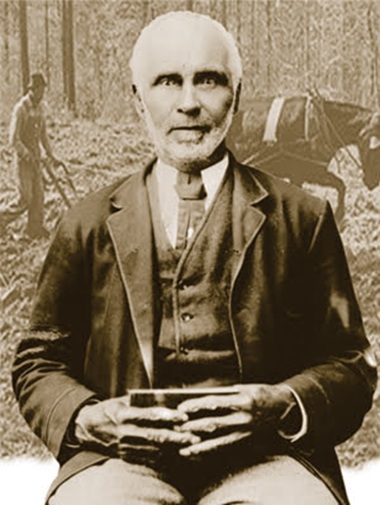
Fielding Spotts was a founder of the first Baptist church in BC. Image: F-00651 Royal BC Museum and Archives
Black History Month was recognized by the Canadian government in 1995. Locally, the BC Black History Awareness Society is particularly active in telling the stories of Black citizens.
Among the more prominent people featured on the site are:
- James Douglas, Governor of Vancouver Island (1851 – 1864) and of British Columbia (1858 – 1864);
- Harry Jerome, Olympic sprinter, teacher and consultant;
- Rosemary Brown, social worker, activist and politician.
Many of the stories relate to the church. Most of the earlier immigrants went to Vancouver Island, while later entries are more in the Vancouver area.
Following are some highlights posted on the BC Black History Timeline:
- 1859: Religious feud / ‘Negro’s corner’
The Daily Colonist reported [October 21, 1859] on a “difference of opinion” between Rev. W.F. Clarke and Rev. M. MacFie, both missionaries sent to Victoria from England by the Congregational Missionary Society.
“Mr. Clark holds that Christianity knows no difference between the white and colored man; and therefore he will not suit the prejudices of anyone by creating a ‘negro’s corner’ in his church. As a matter of ‘taste’ Mr. MacFie prefers separating them.”
- The Colonial Missionary Society settled the issue on August 14,1860 by passing a resolution holding, “That this committee never have sanctioned and never will sanction in Churches wholly or in part sustained by the funds of the Colonial Missionary Society, the compulsory separation, in places of worship, of the colored races from the white population.”
- 1876: First Baptist Church / Fielding Spotts
In the initial stages of this church, Blacks and whites met in homes for prayer meetings. On May 3, 1876, 15 people, including Black pioneers Fielding and Julia Spotts, Thomas W. Pierre and Augustus Christopher, met to organize the First Baptist Church.
This was the first Baptist cause to be inaugurated in British Columbia, and the first Canadian Baptist church west of Winnipeg. Today, the First Baptist Victoria church is located at the corner of North Park and Quadra Streets, Victoria. First Baptist Church History
Farmer, cooper, husband, father, church leader, school trustee . . .
Fielding Spotts was a religious man and perhaps the first recognized Baptist to arrive in Western Canada. He was a charter member of five churches.
The first of these, ‘First Colored Baptist Church’ (1852) was established in San Francisco, USA. In Canada, he was instrumental in the formation of the Shady Creek Church in Saanich, a community church of Methodists and Baptists (1863); First Baptist on Pandora Street, where he was a Trustee and Deacon (1876), and its successor Calvary Baptist on Herald Street (1883), and lastly Saanich Baptist (1898).
When First Baptist of Victoria was reorganized in 1883, its members included as part of their covenant: “No distinction shall ever be made in respect of race, colour or class.” . . .
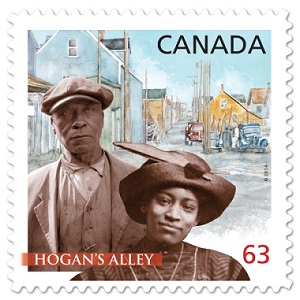 Little is known about the Spotts children other than Fielding William who moved to Vancouver in 1902, lived and owned a business in Hogan’s Alley. He died there in 1937 at the age of 79.
Fielding Spotts Jr. is featured in this Canada Post Black History Month commemorative stamp issued on January 30, 2014: ‘Remembering Vancouver’s Hogan’s Alley.’
Pictured with Fielding is Nora Hendrix, the grandmother of famed musician Jimi Hendrix, arrived circa 1912. She was a community leader and a co-founder of Vancouver’s first Black church, the African Methodist Episcopal Fountain Chapel at Prior and Jackson Avenue.
- 1910: Negro Christian Alliance, Vancouver
The Negro Christian Alliance (NCA) began to hear speakers, review papers, host discussions and debates, and provide opportunities for local talent to perform in the fall of 1910. [Around 1910 Black people began moving to Vancouver’s East Side neighbourhood of Strathcona, a mixed community of mainly Italian, Chinese and Black people. The Black people mostly settled in what became known as ‘Hogan’s Alley.’]
The announcement for the first meeting stated, “All are cordially invited, regardless of colour or creed.” They organized and supported clubs and activities, including a Sunday School, for an estimated 150 youth. The NCA undertook a wide range of activities, such as debates on women’s suffrage. It also took a public stand for Prohibition. In December 1915 the NCA protested the movie Birth of a Nation as racist and dehumanizing.
- 1921: Fountain Chapel
The location at the corner of Jackson and Prior Streets in Vancouver originally had a Lutheran Church that was constructed in 1904. The building was purchased in 1918 through the leadership of local resident Nora Hendrix and around 1921 opened as the African Methodist Episcopal Fountain Chapel. It was the spiritual and social heart of the community.
The first minister to serve was Reverend Ulysses S. Robinson, who arrived in Canada in October, 1921 (1888 – 1947). Reverend Robinson was the longest serving minister. The first Canadian-born minister was Reverend J. Ivan Moore. While today it is a private residence, it was designated as a Heritage Property by the City of Vancouver in 1994.
[I have written about Fountain Chapel here.]
- Joe Fortes: Citizen of the Century
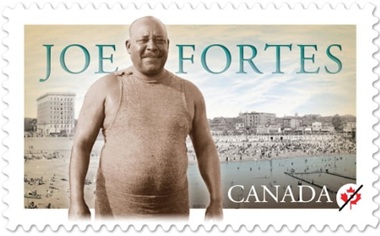 Joe Fortes arrived in Vancouver around 1885 – 1886 when he was about 20 years old. He worked as a bartender but spent many hours at English Bay, taking it upon himself to be the informal swimming teacher and lifeguard.
In 1910 the City of Vancouver recognized Joe as an official lifeguard to be employed and paid by the City. To celebrate Vancouver’s centennial, Vancouver Historical Society formally declared Joe as ‘Vancouver Citizen of the Century.’
[I wrote about his Catholic faith here; he attended Holy Rosary Cathedral. Fortes was recognized with a Canadian Black Heritage Stamp in 2013.]
************************************
There are more religious references, and of course many more general entries. Go here for the BC Black History Timeline and and here for the BC Black History Awareness site, which has several other features describing the arrival, conditions and achievements of the Black community.
The City of Vancouver has a page with various links devoted to Black Heritage Month.
I was fascinated to read the article about Mr Spotts. I grew up attending Shady Creek church with my family in the fifties and sixties. When there were special events at the church, two very distinguished elderly black gentlemen were regularly in attendance from Victoria, Mr Spotts and Mr Alexander.
My father was secretary of the Cemetery Board for many years and did extensive research on the pioneer graves which were becoming hard to read due to environmental erosion. The site, next to the creek, was heavily shaded and damp (hence the name of the church). The research he did was incorporated into the cemetery records. Both the Spotts and Alexander families had plots in the graveyard.