
Reg Bibby has been studying and reporting on Canadian views and activities related to Christianity for more than 50 years.
Fifty years ago, we had only a vague idea of what Canadians thought and believed – because hardly anyone had asked them. We just assumed, wrongly, that we were much like Americans, who had been studied more thoroughly.
Then, in 1975, Reginald Bibby, a sociologist at the University of Lethbridge, commissioned a detailed survey called Project Canada. Since then, Bibby has repeated and updated the survey several times.
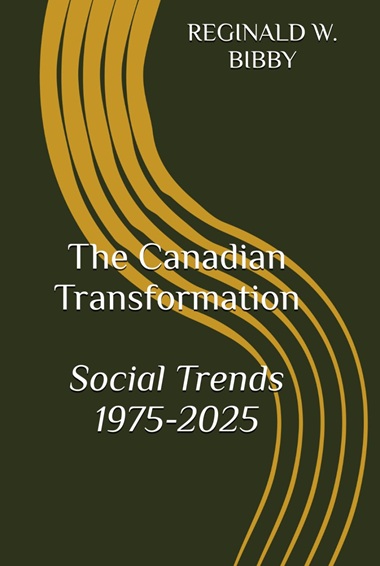
His most recent book, The Canadian Transformation: Social Trends 1975 – 2025 (Project Canada Books, 2026), presents the data from a new, 2025 survey and analyzes trends revealed by his surveys and surveys by others over the past half-century.
The Canadian Transformation covers a very wide range of topics, from politics to sports, far more than can mentioned in this brief review. It should be required reading for every pastor and church leader in Canada. It is vital that churches understand the context in which they minister.
The Canadian Transformation makes for sobering and disturbing reading. Bibby’s “decisive conclusion” is that “Religion in Canada has known something of a golden era. But that era has been over since the final decades of the 20th century.” While Bibby’s first book (in 1987) was called Fragmented Gods, he suggested his latest could have been called Vanishing Gods.
A century ago, 95 percent of Canadians identified as Christians. Now less than half do.
In 1901, 41 percent of Canadians identified as Roman Catholics. Roman Catholics remained above 40 percent through 2001, which Bibby attributes partly to immigration from Roman Catholic countries, but they dropped to 30 percent by 2021.
Mainstream Protestants (United, Anglican, Presbyterian, and Lutheran) were 51 percent of the population in1901 but declined steadily over the next century before dropping to only 8 percent in 2021.
Conservative Protestants (largely evangelicals) were 6 percent of the population in 1901 but rose to 8 percent by 1931 and have maintained that level to the present. Among conservative Protestants, Baptists grew steadily until 2001 but have declined since. Filling the gap, Pentecostal, charismatic and nondenominational churches have continued to grow.
Adherents of “other faiths” (Muslims, Hindus, Sikhs, Buddhists, Jews and others) have grown from less than one percent in 1961 to 11 percent in 2021, largely due to changes in source countries of immigration. Those with “no religion” were negligible a century ago but had grown to 4 percent by 1961 and ballooned to 35 percent by 2021.
In other words, Christian churches have largely lost the battle for the hearts and minds of Canadians.
Church attendance has similarly declined. At one time, a majority of Canadians were in church every week. Weekly attendance had dropped to 31 percent by 1975 and only 9 percent by 2025. Ten percent attended at least monthly in 1975, but that dropped to 4 percent by 2025. A further 33 percent still said that they attended religious services once a year, but those who said they never attend rose from 15 percent in 1985 to 54 percent in 2025.
Confidence in institutional leaders has declined in almost every sector, but the largest decline was among religious leaders (from 51 percent in 1985 to 13 percent in 2025). It seems that only those who still regularly attend church have respect for the clergy.
Private religious practice has also declined. In 1980, 70 percent of Canadians said they prayed privately (very often or sometimes), but by 2025, only 25 percent said they prayed weekly and another 6 percent monthly. Thirty-five percent said they read the Bible or other scriptures in 1980, but only 11 percent read it weekly and another 4 percent monthly in 2025. Watching religious programs on TV has declined from 28 percent in 1980 to 12 percent in 2025, and only 4 – 5 percent watch worship services online.
In 2015, 37 percent of Canadians said that they preferred to “live life without God or a congregation,” but that number had risen to 60 percent by 2025.
A majority of Canadians have still pondered the “big questions” of why there is suffering in the world, what is the purpose of life, what happens after death and whether there is a God, but the numbers are declining.
Forty-eight percent of Canadians no longer believe there are answers to these questions, and only 15 percent say religion is very important to them, down from 26 percent in 1990. In 2015, 40 percent of Canadians wanted a religious funeral service when they die. That dropped to 20 percent in 2025, but the desire was highest among young people aged 18 – 34 at 25 percent.
Church decline is reflected in Canadians’ attitudes on moral issues.
Seventy-six percent of Canadians now support abortion “for any reason” and up to 96 percent in certain circumstances.
Eighty-three percent of Canadians say that premarital sex is “not wrong at all” (up from 38 percent in 1975), and only 5 percent of Canadians say that premarital sex is “always wrong.” There has been no increase in those who say that extra-marital sex (having sex with a person while married to another) is “not wrong at all” (currently 3 percent ) but only 42 percent say it is “always wrong.” Sixty-three percent of Canadians said that same-sex relations were “always wrong” in 1975, but only 11 percent said so in 2025.
Support for the legalization of marijuana has risen from 26 percent in 1975 to 62 percent in 2015.
Any hope that conservative Christians have to change Canadian laws in these areas through political action are delusional. That ship has sailed.
There has also been a change in what people value. Ninety-six percent of Canadians thought that honesty was very important in 1985, but only 82 percent thought it very important in 2025; 84 percent thought family life was very important in 1985, but only 67 percent thought it very important in 2025; 70 percent thought friendliness was very important in 1990 but only 57 percent in 2025; 75 percent thought forgiveness was very important in 1985 but only 46 percent in 2025; 67 percent thought working hard was very important in 1985 but only 45 percent in 2025.
Seventy percent of Canadians now think that “Values in Canada are changing for the worst.” And yet Bibby says, while there is “growing relativism” about values, more Canadians “have become more adamant about the fact that their views are ‘the right ones.’” In other words, there is less consensus on values but also less tolerance of those who disagree with us.
All in all, this presents a bleak picture for Canadian Christians. Yet, Bibby points out that “the big questions” such as “What happens when we die” are still relevant for many Canadians.
And he adds that “a noteworthy core of Canadians continue to place importance on religion.” This “significant minority” not only continues to identify with their religious tradition but are also actively involved and find “high levels of enjoyment” there. Bibby concludes that the gods might be vanishing, but they are “far from vanquished.”
James R. Coggins is a historian, writer and editor currently living in Chilliwack.
***********************************
Broadview posted an interview with Reginald Bibby about his book and his legacy September 16. It began:
Christopher White: Canada has experienced huge changes since you began monitoring social trends five decades ago. What value is central to the Canadian identity today?
Reginald Bibby: If there’s just one that would be right at the top, it’s definitely freedom. Canadians want personal freedom with respect to choices in every part of their lives.
CW: That’s not what I would have expected as the central value. What does the term ‘freedom’ actually mean for Canadians?
RB: It’s a good question. We have just about eight in 10 Canadians saying it’s very important to them. People want choice and flexibility. People want freedom when it comes to personal morality. They have changed over the decades in terms of attitudes toward sexual behaviour and orientation.
But over and over again, if you’re looking for some kind of central thread, it’s that people want the freedom to think the way they want to think and act the way they want to act. And religious institutions are perceived as being almost antithetical to that high level of freedom they wish for in their lives.
Go here for the full interview.