

When we consider the modern missionary movement, we usually think of places like Africa, Asia and Latin America, where its impact has been dramatic. They are now the centre of world Christianity, while the faith has weakened to varying degrees in the sending nations.
One area that might not spring to mind is the Middle East, though it does have a rich history early on as the home to dynamic missionary movements, and later to the recipient of some quite creative missionary initiatives.
In this article I will look at several books which examine missionary initiatives – or the setting for those initiatives – over the past couple of centuries.
First though, it is important to note that if most of us in the West don’t know much about modern missions to the Middle East, it is safe to say that we know even less about the background to those missions.
Just briefly, for example:
* Philip Jenkins reminded us 15 years ago, in his landmark work The Lost History of Christianity, that the centre of the Christian world for at least the first millennium after Jesus walked the earth was the Middle East. Not only that, but the Church of the East (Nestorians) and the Syriac Orthodox (Jacobites) were extremely active in sending out missionaries across Central Asia, as far as China, and India.
* The Crusades have cast a long shadow over relations between the West and the Middle East. Some even make connections between the motivations for the Crusades and those behind the modern missionary movement.
* Christianity was the dominant religion in the Middle East until Islam took over, and remained a very significant force for many more centuries. Wafik Wahba (see Global Christianity and Islam below) quoted Jenkins: “We can see the 14th century as marking the decisive collapse of Christianity in the Middle East, across Asia and in much of Africa.”
* Christianity has been decimated throughout much of the Middle East (and the Muslim world) over the past few decades.
This article is part of a series; I will in the future look at more recent efforts to reach the Middle East, which in some cases are bearing real fruit.
The good news in terms of missions to the Middle East is that quite a few recent books – often from academic presses – are covering the topic.
- Allan Chapman: The Victorians and the Holy Land: Adventurers, Tourists and Archaeologists in the Lands of the Bible (Eerdmans, 2025)
 This book isn’t about missionaries – but it does set the stage well, and in an entertaining fashion. Though Allan Chapman teaches the history of science at Oxford University, The Victorians and the Holy Land is aimed at a more popular audience.
As a Publishers Weekly review states:
In chatty prose, Chapman brings to life a vibrant period of cross-cultural ferment that confirmed and sometimes challenged Westerners’ views on Christianity.
Eerdmans, the publisher, describes the book:
In this engaging study, Allan Chapman shows how the Holy Land took on new meaning for Europeans during the Victorian era. Previously, most Europeans had viewed the area between the Mediterranean Sea and the eastern bank of the Jordan River as a literary backdrop for biblical narratives.
During the 19th century, however, they began to take interest in this region as a literal, physical place. Technological inventions such as steam-powered travel, telegraphy and photography made the Holy Land more accessible. . . .
In addition to explaining how Holy Land studies changed during the Victorian era, Allan Chapman identifies key people who facilitated those changes. He introduces readers to a diverse demographic that includes adventurers, astronomers, missionaries, ministers, learned women of independent means and Queen Victoria’s eldest son. Driven by a wide range of professional and personal motives, these individuals had a powerful impact on the Victorian public’s understanding of the Holy Land.
 In a chapter titled ‘Daring clergymen and a royal prince,’ Chapman covers the pioneering archeological work of Rev. Dr. Edward Robinson (“styled by subsequent scholars as ‘the founder of biblical archeology'”) and Rev. Eli Smith.
While spending most of his time on their archeological work, Chapman also notes, “Eli Smith’s primary concern, however, was not archeology and topographical description so much as Christian missionary work.”
Another chapter is devoted to Thomas Cook, who, according to Britannica, “can be said to have invented modern tourism.” Born into a devout Christian home, Cook’s tours to the Holy Land (and elsewhere) were built on the “aspiration” of working people (especially from the Nonconformist denominations) who were determined to better themselves.
A Baptist lay preacher as a young man, itinerating around the Midlands, he also set up a printing business and ended up “proclaiming the gospel, by travel and train”:
[T]o Thomas Cook, the essential goal in all of this, be it preaching, writing or printing, was the spread of the Christian gospel and a widening outreach to ordinary folk.
Chapman points out that by the early 20th century, “Thomas Cook and Son had brought more western Europeans to the Holy Land than had all the Crusader armies of the Middle Ages combined.”
Allan Chapman’s scholarly work focuses on the history of astronomy and medicine, as well as the relationship between science and Christianity. He has given given a number of lectures at the Faraday Institute for Science and Religion in Cambridge.
- Wafik H. Wahba: Global Christianity and Islam: Exploring History, Politics and Beliefs (IVP Academic, 2025)
Wafik Wahba , professor of Global Christianity at Tyndale University in Toronto, covers a wide range of issues in Global Christianity and Islam – including the role of missions and missionaries.
IVP Academic states:
Together, the adherents of Christianity and Islam make up over half of the world’s population, and their numbers are expected to keep growing. The influence of these two faiths – and their relations with each other – is seen in politics, economics and social interactions.
This book provides a comprehensive overview of Christianity and Islam, covering three interrelated areas:
-
- historical developments and encounters,
- the influence of religion on politics,
- religious beliefs and worldviews.
Wahba highlights key points of similarity and difference and particular factors that contributed to divergence between the Western world and the Muslim world.
Exploring the various narratives that have shaped both Christianity and Islam, he argues, is crucial to understanding current trends in Christian-Muslim interactions and their impact on future relations between the two communities globally.
Wahba states that “while Christian-Muslim encounters between the 11th and 15th centuries were generally intense and destructive . . . the era also included noteworthy spiritual and intellectual encounters, in which Christian missionaries from Europe tried to reach out to Muslims through dialogue rather than fighting.”
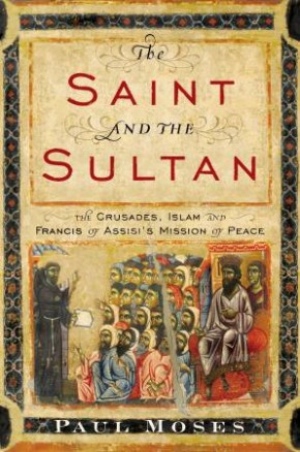
The Saint and the Sultan (Image 2009) tells the story of ‘The Crusades, Islam and Francis of Assisi’s Mission of Peace.’
Particularly fascinating are the stories of Francis of Assisi and Ramon Lull:
Francis believed that Muslims could be won over by extending God’s love through acts of service and ministry. . . . In 1219, while King Louis IX of France was fighting in northern Egypt, Francis was preaching a gospel of peace to the Egyptian sultan al-Kami.
Despite linguistic and cultural barriers, the sultan welcomed Francis to his court and extended hospitality. The sultan did not convert, as Francis had been hoping, but Francis’s attitude toward Muslims was different from that of the Crusaders, one of tolerance and acceptance. . . .
[Lull] was convinced that God was directing him to evangelize the nomadic Muslims, the Saracens – the most hated and feared enemies of Christianity at that time. . . .
His approach to evangelizing Muslims in Tunis and Bugaia, east of Algiers, was primarily through debates. . . . He was stoned to death in Algeria on June 30, 1315.
Wahba describes why we hear more about missions to Asia and Africa than to the Middle East:
While several mission organizations were active globally, very few had interest in doing mission among Muslims. Centuries of conflict and misunderstanding between the Muslim world and the West had contributed to such hesitation. It is challenging to preach Christianity to Muslims for a number of reasons.
Islamic theology criticizes outright basic Christian beliefs in the divinity of Christ, the Trinity and the trustworthiness of the Bible, among a host of other religious affirmations. Muslims’ perceptions of Christianity is often quite negative from the start, requiring significant effort on the part of missionaries to change. Add to this the presence of close family and community ties in Eastern / Muslim societies, which make it hard for Muslims to abandon their religion and culture.
As a result, Western mission to Muslims had been limited. However, interest in mission in Muslim lands grew during the 18th and 19th centuries as various Catholic and Protestant missions provided medical and educational services. Yet many of these Christian organizations ended up redirecting their efforts to convert the Christians living in these Muslim countries to either Catholicism or Protestantism since very few Muslims responded to their efforts.
Wahba, originally from Egypt – whose Coptic Christian minority has suffered waves of persecution (and some periods of tolerance) from the majority Muslim culture over the centuries – writes, “A major focus of the books is to create an opportunity for better ways of communication by clarifying the core Islamic and Christian beliefs that influence people’s actions and attitudes toward the other.”
- Peter Hill: Prophet of Reason: Science, Religion and the Origins of the Modern Middle East (One World Academic, 2024)
 An important biography by historian Peter Hill looks at one man brought up in a local Christian community who became a convinced evangelical.
The publisher writes about Prophet of Reason:
In 1813, high in the Lebanese mountains, a 13 year old boy watches a solar eclipse. Will it foretell a war, a plague, the death of a prince?
Mikha’il Mishaqa’s lifelong search for truth starts here. Soon he’s reading Newtonian science and the radical ideas of Voltaire and Volney: he loses his religion, turning away from the Catholic Church.
Thirty years later, as civil war rages in Syria, he finds a new faith – Evangelical Protestantism. His obstinate polemics scandalise his community.
Then, in 1860, Mishaqa barely escapes death in the most notorious event in Damascus: a massacre of several thousand Christians. We are presented with a paradox: rational secularism and violent religious sectarianism grew up together.
By tracing Mishaqa’s life through this tumultuous era, when empires jostled for control, Peter Hill answers the question: What did people in the Middle East actually believe? It’s a world where one man could be a Jew, an Orthodox Christian and a Sunni Muslim in turn, and a German missionary might walk naked in the streets of Valletta.
Following a breach with his early Catholic faith, Mishaqa spent several years “inquiring again into questions of religion.”
Hill says “Evangelical missionaries knew of, or suspected, the existence of people like Mishaqa, unconvinced of the truth of any recognised religion.” He describes the influence on Mishaqa of a book by Church of Scotland minister Alexander Keith. Plain Evidence of the Truth of the Christian Religion had been translated into Arabic by missionaries.
Christoph Schlienz was one of those translators “before his nudist phase”; he later took to walking naked in the streets of Valletta, Malta, apparently suffering from ‘delusions and hallucinations.’
Hill writes about how the missionaries – “representatives of a new and strange brand of religiosity” with its origins in the great religious Awakenings which had swept Britain the American in the 18th and early 19th centuries – sought to present themselves in the complex world of the Middle East:
This notion of Evangelical Christianity as a golden mean between the extremes of ‘superstition’ and ‘infidelity’ recurs in the writings of the early British and American missionaries. Undoubtedly partisan, this view was imbued with assumptions of superiority over ‘orientals’ as well as disdain for ‘superstitious’ religions.
And it was designed, in part, to answer the charges of Catholics and others that missionary religion was making its hearers doubt religion altogether.
But it reveals, also, one quality of the Evangelical missionaries which made them unusual in the context of Ottoman Syria. They were deeply interested in the individual faith of the people they encountered: in what they ‘kept in their hearts.’ Where other observers saw Muslim, Orthodox, Catholics or Jews, the missionaries saw – in addition – inquirers, doubters and ‘infidels.’

Mikha’il Mishaqa was an impressive and independent thinker who chose to follow Evangelical Christianity.
Mishaqa and a missionary – Rev. Eli Smith (mentioned above, in The Victorians and the Holy Land) – became good friends. Smith was grateful to Mishaqa for helping out with converts, describing him in a letter as “the most intelligent and best informed Arab, with whom I am acquainted.”
Hill makes an interesting point about Smith which illustrates the diversity of opinion within the missionary community about the value, or legitimacy, of having people convert from other Christian backgrounds:
Smith’s own view of the missionary enterprise did not incline him to incite ‘inquirers’ like Mishaqa to leave their own Churches. In the 1830s . . . [he] believed it could be better for those inclined to Protestantism to remain within these Churches, in the hope of stimulating a reformation from within.
Although Mishaqa experienced a “serious falling out” with some missionaries, citing their cultural arrogance, he remained close to Smith (and other missionaries) and true to his chosen Evangelical faith.
Peter Hill is a historian of the modern Middle East, specialising in the Arab world in the 19th century.
Reviews of Prophet of Reason have been very positive, with Eugene Rogan, author of The Arabs, writing:
A masterful and captivating book that rescues one of the greatest thinkers of 19th century Syria from obscurity. Mikha’il Mishaqa bursts from the pages as a three-dimensional character and a pioneer in the debates on secularism and religious freedom in the modern Arab world. An outstanding intellectual biography.
Another fascinating story of conversion is an autobiography: A Muslim Who Became a Christian: The Story of John Avetaranian. Originally a mullah in Turkey, he converted to Christianity, became a missionary to Xinjiang (northwest China) and translated the New Testament into the Uyghur language.
- Reza Aslan: An American Martyr in Persia: The Epic Life and Tragic Death of Howard Baskerville (Norton, 2023)

Version 1.0.0
Another recent biography tells the story of a young missionary who really identified with the people he was sent to reach.
Reza Aslan is, one would think, an unlikely person to write a book about a Christian missionary to his home country, Iran. Aslan converted to evangelical Christianity as a teenager, then reconverted to the Shia Islam faith of his family.
He is known particularly for his best-selling Zealot: The Life and Times of Jesus of Nazareth. That work was widely critiqued in the Christian press, including by one-time Trinity Western University professor Craig Evans, in Christianity Today.
But this is quite a different book, and here Aslan seems to be making the point that there is considerable overlap between religious traditions, with good to be found in all.
The publisher describes An American Martyr in Persia:
Little known in America but venerated as a martyr in Iran, Howard Baskerville was a 22 year old Christian missionary from South Dakota who traveled to Persia (modern-day Iran) in 1907 for a two-year stint teaching English and preaching the gospel.
He arrived in the midst of a democratic revolution – the first of its kind in the Middle East – led by a group of brilliant young firebrands committed to transforming their country into a fully self-determining, constitutional monarchy, one with free elections and an independent parliament.
The Persian students Baskerville educated in English in turn educated him about their struggle for democracy, ultimately inspiring him to leave his teaching post and join them in their fight against a tyrannical shah and his British and Russian backers.
“The only difference between me and these people is the place of my birth,” Baskerville declared, “and that is not a big difference.”
In 1909, Baskerville was killed in battle alongside his students, but his martyrdom spurred on the revolutionaries who succeeded in removing the shah from power, signing a new constitution, and rebuilding parliament in Tehran. To this day, Baskerville’s tomb in the city of Tabriz remains a place of pilgrimage. Every year, thousands of Iranians visit his grave to honor the American who gave his life for Iran.
In this rip-roaring tale of his life and death, Aslan gives us a powerful parable about the universal ideals of democracy – and to what degree Americans are willing to support those ideals in a foreign land.
An in-depth review in the Los Angeles Review of Books points to a divergence between Baskerville’s beliefs and those of the missionary establishment:
Howard Baskerville, a Presbyterian from South Dakota, gave his life for the cause of the Persian Constitutional Revolution on April 19, 1909, in defiance of orders from both the United States government and the Presbyterian Board of Foreign Missions. But this defiance signaled neither an abandonment of his American identity nor a renunciation of his Christian faith.
Rather, in Aslan’s account, Baskerville’s decision to fight for the Persian people embodied the young Christian’s commitment to the universal values at which all religious and political endeavors ultimately aim – or what I would call Reza Aslan’s transcendent truth.
Baskerville’s approach was not typical:
The American missionaries in Persia also took a neutral position [in the midst of a complex political situation]. . . .
This political detachment fit neatly with the evangelical form of Christianity that had launched the mission work in west Persia. A bequest of the Second Great Awakening that swept much of New England and beyond in a frenzy of religious conversion, American evangelicalism has historically been preoccupied with individual salvation and personal piety.
Thus, the missionaries were not in Persia to spread democracy; they were not even there to proselytize Persia’s Muslim population, a political powder keg if there ever was one. They were there, paradoxically, to convert the existing Christian communities in the region, which “were thought by Americans to be misguided and unsaved. Their rituals were primitive and obsolete, their beliefs peppered with ‘superstitions.’”
The mission was thus indirect: the Americans would show the various Christian communities of Persia the evangelical way of faith and pray that the newly converted would, in turn, proselytize their Muslim neighbors. . . .
Aslan maintains that Baskerville did not join the revolution despite his religious convictions and his national identity but because of them: “Baskerville had not abandoned his American identity. On the contrary, this was him exerting it. He had not renounced his faith; this was him putting it into practice.”
- Matthew K. Shannon: Mission Manifest: American Evangelicals and Iran in the Twentieth Century (Cornell University Press, 2024)

Matthew Shannon spends several pages on the phenomenon of ‘remembering Howard Baskerville’ in Mission Manifest.
In 1959, he writes, a gathering of Presbyterian evangelicals, US diplomats and Iranians who knew him “collectively resurrected his ghost to transpose the allegedly friendly mission of an earlier generation of evangelicals onto the United States during the Cold War.”
Three “tropes” were evoked, he said – Baskerville-idealist, Baskerville-militant and Baskerville-martyr. “The Baskerville commemoration,” he argues, “was an exercise in binational myth-making that accompanied the reinvention of American power in Iran.”
Shannon, an Associate Professor of History at Emory & Henry College, looks at the Presbyterian Mission, which existed in Tehran from 1862 to 1965, then focusing primarily on the period between the 1940s and 1060s, “the ‘American moment’ in Iran.”
He writes:
The Presbyterian Mission . . . became manifest in Tehran because of the relationship between Christian evangelicalism, US global hegemony and Pahlavi {dynasty] power during the mid 20th century.
Presbyterian evangelicals worked in Tehran, through churches, as part of development programs, in schools, at cultural centers and across time and space, to advance their ‘old’ and ‘new’ missions.
‘Old’ mission was motivated by the Great Commission and manifest in the Evangelical Church of Iran. ‘New’ mission overlapped with American foreign aid and cultural programs during the Cold War.
The publisher describes the book:
In Mission Manifest, Matthew Shannon argues that American evangelicals were central to American-Iranian relations during the decades leading up to the 1979 revolution. These Presbyterian missionaries and other Americans with ideals worked with US government officials, nongovernmental organizations and their Iranian counterparts as cultural and political brokers – the living sinews of a binational relationship during the Second World War and early Cold War.
As US global hegemony peaked between the 1940s and the 1960s, the religious authority of the Presbyterian Mission merged with the material power of the American state to infuse US foreign relations with the messianic ideals of Christian evangelicalism.
In Tehran, the missions of American evangelicals became manifest in the realms of religion, development programs, international education and cultural associations. Americans who lived in Iran also returned to the United States to inform the growth of the national security state, higher education and evangelical culture.
Shannon delves into the latter point in Chapter Six, ‘The Persian ‘Boomerang.’ He borrowed the term from David Hollinger’s ‘Protestant boomerang,’ included in his influential book, Protestants Abroad: How Missionaries Tried to Change the World but Changed America (which I wrote about here) . . .
While the lines between branches of missionary work – in churches, development programs, schools and associations – were sometimes muddled in Iran, the different meanings of mission crystalized in the American context. In the United States, during the mid-20th century, those missions refracted into the national security state, higher education and neo-evangelical culture.
Mission Manifest has received positive reviews from a range of sources, including Iranian Studies, Journal of Religious History and American Historical Review.
- Christian Windler: Missionaries in Persia: Cultural Diversity and Competing Norms in Global Catholicism (I.B. Taurus, 2024)
 The publisher writes of Missionaries in Persia:
This title explores how in the 17th and 18th centuries, Isfahan, the capital of the Safavid Empire, hosted Catholic missionaries of more diverse affiliations than most other cities in Asia.
Attracted by the hope of converting the Shah, the missionaries acted as diplomatic agents for Catholic rulers, hosts to Protestant merchants and healers of Armenians and Muslims.
Through such niche activities they gained social acceptance locally. This book examines the activities of Discalced Carmelites and other missionaries, revealing the flexibility they demonstrated in dealing with cultural diversity, a common feature of missionary activity throughout emerging global Catholicism.
While missions all over the world were central to the self-fashioning of the Counter-Reformation Church, clerics who set out to win over souls for the ‘true religion’ turned into local actors who built reputations by defining their social roles in accordance with the expectations of their host society.
Writing for Catholic Books Review, Daniel Smith-Christopher offers a brief synopsis of each chapter, adding:
Chapter 6 raises the interesting question of the missionaries ‘in the field’ and their conflicts with their home superiors – documenting some of the disagreements that the missionaries had with policies that were made by those with little understanding of the ‘facts on the ground’ that the missionaries themselves lived with.
Here is one of the most interesting issues in mission studies, especially Catholic mission studies, as the missionaries themselves often found themselves ‘pushing the envelope’ when it came to the acceptability of local adaptations of Christian faith and practice on cultural contexts
Christian Windler is Professor of Early Modern History at the University of Bern (Switzerland). He specializes in the social and cultural history of diplomacy, religious practices and global entanglements from the 17th to the 19th century.
- Jonathan Parry: Promised Land: The British and the Ottoman Middle East (Princeton University Press, 2022)
 At 453 pages, Promised Land covers a lot of ground, including competition among the great colonial powers over the Middle East and complex relationships between people groups with the Ottoman Empire.
But religion was a key factor in all of that, and Jonathan Parry devotes quite a bit of space to it.
The publisher describes the purpose of the book:
Napoleon’s invasion of Egypt in 1798 showed how vulnerable India was to attack by France and Russia. It forced the British Empire to try to secure the two routes that a European might use to reach the subcontinent – through Egypt and the Red Sea, and through Baghdad and the Persian Gulf. Promised Lands is a panoramic history of this vibrant and explosive age.
Charting the development of Britain’s political interest in the Middle East from the Napoleonic Wars to the Crimean War in the 1850s, Jonathan Parry examines the various strategies employed by British and Indian officials, describing how they sought influence with local Arabs, Mamluks, Kurds, Christians and Jews.
He tells a story of commercial and naval power – boosted by the arrival of steamships in the 1830s – and discusses how classical and biblical history fed into British visions of what these lands might become.
The region was subject to the Ottoman Empire, yet the sultan’s grip on it appeared weak. Should Ottoman claims to sovereignty be recognised and exploited, or ignored and opposed? Could the Sultan’s government be made to support British objectives, or would it always favour France or Russia?
Promised Lands shows how what started as a geopolitical contest became a drama about diplomatic competition, religion, race and the unforeseen consequences of history.
Parry argues:
In the 1830s and 1840s, leading [Anglican] bishops pressed for church missions to the ‘primitive’ Churches of the East, which had spent centuries courageously defending their independence from Catholic, Orthodox and Muslim aggressions.
Well-funded evangelical societies also eyed the region because they believed that Islam was about to fall, allowing the word of God to be spread freely. They looked to history to suggest alliances with small groups that could spearhead this evangelism. . . .
This book argues that these explicitly Christian domestic visions had little purchase among British officials in the Middle East itself, where there was usually much more tolerance towards Muslim culture. Nonetheless, their power in Britain gave them a brief political impact.
Parry says religious groups – both Anglican and dissenting – generally acted in too sectarian a manner (and responded to sectarian initiatives on the ground in different ways) to be ideal allies.
He concludes:
Britain tended to act as a non-sectarian power, believing that it could hold the ring between religious groups while respecting Islamic culture. By contrast, hardly any British consuls in the Middle East regarded the promotion of Christianity as a priority. They imagined that it might well revive in the wake of eventual economic development, but that it would take a long time.
There was a lot of British Christian interest in the Middle East, but it was generated overwhelmingly by domestic opinion. Bishops and missionaries alike were brought up on the idea that early Christianity had spread like wildfire across Africa and Asia from its original colonies in Syria and Kurdistan. They hoped against hope that this could happen again.
The Church of England proposed missions to the Nestorians in Kurdistan. Evangelicals also advocated the restoration of the Jews in Palestine in the hope of facilitating Christ’s Second Coming.
. . . [U]nlike France, Austria or Russia, Britain had no significant denominational interests to defend in the East. Protestantism remained a lightweight political force.
Jonathan Parry is professor of modern British history at the University of Cambridge and a fellow of Pembroke College. His books include The Politics of Patriotism: English Liberalism, National Identity, and Europe, 1830 – 1886.
Local scholar (from England) Michael Ledger-Lomas wrote an insightful (and entertaining) review of Promised Lands for The Critic. One portion addressed religious themes:
Nor did Christian zeal distort British policy in what were Bible lands. After chequered efforts to proselytise the Druzes of Lebanon or to turn Jerusalem into a hub for Protestant mission, the British preferred to restrain rather than to plunge into sectarian quarrels. They did not even think their gambits added up to ‘imperialism,’ a word which was then an insult, not an aspiration.
Instead, they considered that they were protecting Ottoman populations against French Catholic or Russian Orthodox imperialism. This pious self-deception was harder to maintain after 1882, when the British occupied Egypt, nominally to support Mehmet Ali’s successors against a revolt, but actually to ensure that no European rival seized what had become the unrivalled thoroughfare to India: the Suez Canal.
These themes are part of larger story, as Ledger-Lomas makes clear: “Jonathan Parry’s magisterial history of Britain’s arrival in Ottoman lands relates these lurches from masterstroke to misadventure with mordant precision, while insisting on their gradual success in establishing Britain as a Eurasian power.”
- Khatchig Mouradian: The Resistance Network: The Armenian Genocide and Humanitarianism in Ottoman Syria, 1915 – 1918 (Michigan State University Press, 2021)
 While Mission Manifest tends to portray missionaries in Iran as serving, or at least working hand-in-hand with, American interests, The Resistance Network highlights the important role of missionaries initiatives, supporting and providing relief to Armenians being persecuted in their own land.
The publisher writes:
The Resistance Network is the history of an underground network of humanitarians, missionaries and diplomats in Ottoman Syria who helped save the lives of thousands during the Armenian Genocide.
Khatchig Mouradian challenges depictions of Armenians as passive victims of violence and subjects of humanitarianism, demonstrating the key role they played in organizing a humanitarian resistance against the destruction of their people.
Piecing together hundreds of accounts, official documents and missionary records, Mouradian presents a social history of genocide and resistance in wartime Aleppo and a network of transit and concentration camps stretching from Bab to Ras ul-Ain and Der Zor.
He ultimately argues that, despite the violent and systematic mechanisms of control and destruction in the cities, concentration camps, and massacre sites in this region, the genocide of the Armenians did not progress unhindered – unarmed resistance proved an important factor in saving countless lives.
While Khatchig Mouradian is particularly keen to highlight actions by the local Armenian population (which he says have been underreported), he writes:
Millions more would be raised in the United States and Europe and sent to the Ottoman Empire in subsequent years for Western diplomats and missionaries to administer [as] relief.
As asymmetric as this relationship between Western humanitarians and locals can appear in the scholarship and discourse on the Armenian genocide, and informed as it was “by colonialism, paternalism and ideas about ethnic and religious superiority,” in the words of historian Keith Watenpaugh, it was also “a relationship in which forms of mutual respect, even friendship, could be established based on class and profession, but based on modern conceptions of shared humanity as well; and this sort of relationship was not just possible, but common.”
Mouradian is a lecturer in Middle Eastern, South Asian and African studies at Columbia University and editor of The Armenian Review. He is co-editor of The I.B.Tauris Handbook of the Late Ottoman Empire: History and Legacy, published this fall.
- Mitri Raheb: The Politics of Persecution: Middle Eastern Christians in an Age of Empire (Baylor University Press, 2021)

Version 1.0.0
Mitri Raheb, founder and President of Dar al-Kalima University in Bethlehem and a widely published Palestinian theologian, casts a jaundiced eye on evangelicals, missionaries and the West in general.
In The Politics of Persecution he actually states at one point:
[W]e can say that evangelical Christians love to see Middle Eastern Christians persecuted and killed by Muslim violence. Such a story sells well with the base of the Christian Right; it serves conservative Christian organizations as a proven tool for fundraising; it helps some Middle Eastern Christians who target support (especially financial help) from Conservative Christian organizations; it fits the agenda of some Middle Eastern Christians who have emigrated to the West and may feel guilt about abandoning their coreligionists in the Middle East, so adopt the same justification of persecuted Christians; and last but not least, it feeds into Israeli propaganda that portrays Israel as a location where Christians are protected.
Baylor University Press, the academic press of a (self-described) “preeminent research university that is unambiguously Christian” – writes of its book:
Persecution of Christians in the Middle East has been a recurring theme since the middle of the 19th century. The topic has experienced a resurgence in the last few years, especially during the Trump era.
Middle Eastern Christians are often portrayed as a homogeneous, helpless group ever at the mercy of their Muslim enemies, a situation that only Western powers can remedy. The Politics of Persecution revisits this narrative with a critical eye.
Mitri Raheb charts the plight of Christians in the Middle East from the invasion of Napoleon Bonaparte in 1799 to the so-called Arab Spring. The book analyzes the diverse socioeconomic and political factors that led to the diminishing role and numbers of Christians in Palestine, Egypt, Syria, Lebanon and Jordan during the eras of Ottoman, French and British Empires, through the eras of independence, Pan-Arabism and Pan-Islamism, and into the current era of American empire.
With an incisive exposé of the politics that lie behind alleged concerns for these persecuted Christians – and how the concept of persecution has been a tool of public diplomacy and international politics – Raheb reveals that Middle Eastern Christians have been repeatedly sacrificed on the altar of Western national interests. The West has been part of the problem for Middle Eastern Christianity and not part of the solution, from the massacre on Mount Lebanon to the rise of ISIS.
The Politics of Persecution, written by a well-known Palestinian Christian [Lutheran] theologian, provides an insider perspective on this contested region. Middle Eastern Christians survived successive empires by developing great elasticity in adjusting to changing contexts; they learned how to survive atrocities and how to resist creatively while maintaining a dynamic identity. In this light, Raheb casts the history of Middle Eastern Christians not so much as one of persecution but as one of resilience.
Raheb refers to missionaries consistently throughout the book. One key point:
Those missions, which came originally to convert Jews and Muslims or to bind the original churches to Rome, ended up creating local congregations from the Eastern churches.
He also states:
Christian missionaries in the Middle East were often portrayed as “cultural imperialists” or as “agents of the empire.” In actuality, it is not possible to conclude that the European Christian mission to the Middle East was unambiguously a colonialist enterprise, nor is it possible clearly to distinguish between the two.
What the two had in common was a desire for the expansion of Western Christian and European influence beyond national or geographic borders.
The book has received positive comments from a wide range of reviewers, including Philip Jenkins, who wrote, “Mitri Raheb offers a trove of information and analysis, written in lucid and approachable terms, both for Christians fascinated by the Holy Land and for anyone interested in the emergence of the modern Middle East.” (Though it is interesting to note that in his own book, The Lost History of Christianity, he seems less hesitant than Raheb to critique certain expressions of Muslim culture.)
A less than positive review by Clifford Smith in Middle East Forum makes the point that while Raheb “does a decent job of covering large swaths of history and discussing how various Christian denominations and institutions interacted . . . This analysis is as simplistic as the one he hopes to refute, just changing the aggressor from Muslims to Westerners.”
Raheb’s most recent book (with Graham McGeoch) is Theology After Gaza: A Global Anthology (Cascade Books, 2025).
Two recent books covering some of the same ground are:
- Luigi Andrea Berto: Christians Under the Crescent and Muslims Under the Cross c. 630 – 1923 (Routledge, 2021): “The aim of this book is to examine the status that was assigned to them, how the rulers managed relations with them, what relationships existed between the subjects of the two religions, and what methods were employed to eliminate or remove the corresponding minority in cases where its presence was considered deleterious.”
- Emrah Sahin: Faithful Encounters: Authorities and American Missionaries in the Ottoman Empire (McGill-Queen’s University Press, 2018): “Sahin’s empirically rich book gives the Ottoman perspective on interactions between their government and the American missionaries. The main strength of Faithful Encounters lies in the many fascinating examples of Ottoman-missionary interactions that Sahin employs. Though he utilizes some missionary-produced material, the book is most groundbreaking when it uses evidence from the Ottoman archives.” H-Net
The ‘Christianity: a missionary religion’ series:
• Introduction
1. History of Missions
2. State of World Christianity
3. Africa
4. Asia
5. Latin America
6. Not So Good News
7. New Approaches to Missions
8. Women
9. Asia
10. Imperialism / Colonialism
11. Seasoned Practitioners Offer Guidance
12. Africa