
The fact that this is the 15th in my ‘Christianity: a missionary religion’ series demonstrates that missions and missionaries are still a matter of interest, at least in some quarters.
The number of new books reflects a reassessment of the missionary enterprise, particularly in academic circles – generally rejecting the ‘all good’ view held by Western cultures at one time, but also the ‘all bad’ view still very much in vogue in some quarters.
Recent books generally accept that missions often had a major influence on the receiving cultures, and that both the motives and achievements of missionaries were varied and complex
This time I am considering nine books which look at Thailand, India, Nepal, Korea, the Philippines (and Hawai’i) and Indonesia. The previous article (Part XIV) covered books about China.
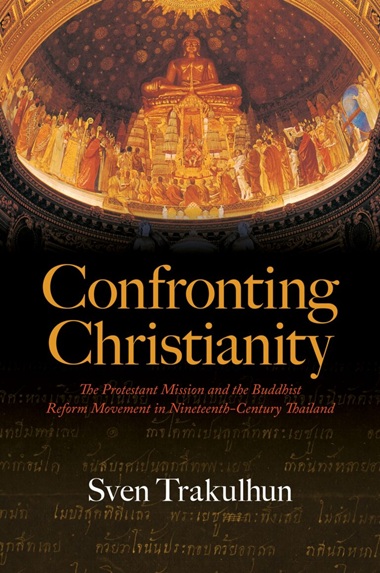
- Sven Trakulhun: Confronting Christianity: The Protestant Mission and the Buddhist Reform Movement in 19th Century Thailand (University of Hawai’i Press, 2024)
The reception of Christianity in Asia has been mixed. In some countries – Korea and the Philippines, for example – the faith has flourished. In others – China, Singapore, Indonesia – it has fared quite well.
But in a number of nations progress has been much slower. Thailand is one of those nations.
Gina Zurlow notes in her Global Christianity, her country-by-country survey of “the world’s largest religion,” that just one percent of the population is Christian, after 200 years of Christian mission.
In Confronting Christianity, Sven Trakulhun explains how Buddhism engaged with Christianity and emerged with renewed vigour.
The publisher writes:
Confronting Christianity explores the history of religious encounters between Christian missionaries and Thai Buddhists during the 19th century, a period of Western imperialism in Southeast Asia that fundamentally transformed Siamese society and religious institutions.
From about 1830 onwards, discussions on religion became a central arena of conflict between rival regimes of knowledge in Thailand, confronting traditional Buddhist views on nature and man’s existence with the ideals and practices of science and rationalism coming from the West.
Protestant missionaries, mostly from the United States, became important brokers of knowledge, as one of their strengths was the ability to offer religion in tandem with modern science and technology.
Historian Sven Trakulhun explains why the intrusion of evangelical Christianity strengthened the position of Theravāda Buddhism rather than undermining people’s belief in traditional forms of worship.
Reviewer Thien Bui writes of the book:
Many of us might be acquainted with conventional narratives that combine 19th century colonialism and Christianity with cultural suppression and forced conversion in Asian territories where local inhabitants fought back intruders and crushed evangelical missions.
In the groundbreaking book Confronting Christianity, historian Sven Trakulhun challenges this popular belief by tracing back to the exceptional case of Siam (now Thailand). Unlike its Southeast Asian neighbors, Siam escaped the claws of European colonialists and successfully modernized the nation without any violence against Westerners. . . .
Trakulhun shows that the Thai elite chose not to be hostile toward Christian missionaries like Vietnam and China but leveraged their ideas to modernize Siam and Thai Buddhism. Nineteenth century Siam consisted of many social groups: political rulers, nobles, Christian missionaries, Western diplomats, businessmen and, of course, Siamese Buddhists.
Through wonderful storytelling and persuasive evidence from archival sources, Trakulhun sets up a compelling story of how Euro-American missionaries and Siamese elites deployed strategies and available resources to achieve their purpose.
A strength of the author is to provide analysis of numerous religious tracts, newspaper articles and kings’ edicts in both English and Thai. Many sections of the book are well described with fierce confrontation, thrilling climaxes and amazing plot twists that can immerse readers in a fascinating world of enthusiastic preachers, rational monks and powerful kings.
A good book to read along with Confronting Christianity would be Baptizing Burma. The publisher notes of that book:
Alexandra Kaloyanides . . . examines how the Burmese majority positioned Buddhism to counter Christianity, how marginalized groups took on Baptist identities and how Protestantism was reimagined as a Southeast Asian religion.
Also worth considering is this statement by Korean author Bong Rin Ro in his Asian Church History.
Though he is particularly enthusiastic about the dynamic Asian church and mission movement, he does acknowledge and give credit throughout the book to Western missionaries and their influence.
For example:
- Education: “The traditional educational system in Asia was basically for the children of the elite aristocratic class . . . Missionaries brought modern education to Asia and revolutionized the educational system of most Asian nations.”
- Adoniram Judson: “Many Christians may consider his missionary work a failure, but he became the ‘spiritual father’ of six million Christians in Burma.”
I wrote about both Baptizing Burma and Asian Church History here.
- Mou Banerjee: The Disinherited: The Politics of Christian Conversion in Colonial India (Harvard University Press, 2025)
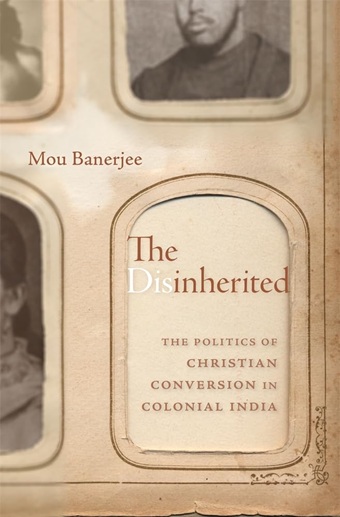
The Disinherited tells another example of reaction to missionary influence – but also the effect upon converted Christians – this time in colonial India.
The titles of two book reviews reflect the nature of the book:
- How conversion anxiety built Hindu nationalism
- Contested conversions
Mou Banerjee states in the Introduction:
Most of the historical work in this field in the last 30 years has been largely based on missionary archives.
Perhaps as a result, there has been too much reliance on the colonial and evangelical point of view in categorizing change wrought by evangelism and the civilizing mission in India over time, and in political, social and legal institutions in the British-Indian colony.
Pointing out that “the book draws upon several years of research in India, Bangladesh, England and the United States, and on material written in Hindi, Urdu, Bengali and English,” she says:
Each chapter tells a richly emotive story of the entanglements between converts and their interlocutors from across elite and vernacular milieus. . . .
I seek to privilege the many Indian interlocutors . . . who participated in the critical debates about conversion.
The publisher writes:
An illuminating history of religious and political controversy in 19th century Bengal, where Protestant missionary activity spurred a Christian conversion ‘panic’ that indelibly shaped the trajectory of Hindu and Muslim politics.
In 1813, the British Crown adopted a policy officially permitting Protestant missionaries to evangelize among the empire’s Indian subjects. The ramifications proved enormous and long-lasting.
While the number of conversions was small – Christian converts never represented more than 1.5 percent of India’s population during the 19th century – Bengal’s majority faith communities responded in ways that sharply politicized religious identity, leading to the permanent ejection of religious minorities from Indian ideals of nationhood.
Mou Banerjee details what happened as Hindus and Muslims grew increasingly suspicious of converts, missionaries and evangelically minded British authorities. Fearing that converts would subvert resistance to British imperialism, Hindu and Muslim critics used their influence to define the new Christians as a threatening “other” outside the bounds of authentic Indian selfhood.
The meaning of conversion was passionately debated in the burgeoning sphere of print media, and individual converts were accused of betrayal and ostracized by their neighbors. Yet, Banerjee argues, the effects of the panic extended far beyond the lives of those who suffered directly.
As Christian converts were erased from the Indian political community, that community itself was reconfigured as one consecrated in faith. While India’s emerging nationalist narratives would have been impossible in the absence of secular Enlightenment thought, the evolution of cohesive communal identity was also deeply entwined with suspicion toward religious minorities.
Recovering the perspectives of Indian Christian converts as well as their detractors, The Disinherited is an eloquent account of religious marginalization that helps to explain the shape of Indian nationalist politics in today’s era of Hindu majoritarianism.
A review in Frontline (published by The Hindu newspaper group) elaborates on the book’s title:
This book is an impressive addition to existing scholarship on nationalism and its variegated affair with reified religion. What makes Banerjee’s intervention unique is the earnest attempt to foreground the complex sense of disinheritance that shapes Indian Christian subjectivity in colonial and postcolonial times.
Banerjee argues that the elusive figure of the native Christian often anchored nationalist and colonial deliberations on religion. With this argument, she recovers at least a few Christian lives from the waiting room of national historiography.
Banerjee concludes The Disinherited on a personal note, recalling the effect on her life as a 15 year old when missionary Graham Staines and his two young sons were murdered by a Hindu militant while sleeping in their car outside a church in the eastern Indian state of Orissa in early 1999.
She was attending a missionary school, taking part in various Christian activities: “I never felt myself to be distinctive in any way from my Christian friends, and neither, I think, did they feel any such overt difference.”
However:
It all changed for me and my classmates with the Stainses’ murder. Suddenly there was a fissure that created a sense of ‘us and them’ in the school And there was deep anxiety among the Christian families of my hometown, Purulia, who were worried for their safety.
I might have been a sheltered teenage girl, but that was the moment when my knowledge of the religious differences between India’s many communities of faith took on a political significance. . . .
This book has been the result of my effort to understand the social, political and religious tensions that led to my devastating political awakening at age 15, when I began to recognize the realities of communal violence in India.
Mou Banerjee is Assistant Professor of History at the University of Wisconsin–Madison.
- Reid B. Locklin: Hindu Mission, Christian Mission (SUNY Press, 2024)
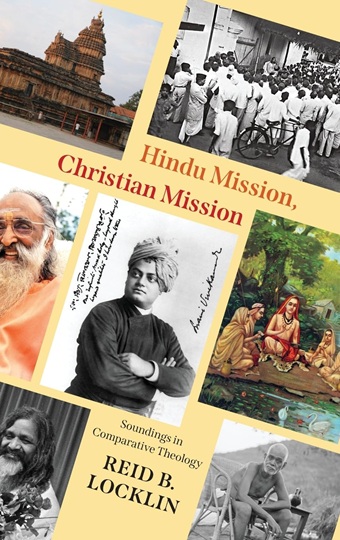
Hindu Mission, Christian Mission is very much a work of Catholic scholarship.
As Locklin points out right off the bat, he can trace the book’s origin to 1999 when he was studying a treatise of “the great 8th century Advaitin Ādi Śaṅkarācārya” when Pope John Paul II made a pastoral visit to India, causing considerable controversy “when he spoke of a ‘great harvest of faith’ in his apostolic exhortation, Ecclesia in Asia.”
Locklin “perceived at least some affinities between the missionary vision of the pope and the Advaita text we were studying.” He presented a paper in 2005, completed his doctoral work and has now written this book.
Thus he is addressing a broad topic, but through a very particular lens. He states in the Introduction:
This [conversion] controversy can be understood in multiple ways . . . In this book I attempt a [theological] engagement through a comparative Hindu-Christian study of mission and missiology.
And he focuses just on one strand of Hinduism, the Advaita Vedanta, highlighting significance of some of its more recent manifestations:
Advaita was among the first and most successful traditions to articulate a theology of worldwide mission in the late 19th century, a theology expressed most clearly by Swami Vivekananda’s (1863 – 1902) repeated calls to “conquer the world through our spirituality.”
I contend that the distinctive theologies of mission articulated by Vivekananda and his successors have deep roots and a complex development from the medieval period to the present day, and that they offer both a significant challenge and intriguing points of resonance with missiological proposals emerging from contemporary Catholicism and the mainline ecumenical movement.
The publisher writes:
For some 400 years, Hindus and Christians have been engaged in a public controversy about conversion and missionary proselytization, especially in India and the Hindu diaspora. Hindu Mission, Christian Mission reframes this controversy by shifting attention from ‘conversion’ to a wider, interreligious study of ‘mission’ as a category of thought and practice.
As a descriptive study of the Chinmaya Mission, the Ramakrishna Mission and other leading Advaita mission movements, Hindu Mission, Christian Mission contributes to a growing body of scholarship on transnational Hinduism.
Anyone looking for Protestant missionaries will not have much luck – William Carey, Amy Carmichael, Henry Martyn, E. Stanley Jones, Lesslie Newbigin are not on the agenda.
Locklin states that any comparative theology of mission will “be limited and provisional by design,” and that he has drawn on “the history and contemporary teachings of Catholic and ecumenical traditions” for the Christian part of his narrative.
In a footnote, he acknowledges:
[T]he choice of Catholic and ecumenical theologies . . . may be read (probably accurately) to presume a theological judgment that these traditions, rather than more evangelical or Protestant traditions, should be regarded as, if not the essence of Christianity, then perhaps its least inadequate expression.
He does devote three pages to René Padilla and his critique of evangelical lack of attention to social improvement at the first Lausanne Congress in 1974. White acknowledging that Padilla spoke from within the evangelical community, he uses him to demonstrate that “questions of social engagement are not much more firmly settled in missionary Christianity than they are in missionary Advaita.” (I wrote about Padilla and his influence here.)
While there is some justification for his contention that evangelicalism has not adequately affirmed social responsibility alongside the need for personal conversion, it is also true that Lausanne has continued to affirm what John Stott, chief architect of the Lausanne Covenant, said at the Congress, that evangelism and social action are like “two wings of a bird.”
As well, many studies of evangelical missionary work – the one directly below this, for example – demonstrate that missionaries do care for the social welfare of their neighbours.
- Robert V. Finley: PREM: An Apostle’s Triumphant Witness for Christ in Nepal (Redemption Press, 2024)
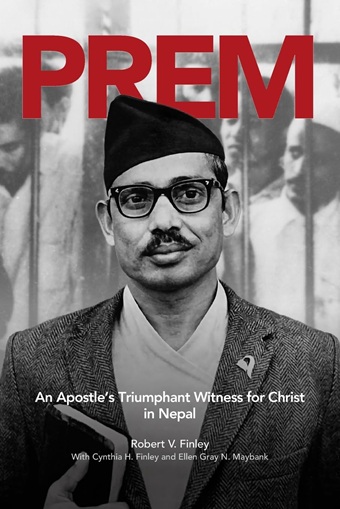
PREM is a book of intimate one-on-one interviews with Prem Pradhan. The interviews were conducted by Robert Finley (1922 – 2019) over a nine-year period in the United States, Canada, India and Nepal (some while Prem was imprisoned there).
The publisher writes:
Prem Pradhan was a Hindu. And he was a soldier. A Gurkha in the British Royal Air Force, then commander of a tank regiment in the Indian army.
But God had other plans for his life.
After being reconciled to God through faith in Jesus Christ, Prem knew he was called to reach a part of the world diametrically opposed to changing one’s religion: his own country of Nepal, where it was a crime to be baptized, punishable by a year in prison.
But not denying his Lord mattered more. So when Prem baptized others, he was sentenced to six years in prison. There he encountered demons, healed other prisoners, and preached the love of God. And that’s just the start of Prem’s story.
In 1950, Nepal had few known Christians. Today? Over one million. Prem is an important part of the reason.
Jonathan Bonk wrote about Prem in the April, 2000 issue of Missiology: An International Review. Here is part of his conclusion:
Between 1966 and 1993, Pradhan continued to be harassed, spending a total of 10 years in 14 different prisons throughout Nepal. Many prisoners were converted.
It was also during this time that Pradhan began to adopt orphaned Nepalese, some 300 in total. His early attempts to provide educational opportunities for these children evolved to the point where by 1990 some 1,200 children from kindergarten through grade 12 were enrolled in his schools. He also established a theological training school in Darjeeling, India, from which a steady stream of Christians from Nepal, Tibet, Bhutan and Sikkim continue to receive training.
Pradhan was last sentenced in 1994 – to 54 years in prison. The sentence was commuted, due in part to the fact that in 1986 the King of Nepal had awarded him the country’s highest recognition, the Social Service Medal of Honor, in acknowledgement of his humanitarian and educational work
Bonk said that Prem “was from Nepal where he had been engaged in missionary work since 1952, and that he was known there as the Apostle to Nepal.”
James Eagles, President of Intercede International, gave me the book at Mission Fest. He told me that Prem had become a Christian through the preaching of Bakht Singh, who himself had become a Christian in Winnipeg through the influence of a woman who had hoped to go to China as a missionary, but had been unable to. (More on that story another time, I hope.)
- Young-mee Yu Cho & Sungmin Park, editors: Korea Letters in the William Elliot Griffis Collection (Rutgers University Press, 2024)
 Korea Letters is based on a wealth of material in Rutgers University’s Griffis Collection – journals, correspondence, manuscripts, photos and more.
William Elliot Griffis (1842 – 1928) graduated from Rutgers and taught four years in Japan before returning to the United States to research and write about East Asia. He wrote 20 books about Japan and five about Korea, including the very popular Corea: The Hermit Nation (1882).
In his introductory ‘Appreciation’ of the book UBC professor of Korean language and literature Ross King writes:
Though Griffis himself never visited Korea until the very end of his life in 1927, he made up for this lack of direct personal experience in Korea with a thriving correspondence that connected him in one way or another – often quite intimately – with virtually every notable leader and opinion maker in the Korean missionary and diplomatic community. . . .
[The] Griffis letters are a treasure trove of valuable firsthand accounts from key movers and shakers in knowledge production about Korea for the approximate period 1890 – 1927.
The book has two sections – letters from missionaries and letters from Japanese and Korean political figures, featuring the history of early American missionaries, the Korean independence movement and Griffis’s views on Korean culture.
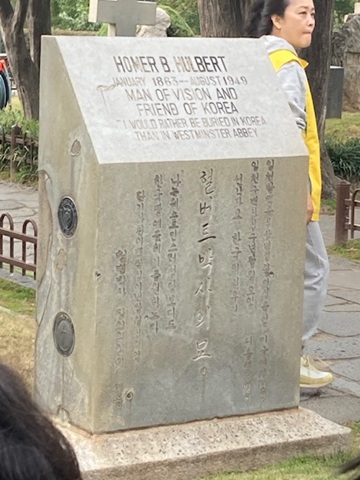
Homer Hulbert is buried in Yanghwajin Foreign Missionary Cemetery in Seoul, South Korea.
Ross King notes that two names stand out in Griffis’ writing projects – Homer Bezaleel Hulbert and Henry Gerhard Appenzeller (along with his wife and children).
Their influence extended well beyond church circles. For example, King wrote:
In many ways the most detailed letters belong to the pen of Homer Hulbert . . .
One . . . project of Hulbert’s that has won him an honoured place to this day in South Korean history and church circles was his campaign against sinographs (“the Chinese character”) and Literary Sinitic (hammun) and in favor of the Korean vernacular script.
A September 26, 1892 letter from Hulbert to Griffis included this statement:
The work to be done in Korea is first and foremost to set in motion some sort of sentiment which shall point in the direction of popularising the true Korean alphabet as distinguished from the Chinese. That work has already been begun. . . . Koreans have told me that within two decades the Chinese character will be discarded in that country.
Last fall I attended the World Evangelical Alliance General Assembly in Seoul, Korea. Our Korean hosts kindly arranged a day trip to three key sites – the Gyeongbokgung Palace, the National Museum of Korea and Yanghwajin Foreign Missionary Cemetery where both Hulbert and Appenzeller are buried.
The ‘Recommended Pilgrimage Course’ allows one to visit 28 graves and the 12-page bulletin includes brief write-ups on each of them. Here is one:
Missionary Hulbert is praised as a foreigner who loved Korea more than Koreans did. Hulbert participated in a documentary mission and introduced Korea to other countries through his writings on Korea.
He also fought for Korea’s independence against Japan as a secret diplomatic envoy of King Gojong. In 1907 he was expelled by Japan.
On the invitation of the new Government of the Republic of Korea he returned to Korea in 1949. But he died from complications related to long-term fatigue only one week after his arrival. According to his wish “to be buried in Korea rather than in Westminster Abbey, he was laid to rest at Yanghwajin.
Young-Mee Yu Cho and Sungmin Park edited Korea Letters. Go here for more information about the William Elliot Griffis Collection, including letters that were not included in the book.
- Don Baker: Korean New Religions (Cambridge University Press, 2025)
Don Baker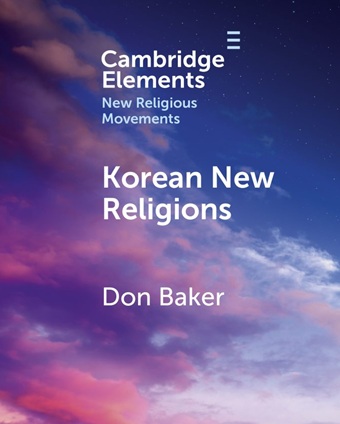 is retiring after 40 years as Professor in Korean History and Civilization at UBC. His Capstone Lecture February 18 on the lives of three brothers – a renowned philosopher, a pioneer biologist and a Catholic Martyr in Chosŏn Korea – marked the event.
Korean New Religions is not about missions or missionaries, though it does reflect on their influence in a sense. Baker notes that although Catholicism is a century older than Protestantism, “all of these new religions [the Unification Church and others] which have emerged from a Christian background originated in Protestantism.”
Baker writes that because the Catholic church is highly organized and hierarchical it has produced no new religions in Korea. On the other hand, “The Protestant community does not maintain as tight a grip on clerical credentials,” though he does point out that “the vast majority or Protestant clerics in Korea today have undergone rigorous theological training.”
According to World Christianity (Zurlo), Christianity now makes up more than 30 percent of the South Korean population, with about 80 percent being Protestant / Independent Christians and 20 percent Catholic. In 1900, with an active missionary presence, just 0.5 percent were Christian.
The publisher notes:
Korea has an unusually diverse religious culture.
In the north, Juche, which has taken on religious overtones, monopolizes articulations of beliefs and values as well as ritual practice. In the south, no single religion dominates, with over half saying that they have no specific religious affiliation.
The remainder report being Protestant, Buddhist and Catholic. Smaller in number but nonetheless noticeable are members of Korea’s many home-grown new religious movements.
Reflecting South Korea’s religious diversity, some of those new religions have Buddhist roots, some have Christian origins, some draw on Confucian beliefs and practices and some have emerged from Indigenous religious traditions such as shamanism.
Korean New Religions examines the most noticeable of Korea’s new religions to discover what they can tell us about distinctive traits of religion in Korea, and how Koreans have responded to the challenge posed by modernity to their traditional beliefs and values.
The contents page reflects the diversity:
- Ch’ŏndogyo: the oldest new religion
- Won Buddhism
- Confucianism and new religions
- Christianity and new religions
- Indigenous gods of the new religions
- Religions and the state
- North Korea and Juche
Baker was a co-editor of the Sourcebook of Korean Civilization and editor of Critical Readings on Korean Christianity. He is also author of Chosŏn hugi yugyo wa ch’ǒnjugyo ŭi taerip (The Confucian confrontation with Catholicism in the latter half of the Joseon dynasty), Korean Spirituality and Catholics, Anti-Catholicism in Chosŏn Korea and A Korean Confucian’s Advice on How to be Moral, an annotated translation of a commentary by Tasan Chŏng Yagyong on the Zhongyong.
- Tom Smith: Word Across the Water: American Protestant Missionaries, Pacific Worlds and the Making of Imperial Histories (Cornell University Press, 2024)

A book which looks at missions in two very distinct, and distant, communities does seem odd. But Tom Smith explains that it would have seemed less odd in the 19th century:
Despite being two places with very different historical relationships to the idea of the Pacific, Hawai’i and the Philippines were shoehorned into a particular US vision of the ocean in ways that served the purpose of imperialism while undermining the sovereignty of islanders.
American missionaries were very much products of their culture, but Word Across the Water makes it clear that they were also able, in varying degrees, to think for themselves.
In an assessment of Word Across the Water in the American Historical Review by Clifford Putney notes:
Smith chose to focus on missionaries in those two places partly because the evangelists left a phenomenally extensive and mineable account of their work but, more importantly, because he wants to show that the linkage between American imperialism and the missionary project in the Pacific was less concrete than one might suppose.
In the minds of many academics, missionaries were simply agents of and cheerleaders for Manifest Destiny, spreading US cultural and political influence across the Pacific and helping to turn it into an ‘American lake.’
Some missionaries were indeed exponents of Manifest Destiny, but Smith argues convincingly that the missionary Weltanschauung was not monolithic, and he proves that the views of missionaries in Hawaiʻi differed from the views of missionaries in the Philippines regarding the role of the United States in the Pacific.
The publisher writes:
In Word Across the Water, Tom Smith brings the histories of Hawai’i and the Philippines together to argue that US imperial ambitions towards these Pacific archipelagos were deeply intertwined with the work of American Protestant missionaries.
As self-styled interpreters of history, missionaries produced narratives to stoke interest in their cause, locating US imperial interventions and their own evangelistic projects within divinely ordained historical trajectories.
As missionaries worked in the shadow of their nation’s empire, however, their religiously inflected historical narratives came to serve an alternative purpose.
They emerged as a way for missionaries to negotiate their own status between the imperial and the local and to come to terms with the diverse spaces, peoples and traditions of historical narration that they encountered across different island groups.
Word Across the Water encourages scholars of empire and religion alike to acknowledge both the pernicious nature of imperial claims over oceanic space underpinned by religious and historical arguments, and the fragility of those claims on the ground.
Smith concludes the book with this comment:
Missionaries were complicit in many ways in efforts to render the Pacific to US audiences as a place where Americans belonged and a place where they could assert moral leadership, but at the same time the perspectives they conveyed from Hawai’i and the Philippines also demonstrated how island spaces could reorient Americans’ vision of geography and history.
Tom Smith is Keasbey Research Fellow in American Studies at Selwyn College, University of Cambridge. His work has previously been published in Diplomatic History, Historical Journal and American Nineteenth Century History.
Emily Conroy Krutz (author of Missionary Diplomacy, which I wrote about here) interviewed Tom Smith about Word Across the Water.
- Anna Maria Busse Berger & Henry Spiller, editors: Missionaries, Anthropologists and Music in the Indonesian Archipelago (University of California Press, 2024)
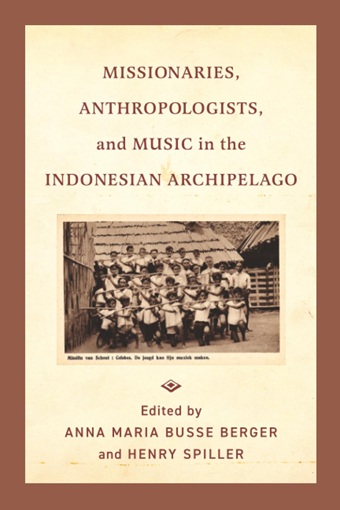
The editors write this description of their book, Missionaries, Anthropologists and Music in the Indonesian Archipelago.
European Christian missionaries were once lauded as bringers of Western civilization to the backwaters of civilization. In the past century, however, they have gotten a bad rap for their part in the colonial domination of Africa, Asia and the Americas.
Nevertheless, the missionary archive (if such a thing can even be imagined as a unitary whole), contains boundless information that has otherwise been lost about those colonized cultures – language, customs and music.
Our book attempts to salvage (dare we say ‘redeem’?) some of this documentation of music and music-related activities from a variety of scattered missionary archives.
As we say in the introduction to the book:
The missionization of the Indonesian archipelago by foreign representatives of world religions has been going on for thousands of years and implicates Hinduism, Buddhism, Islam and Christianity among other religions.
It is difficult in most cases to separate exclusively missionary activities from other sorts of cultural interventions such as trade, invasion and intermarriage. And it is misleading to imagine that each world religion is unitary; Hinduism, Buddhism, Islam and Christianity are all characterized by multiple sects, some of which hold contradictory tenets.
Thus, missionaries vary widely in their power, methods and goals, as well as in their engagement with, opposition to and sympathy for existing local cultures.
Each of our 14 contributors, who represent a wide variety of disciplines, tackles a specific situation and a specific kind of archive to reveal new information about the music history of the Indonesian archipelago.
A couple of the essays (Sumarsam, Kathy Foley) address the effects of Hindu, Buddhist and Islamic missions, which positions parts of the archipelago at the center of the Indian Ocean world.
Other authors grapple with historical documents (David R. M. Irving and Estelle Joubert), Christian missionaries’ encounters with indigenous musics (Henry Spiller, Bernard Arps), the indigenization of Christian hymnody (Julia Byl, Emilie Rook, Philip Yampolsky), the overlapping roles of anthropologists and missionaries (David Hollinger, Dustin Wiebe, Anna Maria Busse Berger) and the place of archival documentation (Sebastian Klotz, Barbara Titus).
Some might think this project aligns with current efforts to push back on anti-colonialism, anti-fascism and ‘woke’ DEI initiatives. We maintain, however, that engaging objectively with missionaries on their own terms – and especially by interrogating the ways they sought to rationalize their appropriation and judgment of indigenous arts – can stimulate new dialogues about the overlapping historical impacts of colonialism, missionization and global modernism.
Documenting, analyzing and questioning the products and effects of colonialism – rather than simply erasing them – present opportunities to ameliorate the negative effects of so-called anti-woke initiatives.
Both Anna Maria Busse Berger and Henry Spiller are emeritus professors of music at the University of California.
Listen to an interview with the editors here.
- Martyn Percy: The Crisis of Colonial Anglicanism: Empire, Slavery and Revolt in the Church of England (Hurst and Company, 2025)
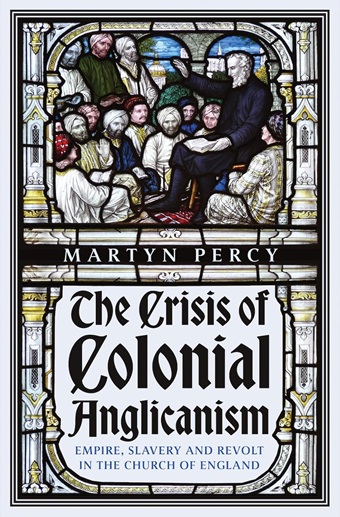
Reviews of The Crisis of Colonial Anglicanism have not been stellar, sometimes quite critical, but it does very much represent a set of views both within the church and beyond.
First, the publisher’s comment:
This book offers a bold and unsettling truth: the British Empire and Great Britain are primarily English constructions, and the Church of England benefited from English enterprise and exploitation, serving as the spiritual arm of the imperial project.
English Anglicanism has cast itself as the lead character in its own ‘serious fiction’ – the main religious player in a drama of Church and Empire.
Yet, in collusion with colonialism, it is now trapped by historical amnesia. Martyn Percy examines the English interests concealed in appeals to Britishness, showing how slavery, exploitation, classism and racism upheld elitist and hierarchical worldviews that bolstered both Empire and Church.
By viewing the rest of the world as lesser, both institutions have declined in global standing, now reduced to minor national players on the world stage.
Religious, social and political imperialism thrived on deprecating others, but those once marginalised have fought for equality and independence. Today, the worldwide Anglican Communion faces a new era of moral reckoning.
Writing for History Today, local (originally British) scholar Michael Ledger-Lomas writes:
Percy is a figure familiar from ecclesiastical history: the clerical malcontent. . . .
Like other rebels in orders, Percy uses a polemical reading of the Church’s history to justify his quarrel with it. The Crisis of Colonial Anglicanism also exploits a vogue in popular history: the exposure of this or that institution’s forgotten links with empire or the slave trade with a view to reforming or discrediting it.
Percy thinks it high time for the Church to get the same treatment as the monarchy or the country house. Its authoritarianism is a hangover of empire.
Formerly Dean of Christ Church, Oxford, Percy is now Provost-Theologian for Hong Kong Sheng Kung Hui; Professor of Religion and Culture, University of Saint Joseph, Macao; Research Professor, Institute of Old Catholic Theology, University of Bern; Senior Research Fellow at the James Hutton Institute; and Canon Theologian to the Convocation of Episcopal Churches in Europe. A unique claim to fame is that he is the only living theologian featured in The Da Vinci Code.
Ledger-Lomas notes that “His book fails to set out its allegations very well,” but does acknowledge that “Still, some interlocking claims emerge, which are as plausible as they are provocative.”
He concludes:
Since Brexit, it has been trendy to say that the English are at once nostalgic for, and amnesiac about, empire. But if you are going to argue that the past inflicted a ‘near fatal soul wound’ on the English, then you need to be clear and accurate about it. Percy rarely is.
To illustrate the wrongs of missionaries in China, he brings up the sexual abuse committed by a diplomat. He mysteriously writes that missionary ‘epistemicide’ caused ‘famines.’
In the rush to draw up the charge sheet, he also misses a persistent streak of Anglican scepticism about empire. Canon Welldon had left Calcutta pessimistic about Christianity’s future in India and disapproving of the clergy’s tendency to act as a mouthpiece for the ‘sultanized’ viceroy, Lord Curzon. It was one thing to have an ‘imperial destiny,’ quite another to meet it.
A review in Church Times is mixed (“He leaves this reader grateful for being made to re-evaluate the history, but asking whether the death of the Anglican Communion and the Church of England may be over-exaggerated, and trusting in his own affirmation that where there is death God can always bring new life.”), while another in History Reclaimed is quite negative.
The ‘Christianity: a missionary religion’ series:
• Introduction
1. History of Missions
2. State of World Christianity
3. Africa
4. Asia
5. Latin America
6. Not So Good News
7. New Approaches to Missions
8. Women
9. Asia
10. Imperialism / Colonialism
11. Seasoned Practitioners Offer Guidance
12. Africa
13. Middle East
14. China